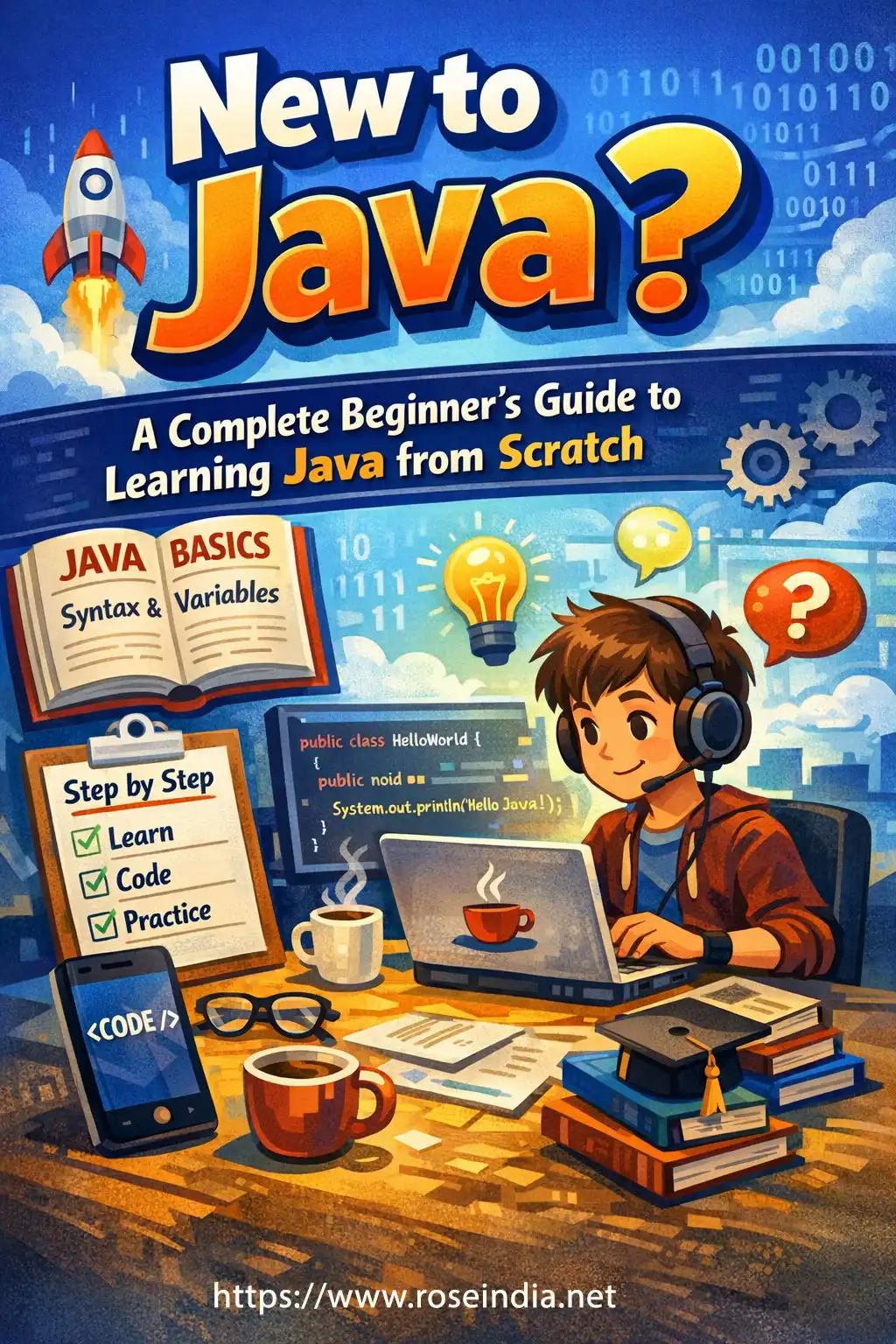
New to Java? A Complete Beginner’s Guide to Learning Java from Scratch
This guide is for the students or professionals starting Java and they are new to Java programming. We have compiled a complete guide that will help you in learning Java step-by-step.
If you are new to Java, you are stepping into one of the most powerful and widely used programming languages in the world. Java is not a new programming language, it has been around for decades, yet it continues to dominate modern software development—from enterprise applications and Android apps to cloud systems, big data, and AI platforms. You can develop everything in the Java programming language. Java is also a very popular choice for cloud-native application development. Spring and Spring Boot are very famous frameworks in Java, which are being used for enterprise and cloud application development.
This guide is written specifically for absolute beginners. No prior programming experience is required. By the end of this article, you will understand what Java is, why it’s important, how it works, and how you can start learning Java step by step. This is a one stop guide to learn Java for beginners.
What Does “New to Java” Mean?
Being new to Java usually means:
- You have never written Java code before, or
- You are switching from another language (like Python, C, or JavaScript), or
- You are a student or professional starting your programming journey
Java is known for being beginner-friendly, yet powerful enough for large-scale systems used by companies like Google, Amazon, Netflix, and banks worldwide. Java is also used for data processing and cloud-native application development. Java is used in banking and finance industries for various application development.
What Is Java?
Java is a high-level, object-oriented, platform-independent programming language developed by Sun Microsystems in 1995 (now maintained by Oracle). The Java programming language is now maintained by Oracle and there is an open source version of Java with the name OpenJDK.
Key Characteristics of Java:
- Object-Oriented – Everything revolves around objects and classes
- Platform Independent – Write once, run anywhere (WORA)
- Secure & Robust – Used heavily in banking and enterprise systems
- Scalable – Suitable for small apps and massive distributed systems
Check more at What is Java?
Why Should Beginners Learn Java?
If you’re new to programming, Java offers long-term value. Java is beginner friendly programming language and comes with easy to learn syntax. Once can easily start learning Java by installing the JDK and developing programs.
1. Massive Industry Demand
Java is used in:
- Enterprise applications
- Banking & finance systems
- Android app development
- Cloud-native microservices
- Big data frameworks (Hadoop, Spark)
2. Strong Foundation for Programming Concepts
Java teaches:
- Object-Oriented Programming (OOP)
- Memory management
- Exception handling
- Multithreading
These concepts transfer easily to other languages.
3. Excellent Learning Resources
Java has:
- Tons of tutorials
- Huge community support
- Rich documentation
- Long-term stability
How Java Works (Simple Explanation)
If you are new to Java, understanding how it works internally helps a lot.
- You write Java code in a .java file
- The Java Compiler (javac) converts it into bytecode
- Bytecode runs on the Java Virtual Machine (JVM)
- JVM allows Java to run on any operating system
This is why Java is platform-independent.
Java Editions Explained (Beginner-Friendly)
Java comes in different editions. Don’t worry—this is simpler than it sounds.
Java SE (Standard Edition)
- Core Java
- Used for learning Java
- Covers basics like variables, loops, OOP, collections
👉 Best starting point for beginners
Java EE / Jakarta EE
- Enterprise-level applications
- Web services, APIs, microservices
Java ME
- Embedded and IoT systems
Setting Up Java as a Beginner
If you’re new to Java, you need just three things:
- JDK (Java Development Kit)
- IDE (Code Editor) – IntelliJ IDEA / Eclipse / VS Code
- Basic Command Line Knowledge
Once installed, you’re ready to write your first program. Check the tutorial: How to Install Java on Any System: The Complete 2026 Beginner's Guide
Your First Java Program (Hello World)
public class HelloWorld {
 public static void main(String[] args) {
   System.out.println("Hello, Java!");
 }
}
What This Means:
- class → Blueprint for objects
- main() → Entry point of Java program
- System.out.println() → Prints output
Check more at: Hello world (First java program)
Core Java Concepts Every Beginner Must Learn
If you are new to Java, focus on these fundamentals first:
1. Variables & Data Types
- int, double, char, boolean, String
Check tutorials: Variables & Data Types
2. Operators
- Arithmetic, relational, logical
Check tutorial: Operators in Java
3. Control Statements
- if-else
- switch
- loops (for, while, do-while)
4. Methods
- Reusable blocks of code
5. Object-Oriented Programming (OOP)
- Class & Object
- Inheritance
- Polymorphism
- Encapsulation
- Abstraction
Common Mistakes Beginners Make in Java
If you’re new to Java, avoid these mistakes:
- Skipping OOP fundamentals
- Memorizing syntax without understanding concepts
- Ignoring error messages
- Not practicing enough coding problems
- Jumping directly into frameworks without core Java
Java vs Other Languages (Beginner Perspective)
| Feature | Java | Python | JavaScript |
| Learning Curve | Moderate | Easy | Moderate |
| Performance | High | Medium | Medium |
| Enterprise Use | Very High | Medium | High |
| Beginner-Friendly | Yes | Yes | Yes |
👉 Java is ideal if you want long-term career stability.
Career Paths After Learning Java
Once you’re comfortable with Java basics, you can move into:
- Java Developer
- Backend Engineer
- Android Developer
- Cloud Engineer
- Big Data Engineer
- Software Architect
Java is especially powerful for enterprise and backend roles.
How Long Does It Take to Learn Java?
If you’re new to Java:
- Basics → 2–4 weeks
- Core Java → 2–3 months
- Advanced Java + Frameworks → 4–6 months
Consistency matters more than speed.
Best Learning Roadmap for Java Beginners
- Core Java fundamentals
- Object-Oriented Programming
- Collections & Exception Handling
- Multithreading
- JDBC & Databases
- Spring Boot & REST APIs
- Real-world projects
Is Java Still Worth Learning in 2026?
Absolutely.
0Java continues to power:
- Enterprise systems
- Cloud-native apps
- Financial platforms
- Government systems
Its stability and demand make it one of the safest languages to learn.
Final Thoughts: New to Java? Start Today
If you are new to Java, don’t feel overwhelmed. Every expert Java developer started with Hello World. Java rewards patience, practice, and consistency.
1Start small, understand the fundamentals deeply, and gradually move to advanced topics. Java is not just a programming language—it’s a career accelerator.
Related Tutorials
- What are the prerequisites for learning Java?
- New to Java
- What is OOP in Java?
- Java Tutorials
- Core Java
- Java SE 6
- Java SE 7
- Advanced Java
- J2ME
- JSP
- Servlets
- JDBC
- EJB
- Web Services
- JSTL
Mastering Java:
2