Complete Course: AI Forward Deployed Engineer (FDE) - Become FDE in 2026
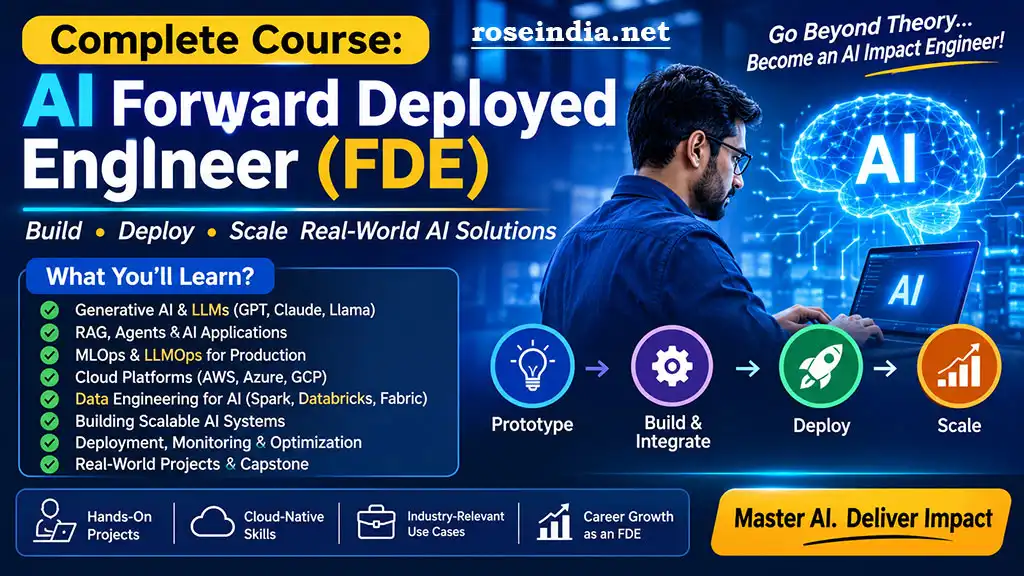
Welcome to our 16-20 week curriculum that will train you to become a successful and production-ready AI Forward Deployed Engineer (FDE). This course is divided into 18 modules across 9 phases and 5 portfolio projects, which will help in becoming a FDE. This course is very extensive and covers programming foundations, enterprise data pipelines, LLM architectures, advanced RAG, stateful agents with LangGraph/MCP, cloud deployment, Security and customer-facing solution architecture.
This course is very well designed to take you from AI/Data engineering fundamentals to job-ready AI Forward Deployed Engineer. After completing this course you will be able to work on Enterprise projects as an AI Forward Deployed Engineer. You will be understanding business problems and AI solutions that can be deployed in the production environment.
This role (AI Forward Deployed Engineer) combines software engineering, AI/ML, data engineering, cloud architecture, and customer-facing problem-solving. Learning these requires a lot of time and effort. The objective of this course is not merely to build demos, but to deliver AI systems that solve real business problems.
Course overview
- 16–20 weeks: Structured learning plan
- 2–4 hours/day: Suggested study schedule
- 18 modules: Beginner to advanced
- 5 capstones: Portfolio-ready projects
Target outcome: build, deploy, evaluate, secure, and explain production-grade AI applications, including RAG systems and AI agents.
Part 1 — Complete syllabus
The modules below are arranged in learning order. Each module contains the topics you should learn and practice. It is advisable to learn these modules one by one to master these concepts. After mastering the basics you will find yourself better prepared for the advanced topics. So, let’s get started with the programming and engineering foundations.
Phase 1: Programming and engineering foundations
Weeks 1–2 · Build the engineering foundation
For the first 1-2 weeks you should learn the beginner's concepts.
Module 1. Python for AI Engineering
- Python syntax, data types, control flow and functions
- Lists, dictionaries, sets, tuples and comprehensions
- Classes, objects, inheritance and composition
- Iterators, generators, decorators and context managers
- Type hints, dataclasses and Pydantic models
- Exception handling, logging and configuration
- Virtual environments, pip and dependency management
- Async programming: asyncio, async/await
- HTTP requests, JSON, file processing and environment variables
- Testing with pytest, mocking and debugging
Module 2. Software Engineering and Developer Tools
- Git, GitHub, branching, pull requests and code reviews
- Linux commands, shell scripting and environment setup
- Data structures, algorithms and complexity basics
- Clean code, SOLID principles and design patterns
- REST APIs, HTTP methods, status codes and authentication
- JSON, XML, serialization and schema validation
- Unit, integration, end-to-end and regression testing
- Debugging production failures and reading logs
- IDEs, AI coding assistants and systematic code review
Practical assignment: Build a Python application that reads documents, exposes a REST API, validates requests, logs errors, and includes automated tests. You may use FastAPI for building the Python REST client. You should also try with GET and POST requests. Also learn to unit test your Python code that you have developed. Unit testing of the code is very important as it tests the code before getting deployed on the production.
Phase 2: Data engineering and enterprise integration
Weeks 2–3 · Connect AI to real business data - Data engineering is the next big area you should learn to become a successful FDE. Here we are giving you the topics you should learn and master before moving ahead.
Module 3. SQL, databases and data pipelines
- SQL fundamentals, joins, aggregations, CTEs and window functions
- PostgreSQL schema design, indexing and query optimization
- Transactions, ACID properties, connection pooling and migrations
- Relational versus NoSQL databases
- Data modeling, normalization and denormalization
- ETL/ELT pipelines, batch processing and incremental loading
- Data validation, deduplication and data quality checks
- Object storage, data lakes and warehouse concepts
- CDC, streaming fundamentals and event-driven architecture
- Metadata, lineage, data governance and PII handling
You should learn how to work with the SQL to interact with the database, for example searching the data from the database or updating the data into database tables. You should learn the concepts like joins, aggregation, CTEs and window functions. You should also learn about data modelling, normalization and denormalization. You should also learn how to make data engineering pipelines to load the data into the database. You should also learn how to handle the PII data in your projects.
Module 4. Enterprise APIs and system integration
- REST, webhooks and pagination
- OAuth 2.0, API keys, JWT and service identities
- Integrating CRM, ERP, ticketing and document management systems
- WebSocket and server-sent events
- Message queues and event-driven workflows
- Rate limits, retries, timeouts and idempotency
- Handling malformed data and partial failures
- Enterprise connectors and secure secret management
- API contracts, OpenAPI specifications and versioning
Practical assignment: Ingest data from an API and a PostgreSQL database, clean it, store it, and expose it through a tested service. You should develop an API server for extracting the data and then loading into PostgreSQL database. This project is good as you will be developing a data ingestion pipeline in Python.
Phase 3: AI, machine learning and LLM foundations
Weeks 4–5 · Understand the technology behind AI applications
Module 5. Machine Learning Essentials
- Supervised, unsupervised and self-supervised learning
- Classification, regression and clustering
- Feature engineering and preprocessing
- Training, validation, test splits and cross-validation
- Overfitting, underfitting and regularization
- Precision, recall, F1, ROC-AUC and confusion matrices
- Embeddings and representation learning
- Recommendation systems and ranking fundamentals
- Model inference, evaluation and deployment
- When to use classical ML versus an LLM
This section is very important as you will learn the foundation of machine learning and understand the steps in developing a machine learning program. You will understand the core of machine learning and compare it with the LLM.
Module 6. Deep Learning and Transformer Fundamentals
- Neural networks, layers, activations and loss functions
- Gradient descent and backpropagation at a conceptual level
- Tokenization and token limits
- Embeddings, positional information and attention
- Transformer architecture and self-attention
- Encoder, decoder and encoder-decoder models
- Pretraining, instruction tuning and fine-tuning
- Context windows and inference parameters
- Open-weight models versus hosted models
- GPU, VRAM, quantization and inference trade-offs
Here you will understand the core behind the LLMs, how it works and what are the uses of it.
Module 7. LLM APIs and Prompt Engineering
- OpenAI and other hosted model APIs
- Local model inference with Ollama or compatible runtimes
- System, developer and user instructions
- Few-shot prompting and structured prompting
- JSON outputs and schema-constrained generation
- Function calling and tool use
- Context management and conversation memory
- Model selection, temperature and token budgeting
- Streaming responses and async inference
- Token usage, latency, cost and error handling
- Prompt injection basics and untrusted input boundaries
You will learn different types of models, the use of these models in the development of LLM powered applications. You will also understand the core concepts of working of the model; concepts like model selection, temperature and token budgeting.
Practical assignment: Build an LLM-powered application that extracts structured data from invoices or support tickets and validates the output against a schema. This project will give you an idea about the real uses of LLM for text extraction from the PDFs and document files.
Phase 4: LangChain, RAG and enterprise knowledge systems
Weeks 6–8 · Core AI application engineering
This is one of the most important phases for an AI FDE because many enterprise projects require AI to answer questions from private documents, databases, and internal systems. You should gain complete understanding of the RAG applications and its working.
Module 8. LangChain Fundamentals
- LangChain architecture and core abstractions
- Models, messages and prompt templates
- Output parsers and structured responses
- Runnable interfaces, composition and LCEL
- Document loaders for PDF, Word, HTML and text
- Text splitters and chunking strategies
- Embeddings and vector store integrations
- Retrieval chains and document combination
- Conversation history and memory patterns
- Async execution, callbacks, tracing and error handling
- LangChain package ecosystem and integration packages
LangChain is a Python library for building LLM powered GenAI applications. You should learn core concepts and its uses in building LLM powered applications. You should also practice by creating sample programs.
Module 9. RAG Architecture and Advanced Retrieval
- RAG architecture: ingestion, indexing, retrieval and generation
- Document parsing, OCR and layout-aware extraction
- Chunk size, overlap, semantic chunking and parent-child retrieval
- Embedding models and vector dimensions
- Vector similarity: cosine similarity, dot product and distance
- Vector databases: pgvector, Chroma, FAISS and managed alternatives
- Metadata filtering, hybrid search and keyword search
- BM25, query rewriting and multi-query retrieval
- Reranking and contextual compression
- Parent-document retrieval and hierarchical indexing
- Citations, source attribution and answer grounding
- Incremental indexing, deletion and document updates
- Multi-tenant data isolation and document-level permissions
- Retrieval evaluation, relevance and hallucination analysis
In this section you will learn to create your first RAG application that extracts documents and ingest into vector db in the form of embedding. You will learn ingestion, indexing, retrieval and generation. You will also learn search and generation of output based on the user query. You will also learn retrieval evaluation, relevance and hallucination analysis.
Module 10. Advanced RAG and enterprise search
Study these topics after you can build a basic RAG application.
- Naive RAG versus advanced RAG
- Corrective RAG and adaptive retrieval patterns
- Query decomposition and multi-hop retrieval
- Knowledge graphs and GraphRAG concepts
- SQL-based retrieval and text-to-SQL
- Structured and unstructured data retrieval
- Multimodal RAG for text, images, tables and scanned PDFs
- Long-context models versus retrieval-based approaches
- Freshness, versioning and source-of-truth management
- Retrieval access controls and audit logging
- RAG observability, latency optimization and cost controls
- Evaluation datasets, retrieval hit rate, MRR, nDCG and answer faithfulness
Practical assignment: Build an enterprise document assistant that ingests at least 1,000 documents, supports semantic and keyword retrieval, provides citations, and respects user access permissions. This gives you in-depth knowledge and experience in development of advanced RAG applications.
Phase 5: AI agents and workflow automation
Weeks 9–10 · Build systems that perform tasks, not just answer questions
Module 11. AI Agents and Tool Calling
- LLM tool/function calling
- Tools with validated input and output schemas
- Agent loops, planning, acting and observation
- Tool selection and execution policies
- Agents versus deterministic workflows
- State, short-term memory and persistent memory
- Multi-step task execution
- Human approval and human-in-the-loop workflows
- Retry policies, timeouts and recovery from failures
- Sandboxed execution and least-privilege tool access
- Preventing unapproved or destructive actions
- Agent evaluation and task-completion metrics
You will develop real world agents that work and perform some tasks. This will give you an edge in job search and you will be able to find dream jobs for yourself as FDE.
Module 12. LangGraph and Stateful Agents
- Graphs, nodes, edges and conditional routing
- State schemas and reducers
- Cycles and iterative reasoning workflows
- Checkpointing and persistence
- Interrupts and human approval
- Resuming interrupted workflows
- Parallel execution and fan-out/fan-in
- Subgraphs and reusable workflows
- Multi-agent architectures and specialist agents
- Supervisor, router and handoff patterns
- Error handling and state recovery
- Streaming intermediate events
- Agent traces and debugging
Learn to develop stateful agents using LangGraph. You will learn the concepts like Graphs, nodes, edges and conditional routing. You will also learn to debut and agent tracing.
0Module 13. MCP and Enterprise Tool Integration
- Model Context Protocol architecture
- MCP clients, servers, tools, resources and prompts
- Building an MCP server in Python
- Connecting agents to internal APIs and databases
- Authentication, authorization and trust boundaries
- Tool schemas and validation
- Local versus remote MCP servers
- Timeouts, errors and tool discovery
- Securing filesystem, database and network tools
- Evaluating whether MCP, a direct API or a custom connector is appropriate
Practical assignment: Build a customer-support agent that searches company documentation, retrieves order information, drafts a response, and requests human approval before issuing a refund or modifying a record. This is a good project to learn and master the skills of developing multi-agent systems.
Phase 6: Backend engineering and AI application interfaces
Weeks 10–11 · Turn prototypes into usable products
Module 14. FastAPI and Production Backend Development
- FastAPI routing, request models and response schemas
- Pydantic validation
- Dependency injection and application lifecycle
- Async endpoints and background tasks
- Streaming LLM output using SSE
- Authentication and role-based access control
- Rate limiting and quotas
- File uploads and document processing
- Database sessions and connection pooling
- API versioning, pagination and OpenAPI
- Caching with Redis
- Task queues and long-running jobs
- Centralized exception handling
- API testing and load testing
Learning FastAPI is also very important for the FDEs as they will be able to develop REST services for their application for consumption. Usually you can expose your GenAI application as a REST service, which can be consumed by other UI applications such an agent frontend developed in node.js.
1Module 15. Frontend and AI User Experience
- Gradio for rapid AI application interfaces
- Streamlit for data-centric prototypes
- React and TypeScript fundamentals
- Chat interfaces and conversation history
- Document upload and indexing status
- Streaming tokens and progress indicators
- Citations and source previews
- Feedback collection and answer correction
- Displaying tool calls and workflow status
- Handling timeouts, failures and empty responses
- Accessibility and responsive layouts
- Secure session management
Practical assignment: Build a web application using FastAPI and Gradio or React, with authentication, streaming responses, document upload, source citations and conversation history. This is a good project that you can develop for practicing and gaining confidence in yourself.
Phase 7: Cloud, DevOps and production deployment
Weeks 12–13 · Deploy applications that can survive real usage
Module 16. Docker, CI/CD and Cloud Architecture
- Docker images, containers and Docker Compose
- Dockerfiles, layers, volumes and networking
- Environment-specific configuration and secret injection
- GitHub Actions or equivalent CI/CD
- Automated tests, linting and security scans
- Infrastructure as code with Terraform fundamentals
- Reverse proxies, HTTPS and domain configuration
- Cloud networking, IAM and private endpoints
- Object storage, managed databases and model endpoints
- Deployment on AWS, Azure or GCP
- Serverless versus containers versus managed AI services
- Development, staging and production environments
- Blue-green and rolling deployments
- Rollback, disaster recovery and backup strategies
- Infrastructure cost estimation and resource sizing
Learn CI/CD concepts for packing and deployment of your applications on the cloud servers such as AWS, GCP or Azure. You should be able to package and build docker images of your Generative AI applications.
2Module 17. LLMOps, Monitoring and Reliability
- Distributed tracing and request correlation
- Logging prompts, outputs and tool execution safely
- OpenTelemetry and LLM observability tools
- Latency, throughput, token usage and cost dashboards
- Model and prompt versioning
- Automated regression evaluation
- Production feedback and evaluation datasets
- Prompt, retrieval and model changes in controlled releases
- Caching, batching and concurrency management
- Rate limits, retries, exponential backoff and circuit breakers
- Fallback models and graceful degradation
- Load, stress and failure testing
- SLOs, SLIs, uptime and incident response
- Monitoring retrieval quality and answer quality separately
Practical assignment: Containerize a RAG application, deploy it to a cloud environment, create a CI/CD pipeline, and demonstrate monitoring, automated evaluation and rollback.
Phase 8: Security, governance and responsible AI
Week 14 · Essential for enterprise deployments
Module 18. AI Security and Enterprise Governance
- Authentication, authorization and role-based access control
- OAuth 2.0, OIDC, JWT and workload identities
- Secrets management and credential rotation
- Encryption in transit and at rest
- PII detection, masking and data minimization
- Tenant isolation in shared AI applications
- Prompt injection and indirect prompt injection
- Data exfiltration through tools and retrieval
- Insecure output handling and excessive agent permissions
- Safe tool execution and approval boundaries
- Secure document ingestion and file validation
- Data retention, deletion and auditability
- AI risk assessment and human oversight
- Model governance, provenance and change management
- Threat modeling, security testing and incident response
- Relevant privacy and AI regulatory requirements for the deployment jurisdiction
Practical assignment: Threat-model your enterprise RAG application, test prompt-injection scenarios, enforce document-level permissions, and verify that one tenant cannot retrieve another tenant's data. This will give you skills to build enterprise RAG applications.
3Phase 9: The Forward Deployed Engineer skill set
The preceding modules teach you to build AI systems. This phase teaches you to deliver them successfully inside a customer's business.
Module 19. Customer Discovery and Solution Architecture
- Understanding the Forward Deployed Engineer role
- Product engineer versus solutions architect versus FDE
- Customer discovery and stakeholder interviews
- Translating business requirements into technical requirements
- Identifying high-value AI use cases
- Mapping current workflows and business processes
- Defining success criteria, KPIs and measurable ROI
- Assessing data readiness, permissions and quality
- Selecting between LLM, RAG, ML, rules and traditional software
- Designing proof-of-concept (POC) and minimum viable product (MVP)
- Estimating implementation effort and operating costs
- Preparing architecture diagrams and technical proposals
- Handling unclear requirements and changing priorities
- Communicating trade-offs to technical and nontechnical stakeholders
Module 20. On-Site and Customer-Embedded Engineering
- Working directly with customer engineering and operations teams
- Rapid prototyping using real customer workflows
- Integrating legacy systems and undocumented APIs
- Debugging data issues in unfamiliar environments
- Building reusable connectors and deployment templates
- Managing customer-specific configuration without code duplication
- Running workshops, demonstrations and design reviews
- Handling production incidents and urgent customer requests
- Balancing delivery speed with security and maintainability
- Measuring adoption and business outcomes
- Creating runbooks, handover documentation and training material
- Converting one-off solutions into repeatable product capabilities
Module 21. AI Product Economics and Optimization
- Cost per request, cost per successful task and cost per customer
- Model selection based on accuracy, latency and price
- Small models versus frontier models
- Prompt and context compression
- Semantic caching and response caching
- Batch inference and asynchronous processing
- Token usage analysis and budget enforcement
- Vector database and embedding cost optimization
- GPU utilization and inference throughput
- Build-versus-buy and managed service decisions
- Measuring time saved, resolution rate and user adoption
- Establishing measurable ROI for enterprise AI projects
Module 22. Advanced AI Engineering
These topics help you progress from implementing AI applications to designing sophisticated AI systems.
- Fine-tuning and parameter-efficient fine-tuning concepts
- LoRA and QLoRA fundamentals
- Model quantization and inference optimization
- vLLM and continuous batching
- Model gateways and provider abstraction
- Multimodal models for vision, audio and document intelligence
- Speech-to-text and voice-agent architecture
- Recommendation and ranking systems
- Knowledge graphs and graph-based retrieval
- Distributed task processing and workflow orchestration
- Multi-agent coordination trade-offs
- Synthetic data generation and evaluation
- A/B testing and controlled model rollouts
- Custom model serving and GPU deployment when justified
Prioritization tip: Learn modules 1–20 thoroughly before spending substantial time on fine-tuning, GPU optimization or complex multi-agent frameworks. Most practical FDE work benefits first from strong software engineering, data integration, retrieval, security and deployment skills.
4Part 2 — Five portfolio projects to master the role
Complete these projects in order. Each should have source code, a README, architecture documentation, tests, a demonstration and deployment instructions.
Project 1. Enterprise Document Intelligence / RAG
Foundation
5Build: A chatbot for company PDFs, Word files, HTML pages and internal policies.
- Ingestion, parsing, chunking and embeddings
- PostgreSQL with pgvector or Chroma
- Hybrid retrieval and reranking
- Citations and source previews
- User authentication and document-level access
- Evaluation dataset with retrieval and answer-quality metrics
Success criteria: Correct source attribution, relevant retrieval, permission enforcement and measurable quality on a test set.
Project 2. Enterprise Customer Support Agent
6Build: An agent that searches knowledge bases, looks up customer orders, categorizes tickets and drafts responses.
- LangGraph state machine
- API tools and MCP integration
- Customer authentication and access controls
- Human approval for sensitive actions
- Retries, state persistence and audit logs
- Task-completion evaluation
Success criteria: Reliable completion of defined support workflows without unauthorized tool execution.
Project 3. Enterprise Data and Analytics Copilot
7Build: A natural-language assistant that answers business questions using approved databases and generates charts.
- Text-to-SQL with schema context
- SQL validation and read-only database access
- Query planning and execution limits
- Results summarization and chart generation
- Semantic metrics definitions
- SQL correctness and answer verification
Success criteria: Correct results on a benchmark of business questions, with no unauthorized or destructive queries.
Project 4. Production-Ready AI Platform
8Build: A secure, observable, cloud-hosted version of one of your earlier applications.
- FastAPI, Docker and PostgreSQL
- CI/CD and automated regression tests
- Cloud IAM and secrets management
- Tracing, latency and token-cost dashboards
- Rate limiting, caching and fallbacks
- Load testing and deployment rollback
Success criteria: Demonstrated reliability under a defined workload, with measured latency, cost and recovery behavior.
Project 5. Customer-Embedded AI Solution
9FDE Capstone
Build: A complete AI solution for a realistic customer scenario, from discovery to deployment.
- Write a customer problem statement and requirements
- Map the existing business workflow
- Create a solution architecture and threat model
- Integrate two or more external systems
- Build a POC, collect feedback and iterate
- Deploy, monitor and measure business outcomes
- Produce a demo, runbook and handover package
Success criteria: Demonstrate a measurable improvement against a baseline and explain the technical and business trade-offs.
0Part 3 — Recommended technology stack
You do not need to master every tool in every category. Select one primary path, then learn alternatives as project requirements demand.
| Category | Primary tools to learn |
| Programming | Python, SQL, Git |
| LLM applications | OpenAI API or another hosted LLM API |
| AI framework | LangChain, LangGraph |
| Retrieval and RAG | Embeddings, hybrid search, reranking |
| Vector storage | PostgreSQL + pgvector |
| Backend | FastAPI, Pydantic |
| UI and prototyping | Gradio |
| Agent integration | Function calling, MCP |
| Data engineering | Pandas, SQL, ETL, APIs |
| Testing and evaluation | pytest, RAG evaluation, LLM tracing |
| Deployment | Docker, GitHub Actions |
| Cloud | Choose AWS, Azure or GCP |
| Observability | OpenTelemetry and an LLM tracing platform |
| Security | OAuth/OIDC, RBAC, secrets management |
Given your existing data engineering and AI application experience, a particularly useful route is Python → LangChain → RAG → LangGraph → FastAPI → Docker → cloud deployment → enterprise security and customer delivery. You can use your data platform experience to build stronger integrations and production-ready AI solutions.
Part 4 — A practical 16-week study schedule
Your learning tracker
10 of 16 weeks
Week 1: Python, Git and testing
Tested Python REST service
2Week 2: SQL, databases and APIs
Data ingestion pipeline
Week 3: ML, transformers and LLM fundamentals
3Structured-output LLM app
Week 4: Prompt engineering and model APIs
Reliable extraction workflow
4Week 5: LangChain and document processing
Document Q&A prototype
Week 6: Embeddings, vector databases and RAG
5Cited RAG application
Week 7: Hybrid retrieval and reranking
RAG evaluation benchmark
6Week 8: Advanced RAG and access control
Secure document assistant
Week 9: Agents and tool calling
7Support agent
Week 10: LangGraph, MCP and human approval
Stateful multi-step workflow
8Week 11: FastAPI and user interfaces
Full-stack AI application
Week 12: Docker, CI/CD and cloud
9Deployed application
Week 13: Monitoring, testing and reliability
Observability and load-test report
0Week 14: AI security and governance
Threat model and security tests
Week 15: Customer discovery and architecture
1Customer proposal and architecture
Week 16: End-to-end FDE capstone
Production demo and portfolio
2Suggested daily routine
For 2–4 hours of study per day:
- 30 minutes: Learn concepts and read documentation.
- 60–90 minutes: Write code and implement a feature.
- 30–45 minutes: Test, debug and evaluate results.
- 15–30 minutes: Document what you learned and update GitHub.
- Optional extra time: Read architecture case studies or practice interview questions.
Spend more time building and debugging than watching tutorials. A working project is a much stronger demonstration of skill than completing a long course without practical implementation.
Part 5 — FDE interview and professional readiness
Prepare to answer questions in five areas.
3- Coding and software engineering
Python, APIs, async execution, SQL, testing, debugging and data structures.
- AI system design
RAG architecture, chunking, retrieval evaluation, agents, tool calling, hallucinations and model selection.
- Production and cloud architecture
Scalability, security, cost optimization, monitoring, CI/CD, reliability and incident response.
4- Customer-facing problem-solving
Discovery workshops, ambiguous requirements, POCs, technical trade-offs, stakeholder communication and ROI.
- Project and delivery leadership
Scope management, prioritization, demonstrations, production handover, adoption and measurable business impact.
Part 6 — Your final mastery checklist
Use this checklist to determine whether you can independently perform the work expected of an AI FDE.
5Readiness assessment:
- Build a tested Python application and REST API
- Integrate enterprise databases and external APIs
- Implement document ingestion and incremental indexing
- Build RAG with citations, hybrid retrieval and reranking
- Create a repeatable evaluation dataset and measure quality
- Develop stateful agents with controlled tool access
- Implement authentication and tenant-level isolation
- Deploy with Docker and an automated CI/CD pipeline
- Measure latency, reliability, token usage and cost
- Diagnose and resolve production failures
- Lead a customer discovery session and define acceptance criteria
- Deliver a complete project with documentation, demo and business metrics
What should you do first?
Start by completing one end-to-end project rather than studying all 22 modules before writing code. A good first milestone is an enterprise RAG application with document upload, PostgreSQL/pgvector, LangChain, citations, FastAPI, Gradio, tests and Docker deployment. Then extend it into an agentic workflow using LangGraph and controlled API tools.
Your goal is to become an engineer who can understand a customer's problem, design the right AI solution, build it, deploy it securely, and demonstrate measurable business value. That combination is what makes the FDE role different from a conventional LLM application developer.
Related Tutorials:
6