What Is Java? A Complete, Up-to-Date Guide (2026)
What is the most common definition of Java you come across after doing a random Google search? Well, the answer to ‘what is Java’ mostly describes it as an object-oriented, platform-agnostic programming language that was created in the mid-1990s and is still widely used for enterprise software projects and Android app development.
While the definition is not wrong, it does not give you any idea about why, after more than three decades, Java remains so popular and why enterprises still prioritize Java over other languages. The definition will not provide any explanation about Java’s demand across enterprise job postings, even for the latest job roles in AI infrastructure, high-frequency trading systems, and cloud-native microservices.
Here we are providing a detailed guide covering the fundamentals of Java, followed by the latest perspectives such as the present-day opportunities for Java developers, where Java stands in the present-day AI, cloud, and microservice landscape, and why Java is still an irreplaceable technology.
What Is Java: The Core Definition
Java is a general-purpose, platform-agnostic, object-oriented, open-source programming language. James Gosling and a team of experts at Sun Microsystems created it, and it was first released to the public in 1995. Oracle took over Sun Microsystems in 2010, and along with a large, globally spread community of developers through the OpenJDK project, it continued to develop, roll out future updates, and maintain Java since then.
Java is not just a programming language, but also works as a computing platform. Besides the syntax and coding rules, it also provides an entire ecosystem. It provides a compiler, a runtime environment, a robust library of multiple pre-built functionalities, and a virtual machine to ensure consistency across operating systems and device hardware. The combined power of Java as a programming language and a fully equipped ecosystem helped Java become so popular and widespread across large enterprise systems.
"Write Once, Run Anywhere": Core Java Principle
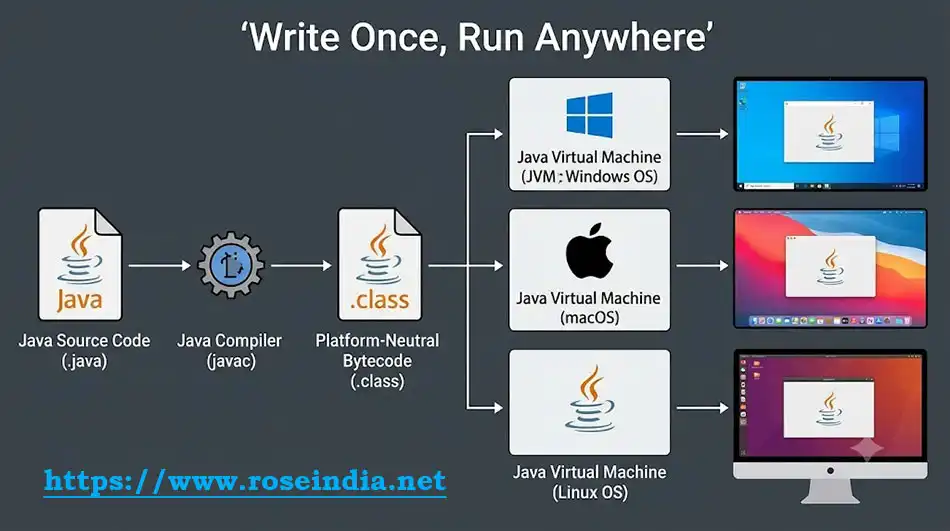
The most popular principle that almost became a slogan for positioning Java’s value proposition is "write once, run anywhere" (WORA). There is hardly any doubt that the rubric rightly describes the key design principle of Java more than any other term. While most traditional languages, after compilation, can only produce code for a single operating system and processor, the code written with Java can run across OS platforms and device processors.
This approach is intrinsic to Java because whenever a Java program is compiled, instead of producing machine code, Java produces bytecode. This bytecode works in the middle as a platform-agnostic code which is stored in .class files. To make the code machine-readable, it is run on the Java Virtual Machine (JVM), a specific Java program that is responsible for translating the bytecode into instructions that the local operating system and device processor can read and execute. Now JVMs can translate code to Windows, macOS, Linux, and other embedded systems, allowing the same compiled Java program to run across multiple systems, without needing any modification or changes.
So the entire structure consists of 3 distinct layers:
- JDK (Java Development Kit): The entire toolkit required for building applications using Java. From the compiler (javac) and debugging tools to everything that developers need to write and deploy code, it is all there in the toolkit.
- JRE (Java Runtime Environment): This environment is what is most essential to translate the code of compiled Java applications, and it consists of the JVM and core libraries. From Java 11 onwards, JRE comes bundled within the JDK, not as a separate package.
- JVM (Java Virtual Machine): Finally, it is the key component responsible for making the code readable and executable for operating systems and machine hardware. It translates bytecode into instructions for the device processor and operating system to execute.
A Practical Example
Instead of explaining the components, it is better understood with a practical example. Here is an example from a simple Java project.
public class HelloWorld {
     public static void main(String[] args) {
         System.out.println("Hello, Java!");
    }
}
Let us call this HelloWorld.java. Now let us run two commands that would lay bare the entire cycle from compilation to running. Here are the two commands:
javac HelloWorld.java # Compiles source code into HelloWorld.class (bytecode)
java HelloWorld # JVM executes the bytecode and prints output. Here is the output of the program:
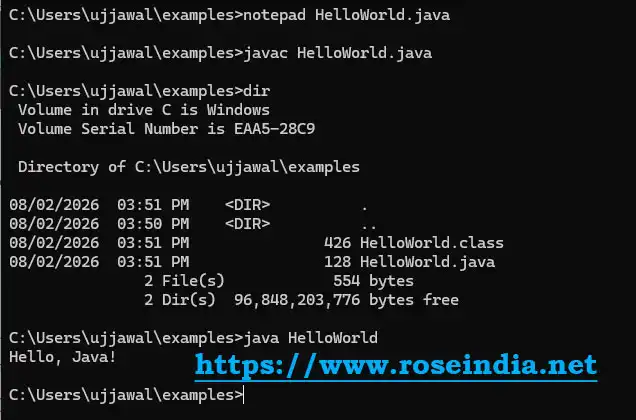
While the first command delivers us platform-agnostic bytecodes, the second one hands over the same bytecode to the JVM. JVM, after receiving the bytecode, runs it on the machine where it is already installed. It can be Windows, Linux, macOS, or embedded systems. When executing the code, the JVM does not make any changes to the source code. These two separate tiers of compiling code and executing it through a machine-installed JVM give Java a unique value proposition.
Key Characteristics That Shaped Java
Java stood out as the most reliable and versatile programming language and computing ecosystem, thanks to several key characteristics. Here we briefly describe some of them.
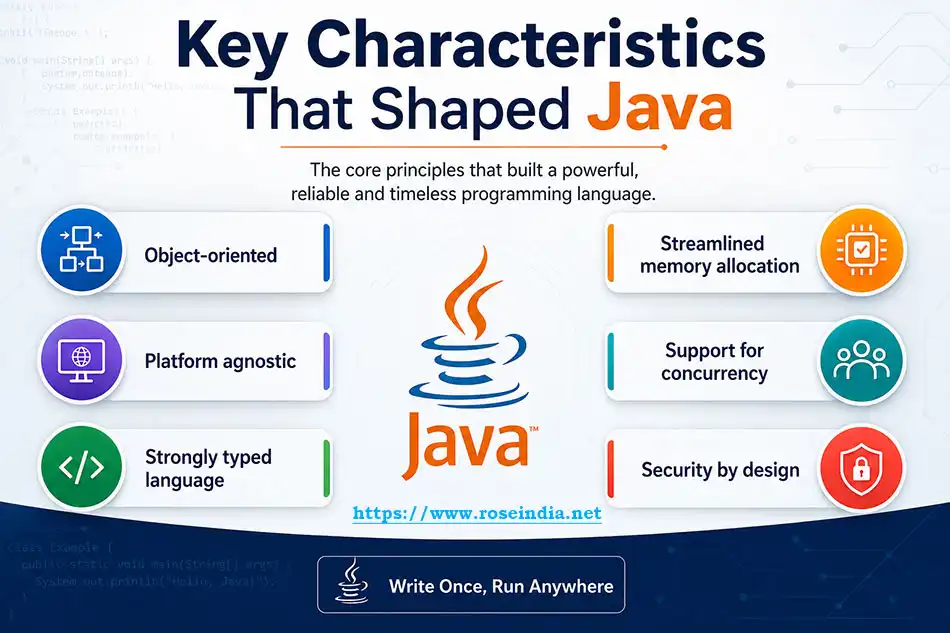
Object-oriented: Following the well-established object-oriented programming principle, Java organizes code into objects and classes. Some of the well-known coding principles it follows include encapsulation, inheritance, polymorphism, and abstraction. Thanks to these principles and structure in any project, large codebases can be easily organized and maintained. This is one of the main reasons for Java's popularity in enterprise production environments.
Platform agnostic: Java's platform-independent character, powered by a machine-installed JVM that can translate the bytecode for execution without changing the source code, makes it a truly flexible language for development projects of any scale.
Strongly typed language: In Java programming, whenever variable types appear, they are checked right during compilation rather than at runtime. This protocol helps avoid a major source of coding errors, well before the code is even executed by the operating system. Although this compile-time check slows down development, enterprises agree to this as a trade-off against reliability.
Streamlined memory allocation: While traditional languages like C and C++ require managing memory manually, the garbage collection feature in Java takes care of memory allocation and deallocation automatically. Through garbage collection, while there can be an extra learning curve for developers to learn how garbage collection works for efficient coding, they can be free from the burden of managing memory allocation.
Support for concurrency: Long before the latest concurrency-focused features arrived through Java 21, even the earliest versions of Java supported multithreading. This support continued to extend and expand, eventually making it a core value proposition. Now with Java 21, we have virtual threads, allowing developers to write simple, readable, blocking-style code that can run across a huge number of concurrent operations. These kinds of large-scale concurrent operations that earlier needed complex asynchronous programming is now taken care of by virtual threads.
Security by design: The core Java architecture has several mechanisms that organically enhance application security. From intermediate bytecode verification, the security manager, classloader isolation, to emphasis on strong typing to avoid vulnerable errors with variable types, Java offers principles and architecture optimized for security.
A Quick Recap of Java Platform Editions
Java, instead of offering itself as a single consolidated ecosystem, comes segregated into several editions addressing the needs based on the types of applications:
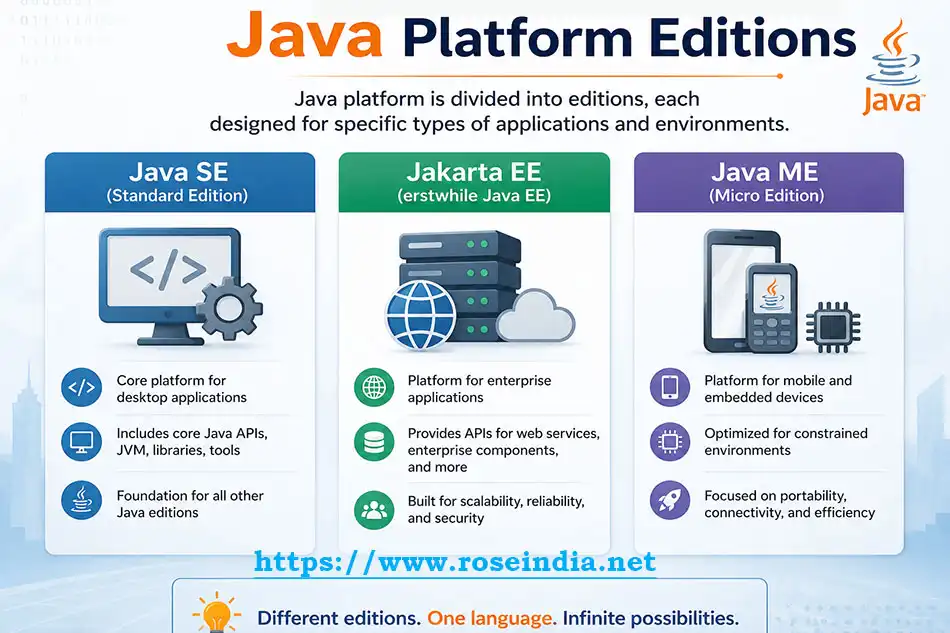
- Java SE (Standard Edition): This is the core platform that encompasses the core Java programming language, APIs, and JVM.
- Jakarta EE (erstwhile Java EE): These are some specifications built over the Java SE to cater to the specific needs of large-scale, distributed enterprise systems. In 2017, Oracle took it to the Eclipse Foundation and rebranded it as Jakarta EE.
- Java ME (Micro Edition): As the name suggests, this is nothing but a smaller version stripped of many features not required by systems with less processing and memory capacity. This Java edition is mostly used in feature phones and embedded systems. Over the years, this edition lost its relevance to a great extent, especially with the rise of robust mobile and IoT device ecosystems around Android and iOS platforms.
What’s New with Java in 2026?
Java is still kicking and thriving, with fresh new features and capabilities coming in every few months. Most importantly, keeping pace with the rapid technological evolution in the last few years, Oracle has now decided to release a new version of Java every six months, while for Long-Term Support (LTS) versions, the gap is 3 years.
Let’s have a quick recap of the latest Java versions. The current LTS version is Java 25, which was released in September 2025, and enterprise projects are expected to align their projects with this version as the standardized one. Java 26 was released in March 2026, only a short-term feature-specific release, and the version is likely to be standardized in the upcoming LTS version, Java 29, set to release not before 2029.
There are some new features, capabilities, and extensions in these new releases that you must know:
- Virtual threads, which continued to evolve and address concurrency needs in a more structured manner, became even better. Now writing code for concurrent Java applications on a large scale has become extremely easy, allowing developers to avoid the asynchronous or reactive programming complexities.
- Java’s syntax also became more concise and expressive to deal with structured data. Now, with the addition of capabilities such as record patterns, sealed classes, and enhanced pattern matching. Java can handle layered and structured data more seamlessly, positioning it on par with some modern JVM languages such as Kotlin.
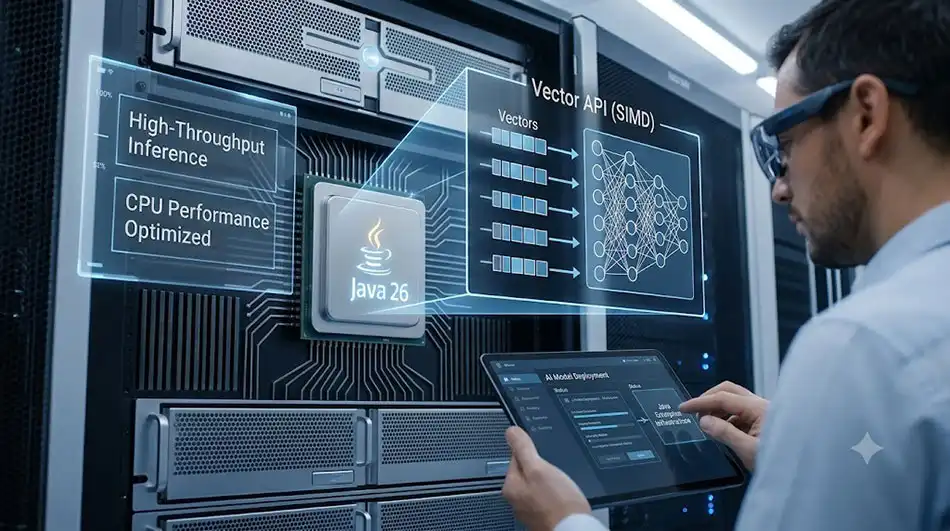
- With the Java 26 release, we have the Vector API, which allows developers to write SIMD (Single Instruction, Multiple Data) code. This capability can help Java developers to deliver vector instructions to optimize CPU performance. This new capability can soon be useful for building AI inference solutions around data analytics and for handling high-precision scientific computing workloads.
- JEP 500 is another feature introduced in Java 26 that is likely to enforce immutability for final fields. This will boost both application safety and performance in projects that use multi-threaded code.
Check Java 2026 tutorials at: JDK 26 Tutorial.
0Why Does Java Really Matter in the AI Era?
Let’s be direct here by stating a common comparison. We all know that Python is a widely used and almost irreplaceable language now used for AI model training and research. While this elementary role of Python behind the AI systems is not going to wane anytime soon, we often forget about the other part, which is deployment.
Once an AI model is built and trained, the logical next step is its deployment and scaling. The same model, as the success trajectory goes up, needs to be integrated into existing business systems and wrapped in reliable, high-performance infrastructure. Now, a lion’s share of the large enterprise infrastructure is built with and runs on Java.
The introduction of the Vector API by Oracle through the latest Java 26 feature release shows how in the future, Java can play an even bigger role in AI interface performance through CPU-optimizing vector instructions. Already frameworks like Spring AI and LangChain4j are making it easy for Java developers to integrate LLMs and AI services into Java applications running inside enterprise production environments.
1Final Thoughts
Java never really lost its core identity, which can be summarized as an object-oriented, platform-agnostic programming language executed through the JVM. But around this core, there have been a lot of value additions in terms of features, capabilities, and release cycles. From faster release cycles to the introduction of the most structured concurrency features to the additions targeting AI-enabled infrastructure, Java continues to evolve and push its relevance higher.
What to Learn Next
In this post you have understood what Java is and why it remains one of the most popular programming languages in the world. The next step for you is to learn the next topics in the Java Programming language. We are giving you the learning path which will build a strong foundation before moving on to Advanced Java topics.
Step 1: Install Java Development Kit (JDK 26)
The first step is to make your system ready for Java application development and for this we need JDK to be installed on our system. So, first learn to install JDK on our system. Learn how to download, install, and configure the latest Java Development Kit on Windows, macOS, and Linux.
2You'll learn:
- Downloading JDK 26
- Setting up JAVA_HOME
- Configuring PATH
- Verifying the installation
Learn it at Install JDK 26: A Complete Beginner's Guide (2026)
Step 2: Getting Started with Java
The next step is to configure the development environment and write your first Java application. Set up your development environment and write your first Java application.
3You'll learn:
- Java project structure
- Writing your first program
- Compiling Java code
- Running Java applications
Check our tutorial: Getting Started with Java.
Step 3: Java Syntax
The next step is to understand the basic building blocks of Java programming language and understand its syntax. Understand the basic syntax rules used in every Java program. In this step you will learn following topics:
4- Statements
- Blocks
- Comments
- Identifiers
- Keywords
- Naming conventions
Step 4: Java Variables
Variables are very important in Java and it's used to store the values in memory during the execution of a program. So, you should learn Java Variables very well. Learn how Java stores and manages data.
In the Java Variables you should learn:
- Variable declaration
- Initialization
- Scope
- Constants
- Type inference with var
Step 5: Java Data Types
Now the data types are very important which allows you to store different kinds of data in the variable. You can make a variable to store a specific type of data. Understand primitive and reference data types.
5You should learn:
- int
- long
- double
- float
- boolean
- char
- String
- Wrapper classes
Step 6: Java Operators
Java operators are used to perform calculations, compare values, assign data, and evaluate logical conditions. Learn how Java performs calculations and comparisons in your Java Program.
You should learn the following topics:
6- Arithmetic operators
- Assignment operators
- Relational operators
- Logical operators
- Bitwise operators
- Ternary operator
Step 7: Java Control Statements
Java Control Statements are used to logically control the execution of a piece of code in Java. Control the flow of your program.
You should learn these:
- if
- if-else
- switch
- switch expressions
- break
- continue
Step 8: Java Loops
Java loops are used to repeat tasks efficiently.
7These are the various loops type in Java that you should learn:
- for loop
- while loop
- do-while loop
- Enhanced for loop
Step 9: Methods in Java
Organize your code into reusable methods. Learn the methods in Java and practice well. You should understand the methods in Java very well and create as many examples as you can. In our tutorial also we have provided many examples.
You should learn:
8- Parameters
- Return values
- Method overloading
- Static methods
- Recursion
Step 10: Object-Oriented Programming (OOP)
Object-Oriented programming is one of the most important topics in Java and you should learn it very well. Learn the concepts that make Java powerful.
You should learn:
- Classes
- Objects
- Constructors
- Encapsulation
- Inheritance
- Polymorphism
- Abstraction
- Interfaces
Step 11: Exception Handling
Write programs that gracefully handle errors. Exception handling is a very important concept and it is a must for the Java developers to learn exception handling. You should be able to write a program in Java that captures exceptions very well, so that program does not crash in the runtime.
9You should be well versed with following concepts:
- try
- catch
- finally
- throw
- throws
- Custom exceptions
Step 12: Java Collections Framework
Java collection framework is packaged into java.util package and it provides a set of interfaces, classes, and algorithms to store and manipulate groups of objects. After mastering the Java Collection Framework you will be able to efficiently manage groups of objects.
You should learn:
0- ArrayList
- LinkedList
- HashSet
- TreeSet
- HashMap
- TreeMap
- Queue
- Stack
Step 13: Modern Java Features
Java comes with modern features enabling development of modern applications. For Java developers learning these modern features are a must. Master the features introduced in recent Java releases.
Java Modern Topics:
- Records
- Sealed Classes
- Pattern Matching
- Virtual Threads
- Text Blocks
- Switch Expressions
Step 14: Java Streams and Lambda Expressions
Write cleaner, more functional Java code with the help of Java Streams and Lambda Expressions. It is advisable for the programmers to learn these features.
1You should learn:
- Stream API
- Filtering
- Mapping
- Collectors
- Lambda expressions
- Method references
Related Tutorials:
Author: Deepak Kumar Last Updated: 2-Aug-2026
2