Java Certification Roadmap 2026: Which Oracle Certs Actually Help Your Career
At first glance, any learner can find Oracle's certification catalog really daunting. You will find associate exams, professional exams, and expert-level credentials for several languages that are already outdated. Though a Google search leads you there, many of these certifications have already been discontinued. This is why, if in 2026 you are looking for credible Java certification programs, you need an updated and current guide. In this post we are discussing How to become Oracle Certified Java Developer and get better job.
Here in this guide, we will not only evaluate the official certifications from Oracle, but will also explain programs that are no longer important, and finally the cost, timing, exam format, and what the certification roadmap looks like. This section also covers Which Oracle Java certification should I take in 2026? Information on this helps you in choosing the right Oracle Java certification for you.
Oracle's Java Certification: An Overview of the Current State of Things
With the evolution of Java, particularly with the Java releases in recent years, Oracle has restructured the Java certification path to a great extent. It started from Java 11, followed by the changes brought by Java 17 and Java 21. You no longer have the two-tier exam structure consisting of the Oracle Certified Associate (OCA) exam followed by the Oracle Certified Professional (OCP) exam. Instead of clearing two consecutive exams, now for Java SE 17 and Java SE 21, you need to pass a single standalone professional exam. The single certification exam now covers both basic and advanced learning materials.
From the perspective of the learners, the change is really helpful as they don’t need to budget and schedule learning time for two separate certification exams. They can now follow a single preparation cycle, pay a single exam fee, and get the necessary Java credentials that employers seek.
If you are looking for an entry-level course, there is the Java Foundations Certified Junior Associate program. If you are a starter with no coding knowledge or background, this is the ideal course to start your journey into programming. But it should not be conceived as a professional certification that can land you a developer job.
Is Oracle Java certification worth it in 2026?
Yes, Oracle Java certification provides you an opportunity to show your skills to employers. You will be able to find yourself ahead in the job search market. So, at least one Oracle Java certification is necessary for the Java developers. In this guide we are providing you all the information you need to know to prepare for the Java Certification.
Java Certification Roadmap 2026
Java is continuing to be highly popular and one of the most popular programming languages for enterprises. Companies are using Java for developing enterprise applications, cloud native applications, backend application development, Android apps and various AI-powered solutions. An Oracle certification is a must for Java developers as it validates your programming expertise and helps you stand out in a highly competitive job market. In this post we are providing a guide to help you prepare and clear Oracle Java certification. We have listed all the certifications available today and explained its benefits.
Step 1: Learn Java Fundamentals
Build a strong foundation by mastering:
- Java syntax and data types
- Operators and control statements
- Methods and arrays
- Object-Oriented Programming (OOP)
- Exception handling
- Collections Framework
Step 2: Master Intermediate Java
Expand your knowledge with:
- Generics
- Multithreading & Concurrency
- Lambda Expressions
- Streams API
- File I/O
- JDBC
- Java Modules
Step 3: Learn Modern Java Features
Focus on the latest Java releases and LTS versions:
- Records
- Pattern Matching
- Virtual Threads
- Switch Expressions
- Text Blocks
- Sealed Classes
- Foreign Function & Memory API
Step 4: Earn an Oracle Java Certification
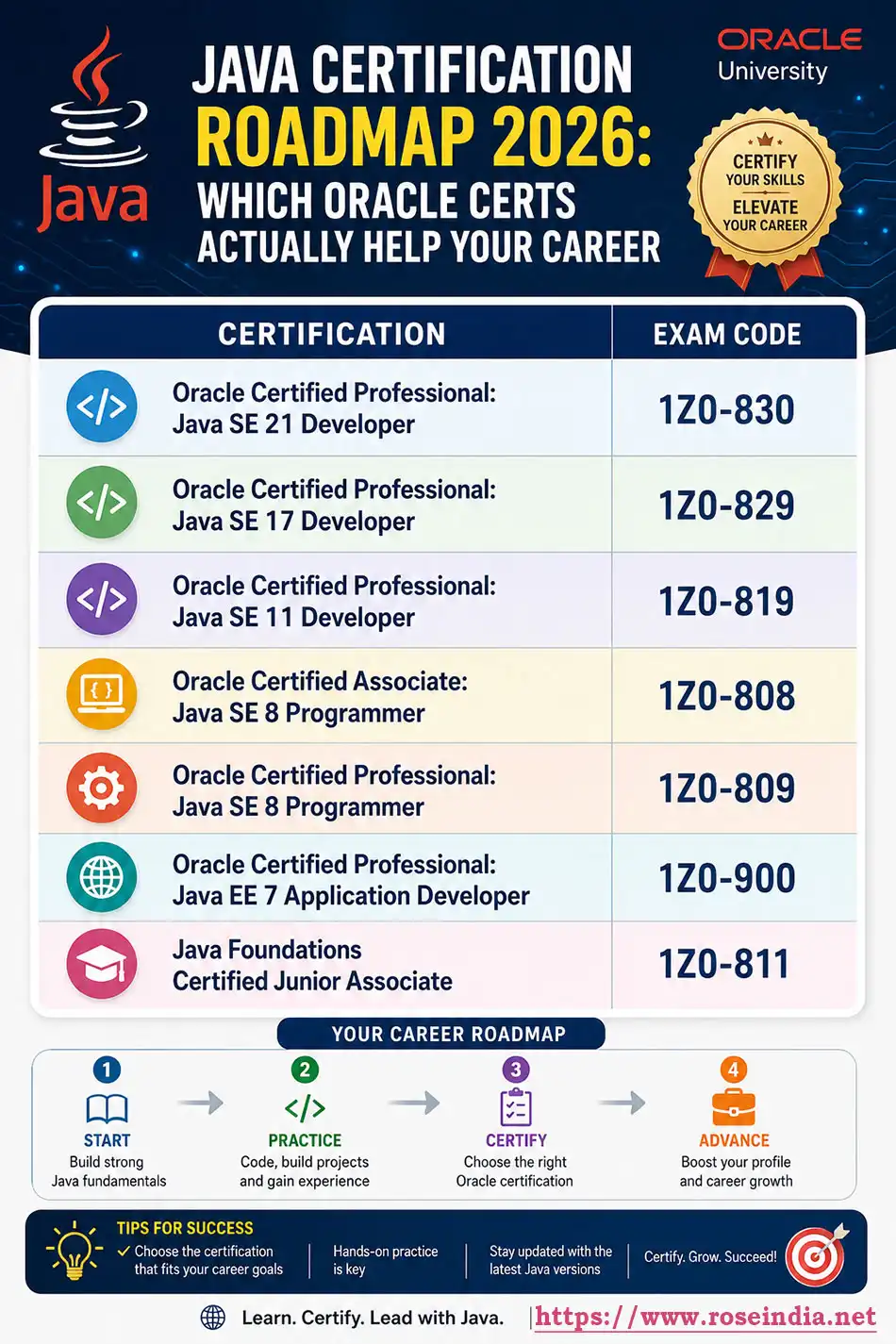
Oracle currently offers the following active Java certifications:
| Certification | Exam Code | Recommended For |
| Oracle Certified Professional: Java SE 21 Developer | 1Z0-830 | Developers working with the latest modern Java (Recommended certification for 2026) |
| Oracle Certified Professional: Java SE 17 Developer | 1Z0-829 | Developers using Java 17 LTS |
| Oracle Certified Professional: Java SE 11 Developer | 1Z0-819 | Developers maintaining Java 11 enterprise applications |
| Oracle Certified Associate: Java SE 8 Programmer | 1Z0-808 | Beginners learning Java fundamentals |
| Oracle Certified Professional: Java SE 8 Programmer | 1Z0-809 | Intermediate Java developers |
| Oracle Certified Professional: Java EE 7 Application Developer | 1Z0-900 | Enterprise Java EE developers |
| Java Foundations Certified Junior Associate | 1Z0-811 | Students and beginners starting their Java journey |
If you are starting your career in Java programming then the Oracle Certified Professional: Java SE 21 Developer (1Z0-830) is the best certification to pursue. This certification covers modern Java language features and all the best practices that developers should know. Oracle is already providing certification paths and training for new/experienced Java developers through its online portal Oracle University. You can join Oracle University for training and certification preparation materials.
Step 5: Build Real-World Projects
Strengthen your resume with projects such as:
- Student Management System
- Banking Application
- REST APIs with Spring Boot
- Inventory Management System
- Employee Management Portal
- Microservices-based applications
Step 6: Learn Enterprise Java
After certification, continue with:
- Spring Framework
- Spring Boot
- Spring Security
- Microservices
- Docker
- Kubernetes
- Kafka
- JPA/Hibernate
- REST APIs
- Cloud deployment (AWS, Azure, GCP)
Step 7: Keep Learning
Java evolves every six months. Stay updated by:
- Following new JDK releases
- Learning new language features
- Practicing coding challenges
- Contributing to open-source projects
- Building production-ready applications
The Best Option: OCP Java SE 21 Developer (1Z0-830)
If you are confused about prioritizing one Java certification, we recommend this one. Java SE 21 is the latest Java release and enjoys long-term official support. Moreover, you have the industry-acclaimed and widely valued OCP credential attached to it. The curriculum takes you through all the latest Java language features that changed the way Java code is written in 2026.
Java SE 21 introduces all the most advanced and latest Java features such as virtual threads from Project Loom, record patterns, sealed classes, and pattern matching. Instead of being just fancy feature additions, these features in more ways than one changed the way Java code is now written. For example, the introduction of virtual threads brought a new paradigm shift in handling concurrency. So, Java SE 21 OCP provides a certification that testifies to your knowledge and familiarity with the latest Java protocols, not just the legacy Java syntax.
It is a single-sitting exam with 50 questions, a time limit of 90 minutes, and a 68% pass mark. The most important thing is that, while being interviewed by technical leads, this certification showcases your familiarity with the latest Java features and protocols and can always make a better impression than other OCPs. They know that you understand concurrency handling, memory management, or how APIs are designed now in large enterprise systems. Such understanding can often be a critical differentiator.
An OCP for Large Enterprise Projects: OCP Java SE 17 Developer (1Z0-829)
Though Java continues to advance and Java 17 apparently looks outdated, it still remains the most widely adopted LTS version in large enterprise environments. Since large enterprises do not upgrade the foundational production-environment programs so often and they always behave cautiously in this regard, Java SE 17 still holds immense demand for many developer roles. Migrating a legacy banking or insurance system from Java 17 involves several risks and cautious steps, and so many of them are still running on Java 17, or even older Java versions. This is why the OCP Java SE 17 Developer certification is still so relevant in the job market.
As an aspiring Java developer, if you are eyeing large enterprise roles or a place in the technical team of a bank or insurance company, you may be better placed with well-rounded Java 17 knowledge rather than the latest Java features. Since in large enterprise environments, most useful Java knowledge is often given priority over the knowledge of the most updated Java features, the OCP for Java 17 has a solid case here.
The exam structure of Java 17 OCP is very similar to that of Java 21, with the same number of exam questions and time limit. If you are already thinking whether the Java 17 OCP is worth taking alongside the Java 21 OCP, the practical answer will be no, since there is considerable overlap between the two OCPs in terms of curriculum and questions. On the other hand, if you want to have the best chances by grabbing both the most updated and the most useful legacy system-specific Java knowledge, you can enjoy the critical edge with your all-around Java credentials.
Does OCA Still Matter? If Yes, How?
The online guides, especially the old ones that have not updated the information for some time, really make it more confusing for learners who search for Oracle Certification Programs. Many of these guides still tell students that they need to obtain Oracle Certified Associate (OCA) programs to go through OCP, while in reality, that two-step structure does not exist anymore. OCA was mandatory for Java 8 and earlier versions, and it does not apply to any Java version from Java 9. As we have already explained, for all the recent versions, Oracle has merged the foundation-level curriculum with the single professional OCP exam.
So, OCA no longer matters. Java 8 and earlier versions have already been outdated for years, and those outdated environments are rarely needed for legacy maintenance work. If you want to start your Java developer career, it is better to start with the latest Java OCPs, ideally Java 21 and Java 17.
From a mere psychological point of view, one can argue that a learner may want to gain confidence by completing smaller milestones before advancing to the latest Java versions. Well, to satiate that step-by-step learning need, you can always go for online mock tests and unofficial exams, without paying the fees and spending time on an official associate-level program.
A Look Back at the Discontinued or Obsolete Oracle Certifications
Let’s admit that with the advancement of technologies, many certifications and learning programs of yesteryear are bound to be discontinued or become obsolete; it is not very different with Oracle certifications as well. Oracle discontinued many of its erstwhile popular certifications such as Java EE 6, which used to cover EJB, JPA, Servlet/JSP, and web services. Though occasionally, some job postings for legacy system roles may mention such credentials, most of these certificate holders have been either phased out or replaced by more advanced and recent professional certifications. Naturally, these older certifications no longer hold any value.
Few chase certifications just thinking that adding a bunch of them will only make their resumes more credible. But in reality, holding multiple Oracle credentials that are not backed by hands-on project experience can never impress a technical interviewer. A single certification that showcases your orientation and knowledge of advanced Java features is enough to create an impression if you can back it up with real project exposure and hands-on skills.
The Fees, Required Study Time, and the Exam Format
While most online guides often fail to advise and inform properly on the fees, the required study time, and the detailed exam format, we consider it a necessary prerequisite.
Let’s start with the exam fees. Both the Java SE 17 and Java SE 21 OCP exams charge $245 as the exam fee. Since the prerequisite associate programs are now merged with the professional certification programs, the learners need to pay once for a single exam.
The required timeline to prepare for the exam may vary to a great extent, based on the exposure of the student to programming and real projects, prior knowledge and experience of Java, and aptitude level. If you have fair knowledge of Java and if you are already working on a Java project, six to eight weeks of focused study may be enough to clear the exam successfully. People with Java experience mostly need to fill their knowledge gaps around the latest features, a few uncommon APIs and protocols like virtual threads for concurrency handling. But someone absolutely new to foundational concepts of Java, like object-oriented programming, may need several months of focused study and hands-on coding practices.
0The best part is that these two OCPs are valid once you clear the exam, and they do not expire. So, you do not need to worry about reconciling with the latest updates and paying new fees for mandatory reconciliation. On the other hand, Oracle has also designed each OCP for a single Java version instead of offering a Java Developer certification. So, your proven expertise with a Java version is established once and for all. You do not need to reconcile with any new release to keep the certification valid.
Final Words
Now with the merger of two-step certification programs into one professional program, the Oracle Java certification landscape has become more concise and focused. The path to becoming a Java developer with Oracle certification boils down to two major options, namely, OCP Java SE 21 and OCP Java SE 17. The first one is relevant for most developers looking to establish expertise with the latest Java features and protocols, and the second one is for developers eyeing opportunities in large enterprise production environments where Java 17 has a wider footprint than any other Java version.
Getting Oracle certification is one of the most important methods to show your expertise and commitment for professional application development. We have provided you with a detailed guide on Oracle Java Certification. After completing all the topics mentioned here, you will make a foundational step towards getting valuable Oracle Java Certification. Tutorials given above will help you in learning and mastering Java programming language. You should learn Java from tutorials given above. After learning Java from above tutorials you will find yourself in better position to clear Oracle Java Certification.
1