
Top 10 Reasons to Learn Java in 2026
For many years, there has been buzz from time to time about Java being outdated and surpassed by one or another language. But the developer job listings, the codebases of many advanced solutions on GitHub, and the code footprints across the Android app ecosystem silently contradict such ideas. Java turned 30 last year, and it’s still thriving. Java is still one of the most widely used, learned, and taught programming languages in the world. It’s still widely used in banking and financial software and applications, telecom systems, e-commerce stores, and the vast majority of Android apps.
What made Java indispensable as a programming language? Well, there are many fronts where Java is already miles ahead of other languages, such as stability, interoperability, and backward compatibility. Most importantly, Java remained relevant for applications representing three distinct facets of computing, such as desktop applications, web servers, and cloud-native microservices.
We have done thorough industry research and come up with our final report. We have identified the most valuable reasons for learning Java in 2026 and beyond. Java is still a strong programming language which is growing fast and adapting to modern changes coming in the field such as cloud application development, vector data processing, image data processing and machine learning applications.
SpringBoot is one of the most famous frameworks in Java which is being used for development of microservices and machine learning pipelines. Java is also used in Apache Spark based large scale in-memory data processing. The usage of Java Programming Language is tremendous in the modern world. Developers are encouraged to learn Java Programming Language in 2026 and beyond to make a strong career in software development.
Based on our research we have come up with the top 10 reasons for learning and mastering Java in 2026 and beyond.
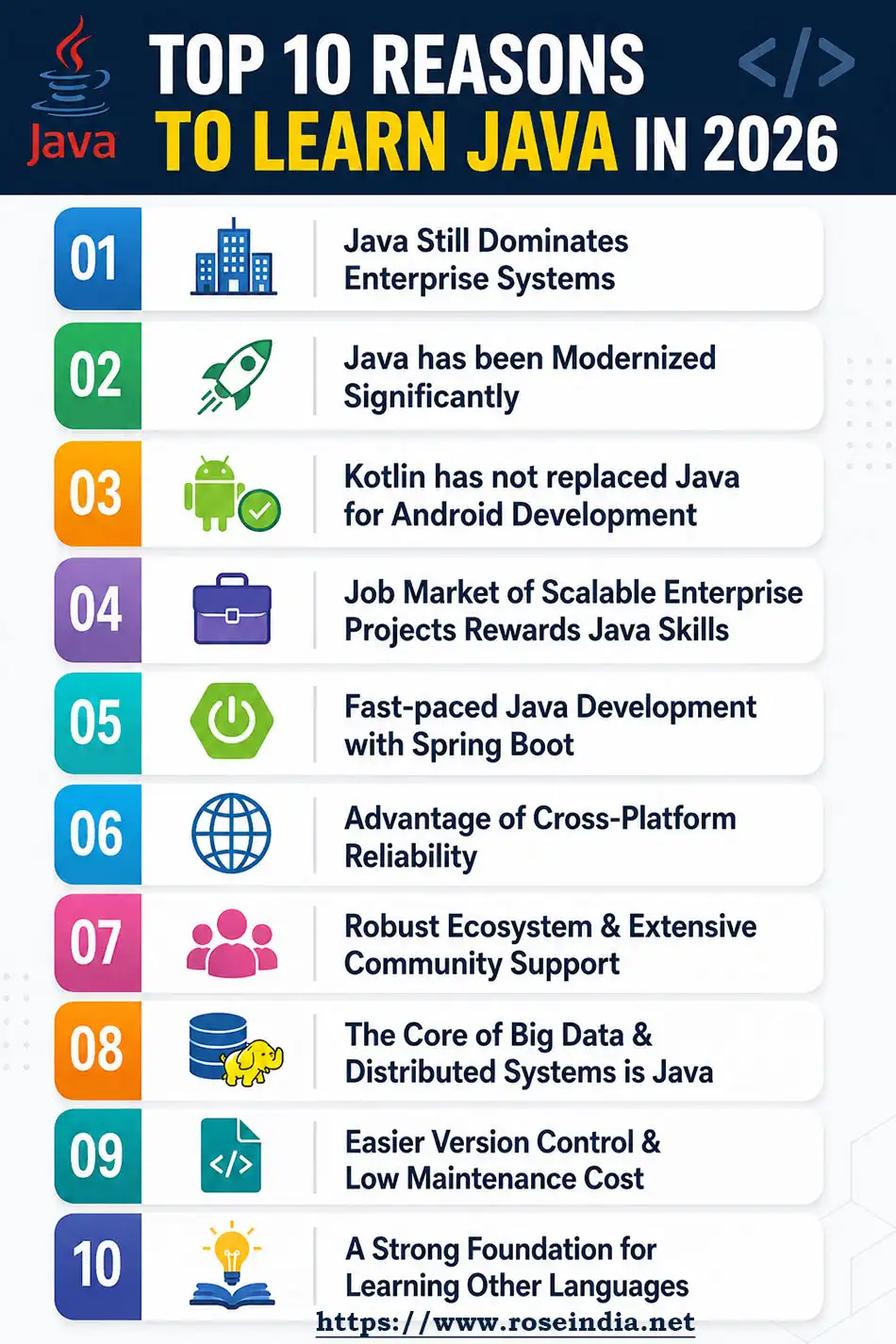
Are you still hesitant about learning Java to kickstart your career as a developer? Here we explain the top 10 reasons to learn Java in 2026.
1. Java Still Dominates Enterprise Systems
Just walk into any large bank, insurance company, telecom service provider, or logistics firm, and you will likely find that the core infrastructure of their solutions is built using Java. This is far from accidental, because large enterprises always prioritize predictability and reliability over trending and new functionalities. Java brings a mature and foolproof ecosystem characterized by strong coding protocols, an extensive toolset, extremely mature and evolved documentation, and well-versed best practices. Simply put, Java’s ecosystem makes it harder for enterprise systems to fail.
As most industry indexes show, including the TIOBE Index, Java has been ranked among the top programming languages for decades, while many languages rose to fame and faded to oblivion in the same period. This longevity, which beats the regular hype cycles, reflects sustained enterprise demand and solid reliability that do not evaporate in the face of competition.
2. Java has been Modernized Significantly
Many Java tutorials rehash the same wheel of Java knowledge for years and do not update enough about the evolution that has taken place with Java over the years. It is important to understand that Java in 2026 is not the same as Java in 2010. Java has long ago shifted to a six-month release cycle, and since then the language has introduced new features that were considered unique value propositions of several new languages. Some of the advanced and trending features that have helped Java remain competitive include concise data classes, closed classes catering to controlled inheritance hierarchies, clean conditional logic with pattern-matching capability, and virtual threads for applications with high-concurrency instances.
Let’s take the introduction of virtual threads as the most befitting example. Any application that needs to facilitate a massive number of concurrent connections can now leverage the simple and easy-to-scale code blocks and replace the need to use reactive frameworks or asynchronous programming.
3. Kotlin has not replaced Java for Android Development
Kotlin was widely welcomed as a more efficient language for Android development and it has become the preferred official language for new Android projects. But the fact that deserves attention is that Kotlin runs on the Java Virtual Machine and the vast majority of the official Android codebase is mostly Java code. Since Kotlin is interoperable with Java, most Android apps in production still rely only on Java code or opt for a hybrid coding approach.
Most importantly, if you have strong Java knowledge and skills, you can learn Kotlin faster. Learning core Java concepts like object-oriented design, memory management, and having a solid grasp on the underlying architecture of the Android SDK can help you become an accomplished Android developer. In that regard, learning Java is more like a stepping stone for would-be Android developers rather than a competitive choice to Kotlin.
4. Job Market of Scalable Enterprise Projects Rewards Java Skills
Most of the leading job boards feature Java as one of the highly demanded skills for backend and enterprise software job positions, especially for mid-to-senior developer roles. The large-scale enterprise systems where round-the-clock availability and consistent performance are crucial still consider Java as one of their preferred backend options. This is why job listings for Java developers are so common for projects like payment processing, healthcare solutions, and government systems.
Now, along with this, consider the compounding effect of experience. Since Java has been a dominant language for years and has evolved by adding new features and capabilities, the supply of experienced developers is higher for Java compared to other languages. But the supply of experienced Java developers is still not enough to meet the market demand.
Many talent hunters responsible for supplying skilled resources to enterprise projects frequently face the lack of mid-level Java engineers with enough experience to simultaneously handle legacy code and modern frameworks. So, if you want to flourish and become indispensable as a Java developer, focus on sharpening fluency in the latest tools besides the core Java skills.
5. Fast-paced Java Development with Spring Boot
The common allegations that Java is code-heavy or verbose have been common criticisms for years. Then, Spring Boot changed this perception and gave Java the boost it required for years. Spring Boot, by handling configuration, dependency injection, and boilerplate setup, helped developers to build a functional REST API in just minutes. The entire work that used to take hours can now be completed in minutes thanks to Spring Boot.
Now Spring Boot 4 has stepped one step further and embraced the latest features of Java, boosting the speed and efficiency for backend developers further. Now Spring Boot supports the latest Java features like native support for records and virtual threads, allowing developers to build and deploy production-grade backend faster than ever before.
Spring Boot framework also made it easier for beginners to learn Java and develop functional solutions more quickly. The framework, by prioritizing convention over configuration, helps new developers to build functionality quickly and then learn about the mechanisms of configuration over time.
6. Advantage of Cross-Platform Reliability
The founding principle of Java, "Write once, run anywhere," still holds immense value because of its cross-platform reliability unmatched by many other languages. The abstraction of the Java Virtual Machine from the operating system it runs on alone guarantees a high level of flexibility. Thanks to this abstracted Java Virtual Machine, a Java application built on Windows can simultaneously run on Linux, macOS, or embedded systems, requiring no further modification. All you have to ensure is a compatible JVM with all these operating systems.
This is one of the core reasons why Java remains a go-to choice for cross-platform enterprise projects. This cross-platform reliability also helped Java share a good chunk of the code in Android's runtime environment. Lastly, the same cross-platform reliability of Java also made Java a preferred choice for organizations that depend on mixed infrastructure comprising some Linux servers and Windows environments. Java helps enterprises to stay clear of platform-specific concerns, even in an environment characterized by the maze of device and OS configurations.
7. Robust Ecosystem & Extensive Community Support
No programming language is learned best in isolation. For any would-be developer, it is natural to look up online help from other developers. This is one area where Java excels in terms of extensive official documentation, developer community forums, Stack Overflow answers, mature IDEs like IntelliJ IDEA and Eclipse, and a whole bunch of open-source frameworks that cover pretty much every developer's need. You have web development frameworks like Spring and Jakarta EE to big data frameworks that are written using Java like Apache Hadoop and Apache Spark.
Thanks to this massive ecosystem and unmatched community support, you learn troubleshooting more quickly, know shortcuts, grasp best practices, and mature as a developer. For every issue around your Java project, you can find an answer on Stack Overflow or in any of the official documents. Since Java has been evolving for over 30 years, it has accumulated more troubleshooting knowledge than any other language.
8. The Core of Big Data & Distributed Systems is Java
Distributed systems such as Blockchain and Big Data computing have already set the trajectory of future computing and data management. Java can be the best entry point for an aspiring developer to set foot in the burgeoning world of Big Data and distributed computing, since most of them are either written in Java or are deployed natively on the Java Virtual Machine. You can have a solid head start in the lucrative data engineering roles with knowledge of the memory model, concurrency primitives, and object-oriented structure of Java.
As an aspiring Java developer, you do not need to restrict yourself to a set of traditional job roles. If you have primarily learned Java to become a backend web developer, don’t hesitate to look up to bigger career roles in the field of data science and distributed systems, because the required foundational knowledge of Java remains the same for a data scientist. If you know how the JVM handles memory, how it collects garbage, how the threads behave, and how concurrency models react, you already have a strong foundation that almost any distributed data processing system requires.
9. Easier Version Control & Low Maintenance Cost
Programming languages are also chosen, considering their maintenance overhead and long-term cost. A strongly-typed language that makes it easy to debug, release new versions, and roll out new feature updates has an edge over a dynamically-typed language. Java's offering of static typing helps eliminate errors right when the code is compiled. Because of the object-oriented structure, it also supports creating patterns to help scalability with the growth of the application codebase.
Though these strengths cannot be considered advantageous for all instances, they can be a trade-off against the fast-paced prototyping that dynamically typed languages like Python and JavaScript offer. This is why large enterprise systems that do not mind going slow at the initial phase but prioritize easy version control and low-cost maintenance opt for strongly-typed languages like Java.
10. A Strong Foundation for Learning Other Languages
Most computer science programs and curricula around the world still feature Java heavily as a teaching language, and there is a reason for that. Java provides learners with a strong foundation that further helps them learn other languages. To help a student grasp the elementary programming concepts and practices, the object-oriented principles, explicit syntax, and structured coding approach are extremely effective. This is why any aspiring developer versed in Java’s .class hierarchies, interfaces, and exception handling can easily start learning Kotlin, C#, or others.
Java helps students internalize the essentials of programming logic, making it easier to learn any other language. This is why Java has gained the reputation of a starter language, not because it is easy to learn, but because it helps would-be developers to internalize the best practices and build good habits early on.
0Final Words
Java is known for depth, stability, reliability, and huge footprints across enterprise systems. For a learner, it not only opens doors to the sought-after middle or senior-level developer roles in large enterprises, but it also helps them build careers in burgeoning fields like data science and distributed systems. Last, but not least, Java as a foundational language can also help you groom your skills in Kotlin, JavaScript, Python, or any other language.
Above tutorials are the best tutorials for learn Java from beginning in 2026. In 2026 and beyond Java Programming language is used for developing native cloud applications, machine learning applications and many enterprise applications. Java is most used in the Banking and Finance applications. So, learning Java in 2026 and beyond is best choice for making career in the programming world.