
Java 26 (JDK 26) Features with Examples – Complete Guide
Welcome to complete guide on Java 26 (JDK 26) features and improvements. In this post we are going to understand the features and improvements of Java 26 with examples. You need to have JDK 26 installed on your system to run the examples provided in this tutorial.
Java 26 was released on March 17, 2026 and now it's available for download use for the developers. If you have not downloaded it download it from here. For running the examples given here you will need Java 26. Java 26 has delivered 10 JDK Enhancement Proposals (JEPs) like HTTP/3 support and minor to medium-sized changes. These changes make Java 26 interesting and it is advisable to upgrade your code to Java 26 to take full advantage of the latest Java.
Published: March 17, 2026
Category: Java, JDK, Programming
1. Better Pattern Matching
2. Improved Record Patterns
3. Better Switch Pattern Matching
4. Primitive Types in Pattern Matching
5. Virtual Threads Improvements
6. Structured Concurrency Enhancements
7. Scoped Values Improvements
8. Foreign Function & Memory API
9. Vector API Improvements
10. Garbage Collector Improvements
11. JVM Startup Improvements
12. Better Memory Management
13. Security Enhancements
14. Performance Improvements
15. Better Container Awareness
16. Improved String Performance
17. Better Collections Performance
18. Better Reflection Performance
19. Better Class Loading
20.
Example: Virtual Thread Web Server
Introduction
Java is continuous development, which is evolving and bringing improvements in developer productivity, application performance, security, cloud-native deployment, and AI-ready programming capabilities. In today’s Cloud and AI world Java has evolved to provide support for development of AI and Cloud applications. Java 26 (JDK 26) is built on the strong foundation established by Java 25. Java 26 brings several preview, incubator, and permanent features designed to make Java applications more expressive, safer, and faster. In this post we are providing many examples exploring the features of Java 26.
Developers of enterprise applications, Spring Boot microservices, cloud-native systems, or AI-powered applications, can use Java 26 to provide new capabilities in their application. As developers you should learn all these new features of Java/JDK 26 and practice.
In this tutorial, you'll learn:
- What's new in Java 26
- JDK 26 language enhancements
- JVM improvements
- Garbage Collection updates
- Performance optimizations
- Security enhancements
- Preview features
- Practical code examples
- Migration guide
What is Java 26?
Java 26/JDK 26 is the latest short-term feature version of the JDK that arrived on March 17, 2026. Following the Java 25 LTS release, this version emphasizes runtime performance, platform modernization, and deprecation of legacy components over introducing major language syntax changes. So, Java 26 is more advanced and evolving into a modern AI and Cloud application tool. Java is very popular among enterprise developers for development of cloud native enterprise applications. So, learning Java 26 is a must for Java developers or freshers aiming to make a career in Java technologies.
Java 26 is the latest release of the Java Platform Standard Edition (Java SE). Like other modern Java releases, it follows the six-month release cadence.
Java 26 focuses on:
Support for HTTP/3 - Java 26 via JEP 517 introduced default support for HTTP/3 in its standard HttpClient API. HTTP/3 is more advanced and uses the QUIC protocol over UDP rather than TCP. This protocol is good and it reduces connection latency and eliminates head-of-line blocking.
Stricter Final Fields & Integrity: A new feature is now introduced which restricts the modification of final fields using Java reflection framework. This is a major security vulnerability, which can introduce major bugs and cause accidental errors in critical business systems. So, now in Java 26 it is being fixed.
Startup & AOT Caching: AOT (Ahead-of-Time Object Caching with Any GC) is introduced in JDK through JEP 516. This feature allows the JVM (Java Virtual Machine) to store and load pre-initialized objects on the heap regardless of the Garbage Collector used. This optimizes the application startup and warmup times, which is good for cloud native applications and serverless environments.
Performance Upgrades: This version (JDK 26) includes G1 Garbage Collector (GC) synchronization improvements and also includes the modernized support for the HTTP/3 protocol. This reduces the network latency and speeds up network operations. So, you will be able to create fast applications that interact with the http servers.
Concurrency & Language Refinement: Java 26 brings more refinements to Virtual Threads and pattern matching. This feature makes Java concurrency much safer for real-world code alongside foundational groundwork for upcoming features. Now you will be able to make more reliable and robust applications in Java 26.
API Modernization: In the Java 26 outdated Java Applet API has been removed. New utilities like the Foreign Function and Memory API and "Lazy Constants" have been added to this version of Java ( JDK 26).
Better developer experience: All these new features and updated features bring better experience for the developers.
Higher runtime performance: Java 26 brings higher performance in the runtime.
Major Features of Java 26
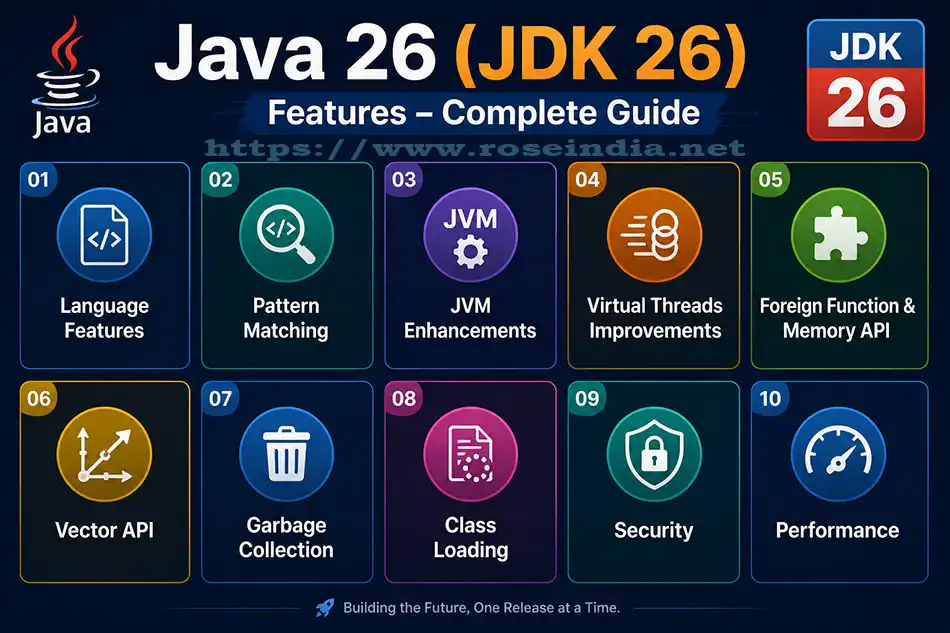
The major areas improved include:
- Language Features
- Pattern Matching
- JVM Enhancements
- Virtual Threads Improvements
- Foreign Function & Memory API
- Vector API
- Garbage Collection
- Class Loading
- Security
- Performance
Let's explore each feature.
1. Better Pattern Matching
Pattern Matching continues to become more powerful. Through JEP 532 Primitive Types are allowed to be used in Patterns, instanceof, and switch (Fifth Preview). This makes programming much easier and it can be used during testing and data exploration. Now instead of writing nested instanceof checks, Java Programming language allows concise code.
Old Style
Object obj = "Hello";
if (obj instanceof String) {
  String str = (String)obj;
  System.out.println(str.length());
}
Modern Java
Object obj = "Hello";
if (obj instanceof String str) {
   System.out.println(str.length());
}
More examples:
Before JDK 26:
Object value = 10;
if (value instanceof Integer i) {
   int v = i.intValue();
   System.out.println(v + 1);
}
With JDK 26 Natively:
Object value = 10;
if (value instanceof int i) {
  System.out.println(i + 1);
}
Enhancements to switch Expressions
Both Primitives and reference types or record components can be used together in developing much optimized code. Here is one example:
public static String evaluateInput(Object input) {
	return switch (input) {
	case int i when i > 100 -> "Large integer";
	case int i -> "Standard integer";
	case double d -> "Floating-point double value";
	case String s -> "String text: " + s;
	default -> "Unknown type";
	};
}
Benefits
Here are the benefits of pattern matching features in Java 26:
- Less casting
- Cleaner code
- Fewer bugs
Feature Status
0In the JDK 26, this capability feature is in its fourth preview, we need to enable few flags. To compile and experiment with these features, you should use these flags with javac and java commands:
javac --enable-preview --release 26 YourFile.java
java --enable-preview YourFile
12. Improved Record Patterns
Now in JDK 26 record pattern comes with the much powerful enhancement. Through JEP 530 (Primitive Types in Patterns, instanceof, and switch—Fourth Preview), JDK 26 introduces indirect yet substantial improvements to record patterns. Even though standard record patterns were finalized back in JDK 21, the release of JDK 26 markedly elevates the deconstruction of record components by seamlessly incorporating primitive types directly into pattern matching contexts.
Record Patterns simplify extracting values from records. This feature makes programming much easier.
Example of record for extracting values from records:
2
record Employee(String name, int age) {}
Employee emp = new Employee("John", 30);
if(emp instanceof Employee(String name, int age)) {
   System.out.println(name);
   System.out.println(age);
}
Output
John
30
33. Better Switch Pattern Matching
Through JEP 530, Java 26 brings full support for primitive types directly into instanceof and switch statements. Now developers are able to check types, safely and bind variables across all primitives (like int, long, float).
Switch expressions become more expressive.
Example
4
static String describe(Object obj) {
   return switch(obj) {
   case Integer i -> "Integer : " + i;
   case Double d -> "Double : " + d;
   case String s -> "String : " + s;
   default -> "Unknown";
};
}
Usage
System.out.println(describe(100));
System.out.println(describe("Java"));
Output
Integer : 100
5String : Java
4. Primitive Types in Pattern Matching
Java 26 improves matching of primitive values in switch expressions. This change is good for writing concise and better manageable code. Here is the sample example program that demonstrates primitive types in pattern matching in Java 26.
Example
6
int value = 20;
switch(value) {
  case 10 -> System.out.println("Ten");
  case 20 -> System.out.println("Twenty");
  default -> System.out.println("Other");
}
5. Virtual Threads Improvements
Virtual Threads remain one of Java's biggest innovations. Project Loom's virtual threads in Java 26 are now production-ready and highly refined, which can be used to develop threaded applications in a much easier way. Key improvements include enhanced debugging support, more stable scheduling, and optimized integration with structured concurrency. These advancements build on crucial earlier updates, notably the significant resolution allowing virtual threads to block within synchronized blocks without pinning.
Traditional Threads
ExecutorService executor = Executors.newFixedThreadPool(100);
Virtual Threads
7
ExecutorService executor =
Executors.newVirtualThreadPerTaskExecutor();
executor.submit(() -> {
   System.out.println(Thread.currentThread());
});
Advantages
- Millions of threads - You can run millions of thread to process data very fast
- Less memory - It utilizes less memory
- High scalability - Application is highly scalable
- Better microservices - These are best for microservices
6. Structured Concurrency Enhancements
Structured Concurrency makes concurrent programming easier. In Java 26, Structured Concurrency enters its sixth preview through JEP 525, which is focusing on the API refinements, improved timeout behaviors, and stream-to-collection optimizations. It is to be noted that there was a major architectural overhaul introduced in JDK 25.
Example
8
try(var scope = new StructuredTaskScope.ShutdownOnFailure()) {
	Future<String> user = scope.fork(() -> getUser());
	Future<String> order = scope.fork(() -> getOrders());
	scope.join();
	System.out.println(user.resultNow());
	System.out.println(order.resultNow());
}
Benefits
- Better cancellation
- Cleaner code
- Error propagation
- Easier debugging
7. Scoped Values Improvements
Scoped Values are a better alternative to ThreadLocal. Java 26 brings a finalized and robust implementation of Scoped Values (via JEP 506: Scoped Values). This is designed as a safer, immutable, and far more performant alternative to ThreadLocal. Scoped values allow one-way transmission of data without parameters, which makes them ideal for virtual threads and structured concurrency. This feature will be used by developers to send on-way data in the threaded application.
Here is an example of Scoped Values that shows improvements came with JDK 26:
9
import java.lang.ScopedValue;
public class ScopedValueExample {
// 1. Declare the Scoped Value
public static final ScopedValue<String> REQUEST_ID = ScopedValue.newInstance();
public static void main(String[] args) {
// 2. Bind the value for a specific lexical scope
ScopedValue.where(REQUEST_ID, "req-12345").run(() -> {
   processRequest();
  });
}
public static void processRequest() {
    // 3. Read the value anywhere within the scope without passing it as an argument
    System.out.println("Handling request: " + REQUEST_ID.get());
  }
}
Benefits
- Immutable
- Safer
- Better performance
8. Foreign Function & Memory API
The Foreign Function & Memory (FFM) API in Java 26 is a permanent and standard feature (located in the java.lang.foreign package). These features allow Java programs to safely and efficiently interoperate with code and data outside the Java runtime. For example you can call the C functions in your Java program. It links your Java program with the outside library and enables us to call native library functions. Finalized in JDK 22 via Project Panama, it serves as a modern, high-performance replacement for the complex and brittle Java Native Interface (JNI).
Calling C libraries becomes easier.
0Example
import java.lang.foreign.*;
import java.lang.invoke.MethodHandle;
public class FfmExample {
public static void main(String[] args) throws Throwable {
	// 1. Obtain the system linker and lookup directory for native libraries
	Linker linker = Linker.nativeLinker();
	SymbolLookup stdlib = linker.defaultLookup();
	// 2. Locate the memory address of the target C function (strlen)
	MemorySegment strlenAddress = stdlib.find("strlen")
	.orElseThrow(() -> new IllegalArgumentException("Function not found"));
	// 3. Define the function signature: returns a long (size_t) and accepts a pointer (ADDRESS)
	FunctionDescriptor descriptor = FunctionDescriptor.of(ValueLayout.JAVA_LONG, ValueLayout.ADDRESS);
	// 4. Create a strongly typed, optimized MethodHandle for the downcall
	MethodHandle strlen = linker.downcallHandle(strlenAddress, descriptor);
	// 5. Manage memory inside a bounded, deterministic Arena block
	try (Arena arena = Arena.ofConfined()) {
		// Allocate off-heap native memory for a C-compatible string
		MemorySegment nativeString = arena.allocateFrom("Hello from Java 26!");
		// Invoke the native function directly using our handle
		long length = (long) strlen.invokeExact(nativeString);
		System.out.println("String length calculated by C library: " + length);
	} // The native memory is automatically and safely deallocated here
	}
}
Applications
- AI libraries - You will be able to call AI libraries in your Java program.
- CUDA - Use CUDA in Java
- Image Processing - Use external Java image processing libraries
- Native APIs - Now use Native APIs in Java Applications.
9. Vector API Improvements
Java 26 brings Vector API which is delivered under the JEP 529: Vector API (Eleventh Incubator). This release focuses on the stability of API while it awaits the finalization of Project Valhalla.
1Vector API enables SIMD (Single Instruction Multiple Data) programming.
Example
FloatVector a = FloatVector.fromArray(
	SPECIES,
	array1,
	0);
FloatVector b = FloatVector.fromArray(
	SPECIES,
	array2,
	0);
FloatVector c = a.add(b);
Benefits
2- Faster ML - It is used for fast ML processing
- Scientific computing - This is used for scientific computing
- Image processing - It can also be used for image processing
10. Garbage Collector Improvements
Java 26 brings garbage collection improvements through the JEP 522, which brings boosts to garbage collection delivering upto 15% throughput gains particularly in the workloads with heavy object-reference modifications.
Java 26 improves
- G1 GC
- ZGC
- Shenandoah
Benefits
3- Lower latency
- Better throughput
- Reduced pauses
Example
java -XX:+UseZGC App
11. JVM Startup Improvements
Java 26 brings major internal enhancements to the Java Virtual Machine (JVM) through the JEP 516: Ahead-of-Time (AOT) Object Caching with Any GC. This change heavily reduces the application startup and warmup latency. Java 26 reduces startup time.
4Benefits
- Faster containers
- Better Kubernetes deployments
- Better serverless functions
12. Better Memory Management
JDK 26 comes with better memory management and it optimises the garbage collection and off-heap interaction, which dramatically reduces the memory overhead. The Java 26 focus is to remove the synchronization bottlenecks between application threads and the garbage collector. This improves the container efficiency and stabilises the off-heap data translations. In Java 26 Memory allocation has become more efficient.
Benefits
5- Lower heap usage
- Reduced GC
- Better caching
13. Security Enhancements
Security continues to improve.
Highlights
- Better TLS
- Updated certificates
- Stronger cryptography
- Improved secure random generators
14. Performance Improvements
Benchmarks show improvements in
6- Startup
- Memory
- Throughput
- Compilation
Ideal for
- Spring Boot
- Quarkus
- Micronaut
15. Better JIT Compilation
JIT compiler improvements include
- Faster compilation
- Better optimization
- Improved inlining
16. Better Container Awareness
Java detects container limits more accurately.
7Useful for
- Docker
- Kubernetes
- OpenShift
Example
docker run myapp
8Java automatically respects
- CPU limits
- Memory limits
17. Improved String Performance
String operations continue to become faster.
Example
9String message =
"Java " + "26";
Internal optimizations reduce allocations.
018. Better Collections Performance
HashMap
ArrayList
HashSet
1ConcurrentHashMap
receive additional optimizations.
19. Better Reflection Performance
Reflection is faster.
2Useful for
- Spring Framework
- Hibernate
- Jackson
20. Better Class Loading
Applications start faster.
Especially beneficial for
3- Enterprise applications
- Cloud-native systems
Example: Virtual Thread Web Server
import java.util.concurrent.*;
public class Server {
public static void main(String[] args) {
	ExecutorService executor =
	Executors.newVirtualThreadPerTaskExecutor();
	for(int i=0;i<100000;i++) {
	int id=i;
	executor.submit(() -> {
	System.out.println(
	"Request " + id);
	});
      }
   executor.shutdown();
   }
}
Example: Pattern Matching
public class Demo {
	static void print(Object obj){
		switch(obj){
		case Integer i -> System.out.println(i);
		case String s -> System.out.println(s);
		default -> System.out.println("Unknown");
		}
	}
	public static void main(String args[]){
	print(100);
	print("Java");
   }
}
Java 26 JVM Options
java --enable-preview MyApp
Enable preview features
javac --enable-preview --release 26 Demo.java
4Run
java --enable-preview Demo
Java 26 vs Java 25
|
Feature 5 |
Java 25 |
Java 26 |
|
Performance 6 |
Excellent |
Improved |
|
Pattern Matching 7 |
Good |
Better |
|
Virtual Threads 8 |
Stable |
Optimized |
|
GC 9 |
Improved |
Faster |
|
Startup 0 |
Fast |
Faster |
|
Memory 1 |
Better |
Optimized |
|
Security 2 |
Strong |
Stronger |
|
Container Support 3 |
Good |
Better |
|
JIT 4 |
Good |
Enhanced |
|
Foreign Memory API 5 |
Improved |
More Mature |
Should You Upgrade?
You should consider Java 26 if you:
6- Build Spring Boot applications
- Develop REST APIs
- Use Kubernetes
- Run microservices
- Build AI applications
- Process big data
- Need high-performance servers
Migration Tips
- Install JDK 26
- Update Maven or Gradle.
- Compile with --release 26.
- Run your test suite.
- Benchmark performance before deploying to production.
- Enable preview features only if you need them and understand their stability guarantees.
Best Practices
- Prefer virtual threads for I/O-bound workloads.
- Use records and pattern matching to simplify data-oriented code.
- Adopt structured concurrency for related concurrent tasks.
- Use the Foreign Function & Memory API instead of JNI where appropriate.
- Keep dependencies updated to versions that support Java 26.
- Monitor GC behavior after upgrading to validate latency and throughput improvements.
Conclusion
Java 26 continues Java's evolution toward a modern, cloud-native, high-performance platform. Now Java can be used for development of cloud-native, high-performance applications. Java 26 brings improvements to concurrency, pattern matching, memory management, garbage collection, and the JVM. With these improvements , developers can write cleaner, safer, and more scalable applications.
Java 6 brings improvements and is equally important for the developers building enterprise systems, REST APIs, AI services, or microservices. This version improves both developer productivity and JVM runtime efficiency. So, developers should consider migrating their applications to Java 26.
Java Tutorials:
7