
Handling PII Data in Data Pipeline: A Complete Guide to Compliance, Security, and Best Practices
Proper management and handling of the PII data is one of the crucial parts of the modern data pipeline. Handling Personally Identifiable Information (PII) responsibly is also very important for ethical and legal data practices. Data engineers building a data warehouse, a real-time analytics system, or a customer-facing data product must understand ins and outs of PII data handling in the different types of projects. Mishandling such data might lead to breaches, lawsuits, and a loss of public trust for the organization. So, PII data handling is one of the crucial parts of any enterprise application.
In today’s data driven world where a high volume of data is being managed by clients to get insights of their data to get maximum output from their business. In this post I will explain to you how to handle PII data in various applications and on the Cloud Data platforms. You will also learn to manage PII data during the data acquisition process starting from the ingestion, processing, storage, access and governance layers.
Table of Contents
- What is PII?
- Why Handling PII Matters
- Common Types of PII in Modern Data Pipelines
- Key Challenges in Handling PII Data
- Strategies to Handle PII Data
- Identification
- Minimization
- Masking and Tokenization
- Encryption
- Access Control
- Auditing and Monitoring
- Regulatory and Compliance Considerations
- PII Handling Best Practices
- Technologies and Tools
- Real-World PII Handling Workflow
- Conclusion
1. What is PII?
Now first of all we will define PII and provide you with examples of PII. The full form of PII is Personally Identifiable Information and it refers to the personal information that identifies a person. The examples of PII are names or Social Security Number or phone numbers. It also includes addresses and any other information that identifies a person. Such information is private to a person and can’t be made public without one’s permission. Here are more examples of PII.
Examples of PII:
- Full Name - Full or First/Last name of the person
- Email Address - Email address of a person or organization.
- Phone Numbers - Personal or home phone numbers of a person
- IP Addresses - IP address from where the user accessed the given website, this can be used to find the location of a person and its PII information.
- Passport Numbers - The passport number of a person is also very important PII information and it should be kept private.
- Social Security Numbers - SSN is very important PII information for a person.
- Financial Account Information - Various Financial information are very secret PII information for a person.
- Biometric Data - Biometric Data such as finger print, iris data and others are very important and should be kept as secret information.
- Location Information - Some applications track the location data as you travel across the country/world and this is one of the important PII data.
2. Why Handling PII Matters
These days organization’s business data is considered as the most valuable asset and properly handling the data is key to success. In the age of Internet data is generated from social media platforms, e-commerce websites, mobile applications and various other media streams. This data might include personally identifiable information (PII) and protecting PII data is very important for the organization. PII mishandling may lead to various legal and other problems for the company. So, handling PII data is very important for the company. There are a lot of risks of non-compliance of PII data.
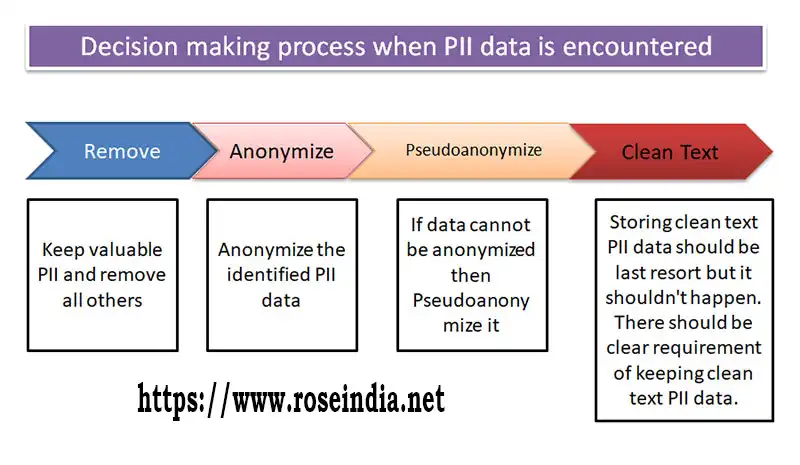
Here are the top reasons for proper handling of PII data in the organization:
1. Compliance with Laws and Regulations
There are strict laws imposed by Governments around the world to regulate the data collection, storage and use of personal data. All organizations must comply with these laws to avoid any lawsuit or any kind of business disruption in the country.
Organizations must comply with following laws:
- GDPR (General Data Protection Regulation) – This is application in European Union
- CCPA (California Consumer Privacy Act) – Applicable in United States
- HIPAA (Health Insurance Portability and Accountability Act) – This law is for U.S. healthcare sector
- PDPA (Personal Data Protection Act) – This law is specific to Singapore
- IT Rules (India 2021) – This rule is related to sensitive personal data
Organizations must comply with these rules and any failure can result in heavy penalties. For example, GDPR (in the European Union countries) violation penalties are very high and it can lead to fines of up to €20 million or 4% of annual global revenue. This fine is very high and every organization must comply with the various compliance laws and regulations.
2. Protecting Customer Trust and Brand Reputation
Organizations should respect customers' PII data and handle it very responsibly this will increase the trust and brand reputation. A single data breach can destroy the trust of the organization and many customers may leave the service. As per the 2023 Cisco survey, 81% of consumers said they would stop doing if a single data breach of PII data was reported. So, for companies handling PII data is a must and should be done it using modern technologies.
3. Preventing Identity Theft and Financial Fraud
Cybercriminals could use the PII to chest customers. With the help of compromised data, attackers can:
- Open bank accounts
- Apply for loans
- File fraudulent tax returns
- Commit social engineering attacks
So, PII data is very important and it should be handled properly. PII data breach harms the individuals and it also make the breached organization legally liable.
4. Avoiding Legal Action and Class-Action Lawsuits
Data privacy violations make organisations legally liable and it may lead to lawsuits from individuals or regulatory bodies. The cost of handling such legal cases are very high especially small and medium-sized enterprises.
5. Maintaining Competitive Advantage
With proper PII handling organizations can demonstrate maturity in data governance and can act as a competitive differentiator. PII data handling is very crucial in the In industries like fintech, healthcare, or edtech. Companies should maintain compliance and secure PII data to win the trust of customers and drive more business growth.
Mishandling PII can have severe repercussions and it may lead to Legal Risks, Reputation Damage, Financial Costs and Operational Disruption. So PII data is a liability if not handled properly by the organization.
3. Common Types of PII in Modern Data Pipelines
In the world of Big Data and Internet, and applications like digital platforms and cloud-native data infrastructure, PII is generated fast and companies are collecting these. Here is the list of various PII data types:
| Source | Type of PII |
| Web Logs | IP address, browser fingerprint |
| CRM Systems | Name, email, contact number |
| Financial Systems | Card number, billing address |
| Healthcare Systems | Patient ID, diagnosis, insurance number |
| Mobile Apps | Device ID, GPS coordinates |
| Customer Support | Email transcripts, call recordings |
4. Key Challenges in Handling PII Data
Handling PII data is not easy due to its distribution among different types of data and high volume of data. There are many reasons that makes handling PII correctly a complex task:
- Volume & Velocity: These days companies are acquiring data from many sources at high speed which makes real-time detection and protection a difficult work.
- Schema Evolution: Due to schema evolution new data formats are coming to the system and tracking those new fields for PII data becomes hard.
- Shadow PII: Many companies are ingesting logs or unstructured data such as pdf, images etc. In such cases PII data might be hidden inside logs or unstructured files like PDFs or emails or images or document files.
- Access Control Drift: Over time, users or systems gain access they shouldn’t have.
- Third-Party Sharing: Many companies are sharing data to third parties which makes PII data protection harder and shared data might contain PII data (which was undetected).
5. Strategies to Handle PII Data
Now we will learn the Strategies to Handle PII Data: A Comprehensive Guide. PII data is very valuable and most sensitive for the organization. As explained above PII data includes names, addresses, phone numbers, national identification numbers, location data, any Govt ID card number, biometric data and financial or health records. In this section we will understand the strategies to handle such data. Organisations collecting PII data must protect these data.
a. Data Discovery and Classification
The first step in strategizing PII data handling is to discover and classify organization data. Next we have to understand and classify the PII data under appropriate categories. Organisations must know and document the places where their data resides.
Best Practices:
- Conduct data discovery using automated tools to scan structured and unstructured systems.
- Classify data based on its sensitivity (e.g., public, internal, confidential, restricted).
- Maintain a data inventory or data map documenting data sources, owners, and storage locations.
Why it matters:
A clear understanding of data flows helps in applying appropriate security controls and meeting compliance requirements.
b. Data Minimization
One of the fundamental principles of data privacy is minimization. You should only collect necessary data. If you have less data then you will have to manage less.
Best Practices:
- Limit the collection of PII and just limit to the essential data necessary for business or legal needs.
- You should avoid storing redundant or obsolete data. Un-necessary or obsolete data should be purged from the system.
- Reviewing and de-identify or anonymizing data is a very important strategy, you should do a full identification of unnecessary data and anonymize.
Why it matters:
Less PII means less risk exposure in the event of a breach and if you have more data then there is huge risk in case of data breach.
c. Encryption and Secure Storage
The next step is protection of data and it is achieved through encrypting the PII data both at rest and in transit. This helps in preventing unauthorized access of data.
Best Practices:
- To encrypt the stored data use strong protocols such as AES-256.
- The TLS (Transport Layer Security) should be used for securing in-transit data.
- There should be implementation of role-based access control (RBAC) for access of stored data.
Why it matters:
Data should be always encrypted and even if data is stolen no one should be able to decrypt the data without attackers keys.
d. Access Control and Authentication
You should implement proper access control and authentication for PII information collected by your applications. You should implement a least access privileges strategy and provide data access to only authorized individuals who require it for legitimate purposes.
Best Practices:
- Enforce least privilege access—You should implement the least privileges access policy in your organisation. New users should be created with least privilege.
- Use multi-factor authentication (MFA) for accessing sensitive data systems and this is very important to add one layer of security.
- It is necessary to regularly review and audit user access levels and privileges through your application.
Why it matters:
This is important as most data breaches occur due to internal misconfigurations or human error, not external hackers.
Other important strategies are:
- Data Masking and Tokenization
- Compliance with Privacy Regulations
- Privacy by Design and Default
- Secure Data Disposal and Retention
- Employee Training and Awareness
- Monitoring, Auditing, and Incident Response
- Vendor and Third-Party Risk Management
6. Regulatory and Compliance Considerations
There are different data privacy laws across countries and the world, depending on your location you should implement your system to comply with Law/Framework. Here's a quick overview:
| Law/Framework | Region | Key Requirements |
| GDPR | EU | Data minimization, Right to erasure, Consent |
| CCPA | California, USA | Opt-out rights, Transparency, Access to records |
| HIPAA | USA (Healthcare) | Protection of health information |
| PCI-DSS | Global (Financial) | Secure storage of cardholder data |
| DPDP | India | Purpose limitation, Data localization |
Actionable Tip: Build your pipeline with privacy by design to make compliance easier later.
07. PII Handling Best Practices
Here are the best practices of handling the PII data in the organization. Here are some field-tested practices to follow:
- Shift Left: You should detect and sanitize PII during ingestion or transformation and not after exposure.
- Data Contracts: Use should use contracts to enforce data schema rules for sensitive fields.
- Documentation: A well maintain a live data catalog with classifications is very important for managing PII data efficiently.
- Test PII Handling: Develop well defined framework for automated testing and validation of masking and access control.
- Run Drills: Work well for test simulation and simulate PII leak scenarios to ensure your response plan is robust.
8. Technologies and Tools for PII Handling
Now we will look into various tools and technologies used for PII handling in the organizations. These are the exhaustive list:
| Category | Tools/Frameworks |
| Discovery | AWS Macie, Azure Purview, GCP DLP |
| Masking/Tokenizing | DBT, Protegrity, custom Spark/Python |
| Encryption | AWS KMS, Azure Key Vault, HashiCorp Vault |
| Access Control | IAM, Apache Ranger, Unity Catalog |
| Monitoring | Splunk, Datadog, ELK Stack |
| Auditing | Snowflake Access History, Audit Logs |
| Data Lineage | Apache Atlas, Amundsen, Collibra |
You should use these tools for proper handling of PII data in your data pipeline.
19. Real-World PII Handling Workflow
Here is the final once of the best architectural workflow for real-world handling of PII data at scale. Here is the workflow of PII handling process.

Let’s put it all together with an example architecture:
2Example Workflow: Customer Support Data Pipeline
- Ingest: For the data ingestion customer support loads the data using APIs on the Amazon S3.
- Detect PII: Then detection of PII data begins for example AWS Macie scans text data for emails, phone numbers, and account info.
- Transform: During the transformation process the ingestion jobs such as DBT jobs mask phone numbers and tokenize customer IDs.
- Store: Final data is stored on the dataware house for example Data lands in Snowflake with encrypted storage.
- Access: For data access RBAC is used for example analysts get access via views with RBAC restrictions. No raw PII data is accessible to anyone.
- Audit: Audit setup is very important for example access logs flow into CloudWatch and alert on unexpected queries.
- Retention: As per the retention policy the PII data gets deleted for example raw PII data auto-deletes from S3 after 30 days.
In this section we have discussed the strategy and importance of handling PII data in the organisation. We have also seen the tools and technologies which can be used for handling the PII data in the organization.
10. Conclusion
Handling PII data is very important for the organization and it should be handled well and start from the beginning of data ingestion. In this section we explored it in very detail and provided you with the list of technologies which are being used while developing modern data platforms.
PII data handling is an on-going process and requires constant monitoring of the pipeline for proper discovery, prevention, compliance and vigilance. You should build every component keeping security and privacy in mind.
3