
Search Tutorials
--Ads--What Is a Forward Deployed Engineer and How to Become One?
Companies at the frontier of the AI race know the deployment challenges that kept many promising prototypes from reaching production. Since AI solutions are highly resource-consuming, most of the companies of the early-stage AI revolution focused on hiring engineers who can take responsibility for the entire product life cycle, from development to deployment in the actual production environment. This is how a new job position has emerged, which we refer to as Forward Deployed Engineer (FDE). AI companies like Palantir played a major role in evolving this role.
Since 2025, the demand for Forward Deployed Engineers has been constantly increasing, and the title is reported to be one of the highest-paid engineering job roles in the industry. This short guide will explain the roles and responsibilities of forward deployed engineers, the key reasons behind their demand, and the path to a successful FDE career.
What Does a Forward Deployed Engineer (FDE) Actually Do?
A Forward Deployed Engineer (FDE) works closely with the in-house team of the client organization, often at their premises. The FDE takes end-to-end product life-cycle responsibilities, from scoping, architecture design, actual build and configuration, deploying in the production environment, and post-deployment support.
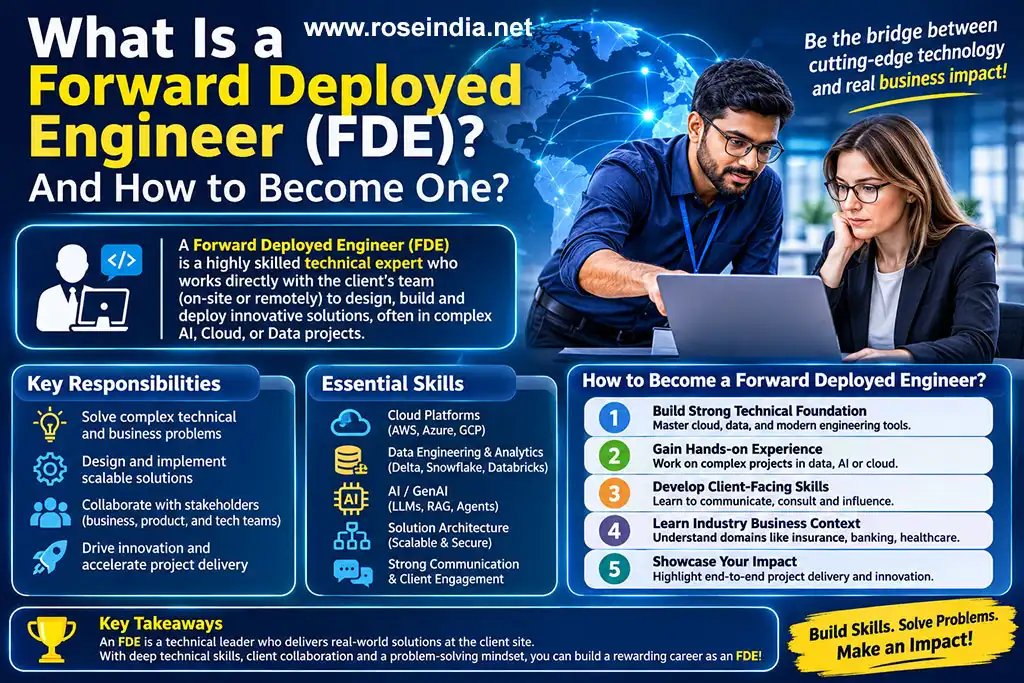
Being responsible for last-mile product deployment and support is what makes FDEs different from other adjacent roles. A typical software engineer only builds a product with the broader use case in mind and creates a prototype that may or may not cater to the actual production environment requirements. On the other hand, the responsibilities of a Sales Engineer or Solutions Architect end with solution scoping and providing some recommendations for actual deployment.
In sharp contrast, an FDE neither stops at scoping a product nor writing actual build code. FDEs decide the product scope based on the client environment, write the actual code, integrate the solution with existing client systems and databases, address the industry-specific compliance and security requirements, run the product in the client environment, troubleshoot problems, and take responsibility for the final post-deployment output.
Where the FDE Role Came From?
More than a decade ago, Palantir introduced this role when the company decided to let its engineers work closely with the client teams to address integration and deployment problems. Despite sitting on a hill of unfulfilled solution prototypes and PoCs, most of which couldn’t see the light of day because of deployment challenges in actual production environments, the industry mostly ignored the importance of such an end-to-end role. But the impressive ROI impact of this approach soon became a lesson for many organizations.
No wonder, cost-intensive large AI companies became the initial flag bearers of this approach. From OpenAI, Anthropic, Databricks, AWS, to Microsoft, all focused on developing their forward deployment engineering capabilities. Some flagship LLM providers, including OpenAI, even started to venture into separate deployment businesses built around the concept of forward-deployed engineering. Anthropic started a joint venture to help Fintech clients by embedding FDEs in their core team.
Decoding the Factors Behind Explosive Demand for FDEs
The demand for FDEs is not going to slow down in the years to come simply because they can bridge the gap between what a model technically can do and what it needs to work in a specific environment. The basic reason behind the overwhelming demand for FDEs is too obvious. As a huge chunk of enterprise AI projects fail because of either poor scoping, integration failure, or other deployment issues, getting an expert to account for the entire cycle, from pilot to production deployment, is a life-saver for AI companies and investors who rally behind multi-million AI projects.
The second reason comes in relation to the first reason we described above. Since enterprise AI adoption is accelerating at a breakneck speed, often the most overlooked areas, such as compliance, security layer issues, and poor evaluation frameworks, cause serious post-deployment troubles within months, if not immediately. FDEs being accountable for evolving compliance, infrastructure, and security challenges play a key role in maintaining sustainability and scalability.
Who's Hiring FDEs, and What Do They Get Paid?
| Company | Typical Total Compensation |
| Palantir | ~215K total (median) |
| OpenAI | 550K (mid-to-senior); $1M+ at principal level |
| Anthropic | 1.2M, depending on level |
| Google Cloud | 183K base + equity |
Apart from the leading AI companies mentioned above, a long list of promising and well-funded AI startups are hiring forward deployed engineers, often under different job titles. From Databricks, Scale AI, Salesforce, to Ramp, the list goes on. Some of the similar job titles that practically refer to the same job responsibilities of an FDE include Applied AI Engineer, Deployment Engineer, and Customer-Facing Engineer. As FDEs need to work often as an embedded professional within the client team, client-site posting or frequent travel to the client site is part of the expectations for an FDE. As of now, fully remote FDE positions are extremely scarce.
Skills You Need to Become an FDE
Forward deployed engineers (FDEs) need multifaceted technical and business communication skills.
Technical skills
An aspiring forward deployed engineer should have a well-rounded foundation in software engineering. Core technical skills include the following:
- Full-stack development fundamentals
- Data pipelines and system integration
- Cloud integration fundamentals
- QA fundamentals
- Test suite writing skills to detect model hallucinations and regressions
- Model training and fine-tuning fundamentals
Business communication skills
Since the FDE is a client-facing role involving close collaboration with project stakeholders and the in-house team, having sound business communication skills is a must. Core skills include:
- Business requirement analysis and scoping
- Defending and explaining technical decisions to non-technical stakeholders
- Composure in the face of adverse output
Openness to Travel
As a customer-facing role, an FDE often needs to work on customer sites and travel frequently. So, openness to travel is a necessary criterion for an FDE.
A Practical Step-by-Step Path to Become a Forward Deployed Engineer
Now, to shape your career to become a successful forward deployed engineer, follow a step-by-step skill development path followed by some necessary steps to position yourself in the job market. Here are the steps.
Uncompromising engineering fundamentals
This is a technically demanding role involving problem-solving in real production environments. So, having top-notch credentials in computer science and software engineering is a must.
Hands-on evaluation testing experience for AI systems
An FDE needs to detect model hallucinations or drifts before they spiral through the system during deployment. So, a solid first-hand experience in writing test scripts for models is absolutely needed.
Have early exposure to customer-facing roles
Even before applying for an FDE job title formally, try to have good exposure to customer-facing technical roles like Internships, support, or solution engineer. Your acumen in these roles will be tested in future FDE interviews.
Build a portfolio of deployed projects in real environments
An FDE is never examined by the prototypes he built, because the whole point is to prove how you ensure smooth deployment in an actual production environment. So, build a portfolio of shipped projects before your first FDE interview.
Go for companies with the highest FDE opportunities.
When you are confident with your skills, portfolio, and exposure, reach out to companies with the highest employment opportunities for forward deployed engineers (FDEs). Apply to FDE or similar roles in Palantir, OpenAI, Anthropic, Google Cloud, AWS, Microsoft, Databricks, and Scale AI.
Prepare for interviews focusing on real case studies
Most FDE interviews ask you to explain with a real case study to understand how you approached a problem with a concrete technical roadmap and executed it. So, prepare for interviews focusing on similar customer-facing projects you have worked on.
Gain exposure through an adjacent role.
Likely, you are not getting a direct FDE offer immediately. It is better to consider adjacent roles with similar customer-facing exposure in the beginning. Such exposure will slowly groom you for a FDE position within a year or two.
Ending Notes
Just as with every highly demanded and rewarding job title, the FDE job pressure and expectations are also incredibly high. An FDE having end-to-end responsibilities needs to cope with customer expectations. If anything breaks during deployment, any integration fails, or there is any instance of model hallucination, it can evoke criticism. An FDE needs to remain calm when facing such intermittent failures, explain the reasons convincingly to the non-technical stakeholders, and address the issues with a clear plan.
Related: