How to Fix java.lang.NullPointerException in Java – An Advanced, In-Depth Guide
This exception is known as NPE for short in Java programming and its most annoying error in Java. Your program complies correctly and in run-time it exits with this error. So, learn in depth about the errors in programming language. This is the type of exception that happens in runtime and known as Java run-time exceptions. This exception is thrown by JVM at runtime, in this post we will explore the reason for this error and learn how to avoid such errors in our program..
The java.lang.NullPointerException (NPE) is arguably the most infamous runtime exception in the Java ecosystem. It has been a part of Java since its earliest versions and continues to be one of the most common causes of application failures—even in modern Java applications built with Spring Boot, Hibernate, Microservices, and cloud-native architectures. So, this exception is affecting a wide type of applications and as a developer you must understand this exception in detail.
Despite Java’s maturity, NullPointerException remains a persistent challenge because it is deeply tied to object references, memory allocation, API design, and developer discipline. So, it's necessary for the programmer to understand this exception and develop programs in such a way that it is handled well in the program.
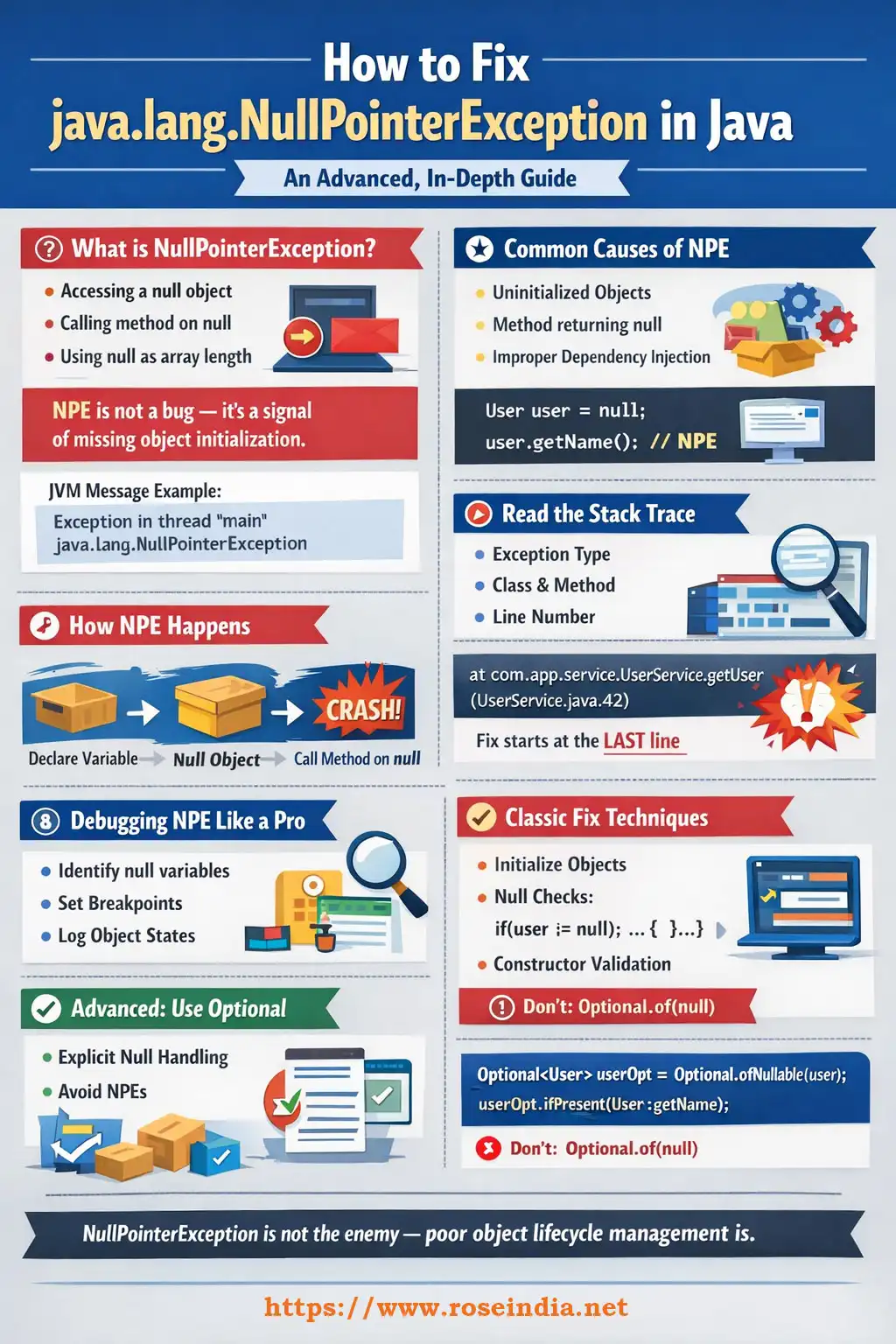
You understand and learn to develop your program free from this exception. This article provides a complete, advanced, and production-oriented deep dive into:
- What NullPointerException really means at the JVM level
- All possible real-world causes of NPE
- How to debug it effectively in enterprise applications
- Modern Java patterns to eliminate NPEs
- Spring Boot, Hibernate, REST API, and Microservices examples
- Testing, tooling, and architectural strategies to prevent NPE permanently
This is not just a “fix the error” guide—it is a masterclass on null safety in Java.
1. Understanding null in Java at a Fundamental Level
Now we will explain this error and you should understand the causes of this error well. First understand null in Java programming language.
1.1 What Is null?
In Java, null is a literal that represents the absence of an object reference.
Key facts:
- null is not an object
- null does not occupy heap memory
- It means the reference variable does not point to any object
Example:
String str = null;
Here:
- str exists in stack memory
- It does not reference any object in the heap
1.2 Why Java Allows null
Java allows null for several historical and design reasons:
- Backward compatibility
- Representing missing or optional data
- Interfacing with databases, files, and external systems
- Simplifying object lifecycle management
However, this flexibility comes at a cost—runtime errors instead of compile-time safety.
2. What Is java.lang.NullPointerException?
A NullPointerException occurs when the JVM attempts to:
- Access a method
- Access a field
- Perform unboxing
- Synchronize
- Throw
- Access array length
on a reference that is null.
Example:
Object obj = null;
obj.toString(); // NPE
At runtime, the JVM throws:
java.lang.NullPointerException
3. How the JVM Detects a NullPointerException
At the bytecode level, method calls like:
obj.method()
translate into:
invokevirtual
Before executing this instruction, the JVM checks:
- Does the reference point to a valid object?
If not:
- JVM throws NullPointerException
- Execution stops immediately
This check happens at runtime, which is why NPE is not caught at compile time. JVM performs this check at the runtime and that’s why this error is not reported at compile time.
4. Common Causes of NullPointerException (Advanced Scenarios)
Here we will now explain the causes of this error with the help of example code.
4.1 Calling Methods on Null References
User user = null;
user.getName();
0Root cause:
- Object was never instantiated
- Object creation failed
- Dependency injection failed
4.2 Accessing Fields of Null Objects
employee.department.name;
If employee or department is null → NPE.
14.3 Uninitialized Collections
List<String> list;
list.add("Java"); // NPE
Common in DTOs and entities.
2Best practice:
List<String> list = new ArrayList<>();
4.4 Null Returned from DAO / Repository Layer
User user = userRepository.findById(id);
3user.getEmail(); // NPE
Databases are one of the largest sources of null values.
4.5 Auto-Unboxing Pitfalls
Integer count = null;
4int total = count; // NPE
Java tries to convert Integer to int, triggering NPE.
4.6 Arrays and Null References
int[] arr = null;
5System.out.println(arr.length);
4.7 Chained Method Calls (Fluent APIs)
order.getCustomer().getAddress().getCity();
One null breaks the entire chain.
64.8 Equals Method on Null
String value = null;
if (value.equals("JAVA")) { } // NPE
Safe alternative:
7"JAVA".equals(value);
4.9 switch with Null
String type = null;
switch (type) { } // NPE
84.10 Synchronization on Null
Object lock = null;
synchronized (lock) { } // NPE
5. Real-World NPEs in Enterprise Applications
5.1 Spring Boot Dependency Injection Failures
@Autowired
9private UserService userService;
If:
- Component scan fails
- Bean creation fails
→ userService becomes null.
0Solution:
- Constructor injection (preferred)
@RequiredArgsConstructor
@Service
1public class UserController {
private final UserService userService;
}
25.2 REST API Request Body Issues
@PostMapping("/users")
public void createUser(@RequestBody User user) {
3user.getName(); // NPE if request body is empty
}
Fix:
4- Validation
- @NotNull
- @Valid
5.3 Hibernate & JPA Lazy Loading
user.getOrders().size();
If:
- Session is closed
- Relationship not initialized
→ NPE or LazyInitializationException
55.4 Configuration & Environment Variables
String apiKey = System.getenv("API_KEY");
apiKey.length(); // NPE
6. Debugging NullPointerException Like a Professional
6.1 Reading Stack Traces Properly
Exception in thread "main" java.lang.NullPointerException
6at com.app.service.UserService.getUser(UserService.java:45)
Always start at:
- The top-most application line
- Not inside Java internal classes
6.2 IDE Debugging Techniques
- Breakpoints before suspected line - You can set breakpoint at the suspected line and run the program in debug mode.
- Inspect variables - Check how variables are created and its values are assigned
- Evaluate expressions
- Step into method calls
6.3 Logging for Null Analysis
log.debug("User object: {}", user);
77. Defensive Programming to Prevent NPE
7.1 Input Validation
public void process(User user) {
if (user == null) {
    throw new IllegalArgumentException("User must not be null");
}
}
7.2 Fail-Fast Using Objects.requireNonNull
this.user = Objects.requireNonNull(user, "User cannot be null");
7.3 Avoid Returning Null from Methods
Bad:
return null;
8Better:
return Optional.empty();
8. Using Optional Correctly (Advanced)
8.1 Why Optional Exists
- Makes null explicit
- Forces developers to handle absence
- Improves API design
8.2 Correct Usage
Optional<User> userOpt = userRepository.findById(id);
9userOpt.ifPresent(user -> System.out.println(user.getEmail()));
8.3 Common Optional Misuse
❌ optional.get(); // unsafe
❌ Optional<User> user = null; // defeats purpose
09. Null Safety in Modern Java (Java 8–21)
9.1 Stream API Null Issues
list.stream()
.map(User::getName)
.map(String::toUpperCase)
1If getName() returns null → NPE.
Fix:
.filter(Objects::nonNull)
29.2 Records and Null Constraints
Java Records do not prevent null by default.
record User(String name) { }
You must validate manually.
310. Testing Strategies to Catch NPE Early
10.1 Unit Testing with Edge Cases
@Test
void shouldHandleNullUser() {
  assertThrows(IllegalArgumentException.class,() -> service.process(null));
}
10.2 Integration Tests
- Validate API payloads
- Test empty DB results
- Validate config properties
11. Static Analysis Tools for Null Detection
- SpotBugs
- SonarQube
- IntelliJ Nullability Annotations
- Checker Framework
Example:
@NotNull
String getName();
12. Architectural Principles to Eliminate NPE
12.1 Null Object Pattern
class EmptyUser extends User {
  @Override
  public String getName() {
    return "";
  }
}
12.2 Immutable Objects
- Less state mutation
- Predictable behavior
- Fewer null transitions
12.3 Boundary Null Checks
Only allow null:
- At system boundaries
- Never deep inside core logic
13. NPE in Microservices & Distributed Systems
Common causes:
4- Missing fields in JSON
- Backward incompatible APIs
- Partial responses
- Timeout fallbacks returning null
Solution:
- Schema validation
- Versioned APIs
- Circuit breakers
14. Real-World Service Layer Example
Problem:
public String getUserEmail(Long id) {
    return userRepository.findById(id).getEmail();
}
Solution:
public String getUserEmail(Long id) {
return userRepository.findById(id)
   .map(User::getEmail)
   .orElse("Email not found");
}
15. Conclusion: Mastering NullPointerException
The java.lang.NullPointerException is not just an error—it is a design signal. It tells you:
- Where assumptions are wrong
- Where contracts are unclear
- Where APIs are poorly designed
By mastering:
5- Null-safe coding
- Defensive programming
- Optional usage
- Testing and tooling
- Clean architecture
By following the methods given here you can nearly eliminate NPEs from your Java applications—even at enterprise scale.
Related Tutorials:
- What Is an Exception
- Exception Classes
- Catching and Handling Exceptions
- List of Java Exceptions
- Exception Handling in Java with try catch
- Java Exception Class Hierarchy Diagram
- Class Cast Exception Example in Java
- Exception handling in Java
- Java Exception Handling Examples
- Logging an Exception in Java
- What are Chained Exceptions?
- Java Tutorials