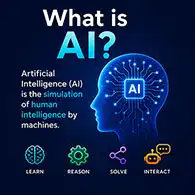
What is AI? AI Explained: From Core Concepts to Real-World Applications
Welcome to our comprehensive tutorial on AI which covers everything a beginner should know about AI. In this tutorial we are describing Artificial Intelligence in detail, so that even a beginner can understand AI very well. After completing this article we hope you will have a thorough understanding of AI and its use cases.
Table of Contents:
- Introduction
- History of AI: How did we get here?
- Definition of Artificial Intelligence (AI)
- Working of AI: How Does It Work?
- Types of Artificial Intelligence
- What is Machine Learning?
- Types of Machine Learning
- What is Deep Learning?
- What are Neural Networks?
- What is Natural Language Processing (NLP)?
- What is Computer Vision?
- Real-World Applications of AI
- Benefits of Artificial Intelligence
- Challenges and Limitations of AI
- Comparison: AI vs ML vs Deep Learning
- What is Generative AI?
- What Programming Languages are Used in AI?
- Future of Artificial Intelligence
- Will AI Replace Humans?
- Common Myths About AI
Let's get started with the exciting world of Artificial Intelligence (AI).

Introduction:
AI is a field of computer science which deals with development of programs and software systems capable of performing tasks which usually require human intelligence.
AI(Artificial intelligence) plays a key role in today's world, almost all industries whether technical or non-technical, have started to integrate AI in their work space to ease achieving goals. AI is not just limited to LLM(Large Language Model) powered models like ChatGPT , Gemini , Claude, Grok etc. It has been in use for many decades, like its use in Tiktok/ Instagram/ Youtube etc..(suggests videos according to the users activity), spotify(suggests songs by analysing users playlist, music taste through platform activity, it also creates a playlist based on different genres and hones it as per user’s taste) etc.
There are limitless AI applications which indicates that learning and applying AI is not a difficult task like many people think. It is obvious that all these AIs are trained differently and are also categorised differently, so let us explore all the AI basics and learn all the possible applications and categories these AI models are based on.
History of AI: How did we get here?
The phrase “Artificial intelligence” officially emerged from the Dartmouth Summer Research Project on Artificial Intelligence in 1956. It all started when Alex Turing , a British mathematician , questioned the idea of whether machines can think or not. This idea led him to create the “Turing test” (a way to see if a computer can pass for a human in conversation).
In late 1970-1980s, experts who tried to work on artificial intelligence suffered problems due to poor storage capacity and low processing power of machines. These reasons halted development of AI. But in 1997, IBM’s Deep Blue model sparked the development when it defeated the world champion of chess, Garry Kasparov, which proved that machines could master complex, rule based logic.
Now due to powerful processing power and huge data storage capacity, AI development is on full pace with multiple industries trying to unlock the full potential of Artificial intelligence.
AI models run on huge amounts of data (“Big Data”) which is now available due to existence of internet, and huge processing power allows “Deep Learning” to flourish which directly leads to development of complex and advanced tools/models like ChatGPT, self driving cars, computer vision(field of AI which lets machines recognise visual data like images and videos, and make sense out of it).
Definition of Artificial Intelligence (AI)
The branch of computer science which involves the study of developing Machines or models which are capable of doing tasks which require human intelligence is known as Artificial intelligence.
Just like any human , AI can be specialised to work by combining several technologies like:
- Deep Learning
- Natural Language Processing (NLP)
- Computer Vision
- Robotics
- Neural Networks
- Machine Learning (ML)
- Robotics
- Neural Networks
Working of AI: How Does It Work?
AI operates by processing big data, identifying patterns within the data set and carrying out the assigned objective.
An AI workflow generally consists of the following stages:
1. Data Collection
Just like we humans rely on books and tutorials for learning , similarly AI systems require data to learn. This data can be of various types such as:
- Visual content like - Images and videos
- Examples of Text like - Written documents , scripts and speech transcripts
- Audio files like - sound files , speech and spoken languages
- Numerical values like - Numerical data and statistics
- User behavior like - Online activity and social interactions.
2. Data Processing
In this process, data collected is organised and cleaned so that the AI model can understand it and try to observe patterns within the data after training.
3. Training the Model
An AI model requires training using a specific set of algorithms which yield a model capable of learning patterns from data.
4. Making Predictions
After proper training of an AI system , it becomes capable of executing various tasks like:
- Predicting outcomes
- Classifying objects
- Answering questions
- Generating content
5. Continuous Learning
Modern ai systems are capable of learning continuously and improve their output as they receive more data . Moreover, AI systems are capable of learning through their mistakes. This is possible through the techniques of machine learning like reinforcement learning.
As we have learnt about the basic functioning of AI systems , let us now learn about the types of AI:
Types of Artificial Intelligence
AI systems are categorized into different types based on their capabilities and functionality.
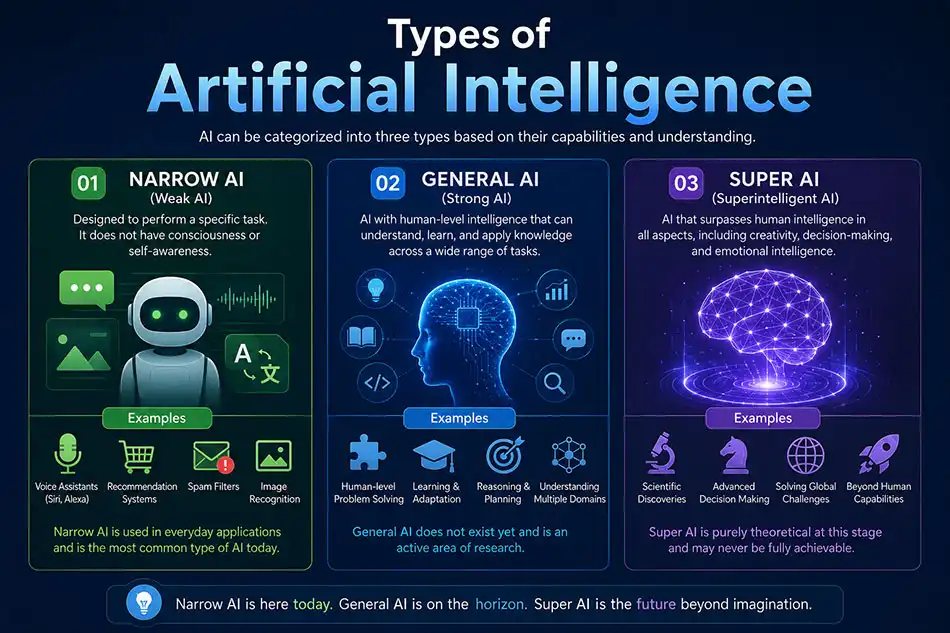
Now let us learn about these different categories of AI:
Types of AI Based on Capability
1. Narrow AI (Weak AI) or ANI ( Artificial Narrow intelligence)
AI systems which are only capable of performing certain specific tasks are classified as Narrow AI (weak AI).
Narrow AI is only designed for performing specific tasks, such examples of Narrow AI are:
- Voice assistants like Siri
- Recommendation systems in applications like spotify, youtube etc.
- Chatbots like Starbucks barista bot, Domino’s pizza bot etc.
- Facial recognition
Most AI applications today are Narrow AI.
Most common and well known examples of Narrow AI are:
- Google Assistant
- Siri
- ChatGPT, Gemini, Grok etc.
2. General AI (Strong AI) or AGI (Artificial General Intelligence)
General AI systems are much more capable than any Narrow AI system. These AI systems are capable of performing any intellectual task a human can do.
However, this level of AI does not yet exist.
3. Super AI
This level of AI is a hypothetical one. In theory it can even surpass human intelligence which indeed can be dangerous.
0Many experts believe Super AI is still far in the future.
Types of AI Based on Functionality
1. Reactive Machines
The most fundamental type of AI which only reacts in the current situation and does not hold any memory. In simple words we can say that these AI models only react using specific types of algorithms and steps which are fed into it during the training phase.
These AI systems do not hold the ability of learning through mistakes or continuous learning.
1For Example:
- IBM’s Deep Blue chess computer. This model only gave output based on its training phase.
2. Limited Memory AI
AI systems which can temporarily store information and act using that information. Although this information is only for short and quick responses and is inapplicable after a long time and cannot build personal or new permanent experiences.
Example:
2- Self-driving cars
3. Theory of Mind AI
This complex and hypothetical AI possesses mental states such as desires, intent, beliefs, emotions is currently under research and most likely far in the future
4. Self-Aware AI
This is the most advanced stage any AI can achieve, it is completely hypothetical as of now and very far in the future. This type of AI system has highly advanced thinking, consciousness and self-awareness.
This is the most advanced theoretical AI with consciousness and self-awareness.
3Such AI does not currently exist.
What is Machine Learning?
Machine learning (ML) is a subset of AI that allows developers to train AI models by only data and skip the part of detailed rules and intense complicated programmes.
Instead of writing detailed rules, developers train machines using examples.
4Example
If you want an AI system to identify cats in images:
- You provide thousands of cat images
- The AI learns patterns
- It eventually recognizes cats automatically
From this example we can conclude that machine learning makes training of AI models convenient and fairly less complicated. All we need is proper data and appropriate examples.
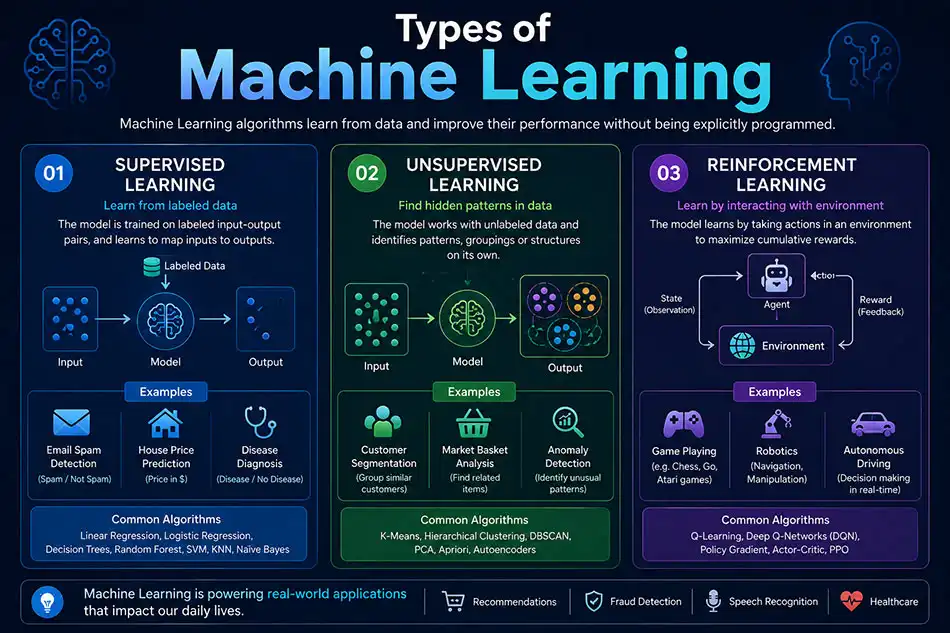
Types of Machine Learning
1. Supervised Learning
In this learning stage, the input provided to the model is provided with answers as well so that the model learns mapping of input with correct answers quickly.
The model learns using labeled data.
Examples
- Spam email detection
- House price prediction
2. Unsupervised Learning
The model finds patterns based on algorithms in an unlabeled data (data without answers).
6The model finds its ways based on the algorithms it has been developed upon, to identify patterns out of an unlabeled data without any human help.
Examples
- Customer segmentation
- Recommendation systems
3. Reinforcement Learning
The model is trained on a reward and penalty based system.
The AI is rewarded for correct answers and given a penalty/punishment for incorrect answers, therefore to maximes it success scores and accuracy, the AI learns and adapts flexibly and the models achieves higher, efficient and correct output value.
7This technique also allows models to learn through their mistakes and provide a valuable output after each failure.
Examples
- Game-playing AI
- Robotics
What is Deep Learning?
Deep learning is an advanced and Specialised branch of machine learning that uses “Neural networks” which mimics the learning pattern of a human brain which allows AI models to think more efficiently rather than following a specific predefined set of rules and algorithms.
Deep learning allows a model to identify complex patterns out of a huge set of data.
8Deep Learning is responsible for many recent AI breakthroughs, including:
- Speech recognition
- Image generation
- Autonomous vehicles
- Language translation
What are Neural Networks?
A Neural network is a specialised machine learning model which mimics the processing of the human brain; it consists of interconnected nodes (neurons) arranged in layers. It enables an AI model for solving and identifying complex patterns with multiple trials ensuring a complete and feasible output.
Integrating neural networks helps make faster and better decision making ability without the need of explicit step-by-step programming.
9Neural networks consist of 3 layers, working of these layers are as follows:
Main Components of Neural Networks
- Input Layer: The entry point of the network, acts as a foundation of the network. This layer only acquires raw data like images, videos, text, speech etc.
It just passes the data forward to the hidden layers, where each neuron represents a variable.
Also, it does zero processing of the data.
- Hidden Layers: These hidden layers act as the network’s analytical engine of the network, these layers are responsible for extracting patterns, logic, useful information etc. from the Data.
It does so by multiplying the data with weights, applying activation functions and adding biases. It does all the work necessary to identify patterns and extract information.
0The more complex data is, the more hidden layers are required to process information efficiently and easily.
A “deep” network comprises multiple hidden layers.
- Output Layer: It is the final layer of the neural network, it delivers the final desired output of the network. It translates the output of the hidden layers into a representable and desired format.
AI systems rely heavily on Neural networks as it helps AI to:
1- Detect patterns from Data
- Recognize speech
- Process images
- Understand language
What is Natural Language Processing (NLP)?
As we know human speech is quite complex because it isn’t just words compiled together to create sentences, it is heavily context dependent and contains idioms. This speech is all messy for a machine to understand. Therefore computers cannot comprehend human speech.
For machines to understand human speech, humans have developed a process called Natural language processing (NLP).
Natural language processing enables machines to understand and communicate in human language.
2HOW DOES NLP WORK?
An NLP Pipeline transforms unstructured text into structured data, in a pattern such that it is easy for machines to understand a sentence.
It simplifies text by removing the punctuations, separating words from sentences and engineering features that machines learning models can read.
3After processing of data, machines are able to analyse sentiments, context, meaning and can generate output of human text.
Only because of NLP, machines are able to communicate in human text and understand it.
NLP powers many technologies such as:
4- Chatbots like:
- ChatGPT (OpenAI)
- Gemini (Google)
- Claude (Anthropic)
- Language translators like:
- Google translate
- Duolingo
- Voice assistants like:
- Siri (Apple)
- Alexa (Amazon)
- AI writing tools like:
- Grammarly
- Jasper AI
- Copy.ai
What is Computer Vision?
Computer vision (CV) is a branch of Artificial intelligence (AI) which enables machines to interpret meaningful information from visual data like photos, videos etc. Human vision allows us to easily distinguish objects based upon patterns and colors, but for machines, it is a whole new complex task. Machines see visual data as a grid of numerous pixels labelled with their color code.
To make sense of these numbers, computer vision relies on machine learning and neural networks (CNNs i.e Convolutional neural networks).
How does Computer Vision work?
5Establishing a model with computer vision takes 3 steps:
- Data Feeding: The system is fed with millions of images and videos about an object, for example, photos and videos tagged “Car”.
- Pattern recognition: The system analyses the pixels to identify repeating patterns and traits like shapes, colors, color gradients etc.
- Model Training: Over time, the system recognises cars (or any other object we have trained it to remember), it can even recognise cars from images the model has never seen.
Applications of Computer vision includes.
- Facial recognition
- Medical imaging ( determines and classifies various tumors, cancer, stones etc in the field of radiology)
- Autonomous driving ( tesla etc)
- Security surveillance
Real-World Applications of AI
Now let us learn briefly about its day-to-day application which we usually ignore.
6AI in Healthcare
AI does not only help engineers or developers it also helps doctors and medical professionals by:
- Detecting diseases precisely and calculation of suitable drug doses
- Analyzing medical scans and estimating the sizes of various tumors, cancers etc. and also helps in detecting categories of fractures and injuries precisely (computer vision)
- Predicting patient outcomes
- Assisting surgeries
Example Uses
- Cancer detection
- Drug discovery
- Virtual health assistants for immediate diagnosis
AI in Finance
Many Banks and financial companies including government bodies use AI for:
- Fraud detection which helps people and banks to keep their money secure and safe
- Calculation of credit scores
- Trading analysis and predicting graphs
- It also helps providing customer support immediately even during off days
Therefore, AI helps improve security and automate financial services which enhances customer satisfaction.
7AI in Education
Another use of AI is seen in Educational platforms. Just like above examples, AI has multiple uses in Education too, like:
- Personalize learning which helps each student identify their weaknesses and strengths which helps in overall growth of a student.
- Recommending courses according to students’ interests and majors.
- Automate grading systems which help in quick result processing which helps students improve is less amount of time.
- Create smart tutoring systems which makes students understand complex topics fast.
Just as AI, AI-powered learning systems are becoming increasingly significant in educational systems.
AI in E-Commerce
AI also has multiple uses in online shopping platforms like amazon, flipkart,ebay etc. AI contributes for these platforms in the following ways by:
8- Recommending products to the customers on the basis of their budget and interests
- Analysing behaviour of customers to develop easy-to-use user interfaces, improve UI, feasible pricing, sales and deals, recommend product varieties etc
- Properly managing inventory which results in minimal errors
- Providing chatbots to users which helps them in many ways like, recommending products, brief analysis of products etc.
- Providing customer support to users who need it
Examples
- Amazon (Rufus as Chatbot)
- Flipkart
AI in Transportation
Nowadays, AI is also being used in transforming transportation by taking it to a new level through various innovations and tools. Some of these tools are:
- Use of AI in self-driving cars and autopilot mode in some airplanes.
- Predicting traffic and finding suitable routes
- Smart navigation systems
Example
- Tesla
AI in Entertainment
Recommendation of webseries, songs and videos has never been an easy job, therefore, a well trained AI model is required to present the form of entertainment a user wants. Everyone has a unique taste and no entertainment platform can provide its users with content they crave, therefore we can assume that a basic machine learning (ML) model cannot handle this job effectively. Therefore a well trained AI model is required in these kinds of entertainment platforms to provide their customers with content of their taste. These models feed on a user’s activity and preference of contents. It sometimes also uses location, time etc to match the interests of the user. AI also helps in targeting the user with advertisements which match the needs of users and grab their interests.
Examples
- Netflix
- Spotify
AI in Social Media
Just as entertainment, Social media also falls under the same category.
9Therefore AI is used for:
- Content recommendations
- Ad targeting
- Image recognition
- Spam detection
Examples
- Meta- Facebook, Instagram, Threads
- YouTube
- X (formerly Twitter)
- Snapchat
Benefits of Artificial Intelligence
As we have seen above, AI provides numerous benefits across industries. Now let us know its benefits quickly.
1. Automation
AI automates repetitive tasks, saving time and effort.
02. Faster Decision Making
AI processes huge amounts of data quickly.
3. Reduced Human Error
AI systems can improve accuracy in many tasks. It can also calculate better than an average human which minimises errors.
4. 24/7 Availability
AI-powered systems can work continuously without breaks. It makes 24/7 customer support more feasible and accurate.
15. Improved Customer Experience
Chatbots and recommendation systems in platforms of education and entertainment enhance user experiences.
6. Increased Productivity
Businesses use AI to improve operational efficiency. It helps in creating schedules, do the light work which consists mostly of fixed processes.
Challenges and Limitations of AI
Just like its advantages, building or using AI also has its own limitations and challenges.
2The challenges that come across for a developer while using or building the AI model are:
1. High Development Costs
Building advanced AI systems requires millions of dollars as an early investment.
2. Job Displacement
Rapid growth of AI has resulted in automation of low effort human jobs, which causes mass layoffs from companies and businesses.
33. Data Privacy Concerns
AI systems often require large amounts of user data to get trained. So much data is used for training, which develops concerns of privacy as many users' data is being used to train AI models.
4. Bias in AI Models
If an AI model is trained using biassed data, it can develop biassed thinking. AI can provide its users with answers bias for a community/race or any particular thing. This bias may cause some users to get uncomfortable or leave a bad review.
5. Lack of Human Creativity
AI lacks emotions and creativity, therefore an AI model cannot act upon ethics, empathy, morals etc. It can only give answers based upon its training. This lack of creativity often results in unsatisfactory answers and makes it hard to understand human emotions.
46. Security Risks
As AI systems are trained on huge amounts of data, it is always prone to cyber threats as any hacker or scammer can misuse a highly advanced AI system.
They can somehow enable AI to give answers unconditionally and unrestrictedly which can surely pose a threat to users, citizens and governments. This enables creation of deepfakes, fraud etc. which is a very serious threat and possibly the biggest flaw of powerful AI models.
Comparison: AI vs ML vs Deep Learning
We have heard these topics above many times, now let us properly distinguish between these topics and clear confusions, if any.
5Let us break down the differences:
| Tech Category | Key Characteristics |
| Artificial Intelligence | The field of computer science aimed to develop software capable of doing human tasks. |
| Machine Learning | A subset of AI, which helps the models to identify patterns and logic from provided data sets. |
| Deep Learning | A specific subset of ML which utilises neural networks which helps in processing complex information. |
What is Generative AI?
AI models specified in generation of contents quickly are classified as Generative AI.
It is undoubtedly the fastest growing category of AI model, it is a type of AI capable of generating new content through prompts given by any user.
6It can create:
- Articles
- Images
- Videos
- Programming code
- Audio
Generative AI models learn from existing content and generate new outputs. These models are highly advanced and extremely usable in today’s world.
We can clearly see application of NLP in these types of models, the prompts provided by the user to the model as input is understood by the model through NLP. Then the model does its work and provides the user with the output.
7Examples of Generative AI Tools
It is the most famous category of AI, let us know some examples of these tools:
AI Writing Tools
- ChatGPT (OpenAI)
- Jasper
- Claude
- Gemini
- Grok
- Grammarly
AI Image and video Generators
- Midjourney
- Adobe
- DALL-E
- Sora
- Gemini (Google)
- ChatGPT (OpenAI)
AI Coding Tools
- GitHub
- Microsoft co pilot
- Gemini (Google)
- Claude (Anthropic)
- ChatGPT (OpenAI)
What Programming Languages are Used in AI?
Just like any software, AI models are built fundamentally on programming languages only.
There isn't any specific programming language on which AI is built on, there are several of them. So now let's learn about of these examples and why are they chosen:
8Python (The Undisputed King)
Python is the most popular AI programming language because of these two reasons:
- Its simplicity, easy to understand syntax makes the code less fussy so that developers can focus on the AI problems. Also, it makes AI development viable for beginners.
- Its Ecosystem of libraries make it a wonderful choice for developers, for example, libraries like TensorFlow or PyTorch (used for deep learning), Scikit-learn (used for Machine learning),NLTK (used for NLP) makes Python the undisputed king for AI development.
Popular Python AI Libraries
- TensorFlow
- PyTorch
- Scikit-learn
- NLPK
Python helps in quick development of models but it isn't speed efficient i.e it has slow execution speed. It is better for projects where execution on tasks does not require speed but rather thinking. However it fails in projects where execution speed matters the most.
That's why we use more programming languages for AI development.
9C++
C++ is generally used when python or any other language fails to give speed priority. Projects and models which require a fast output are generally developed using C++ as the primary language.
Also C++ is mostly used for complex or heavy models. Parallel and hidden processing is easy in AI models which have base language as C++.
In an advanced AI model, even the codes written by programmers in python language have hidden frameworks which translates those commands into highly optimised C++ codes which helps in executing complex matrix multiplications.
0Another cool thing about C++ is that it can access physical components of the computer/machine much more easily than other languages. This helps programmers in many ways, like Direct memory management (RAM) which allows programmers to precisely allocate variables and when to free it back to the computer hardware, this language also allows programmers for optimising ‘CPU Cache’ by storing data as required which speeds up hardware execution time.
Other AI Languages
- Java:
Used for its high security, easy scalability and compatibility in various different platforms. It is mainly used for search algorithms and data networks which operate on large scales. Sometimes ‘Julia’ is also used for these tasks.
- R:
Instead of deep learning, it is preferred for statistical modelling and data analysis.
1Its excellence at mathematical computing, handling complex data and data visualisation makes it a better choice than other languages when it comes to complex problem solving.
- Julia:
It is a new language which is specifically designed for combining easy codes like python and high execution speed of C++ to achieve high performance numerical and scientific computing.
AI in Smart Homes
AI has been proven to be an excellent addition to smart devices for smart homes.
2AI enables these devices to be more compatible with user’s data and their preferences.
Examples
- Smart speakers and smart voice assistants like Alexa (Amazon)
- Smart thermostats, Air conditioners
- Smart security systems
AI in Agriculture
Even in agriculture, AI helps in managing harvest health and makes sure to make every step feasible in every way. Examples of application of AI in agriculture are:
- Crop monitoring
- Weather prediction
- Pest detection
- Automated irrigation
AI helps increase overall agricultural productivity and high economic returns.
3AI in Manufacturing
Manufacturing industries use AI for:
- Predictive maintenance
- Quality control
- Process automation
- Supply chain optimization
- Product management
Future of Artificial Intelligence
With the rapid development of technology, AI has been expected to become even more advanced in the coming years. Let us see some of the possibilities we might be headed towards.
Future AI Trends
1. More Automation
More Businesses will start to automate operations using AI. Which may lead to many jobs to get replaced by AI.
42. AI-Powered Healthcare
Through Computer Vision (CV), AI can detect, measure and distinguish easily between tumors and various other anomalies etc in scans, AI may even improve disease diagnosis and personalized treatment. AI can handle these tasks with more accuracy and speed.
3. Smarter Virtual Assistants
Even though today’s Virtual assistants (like Siri, Google assistant) are already capable of doing many tasks. But in the upcoming future, we may see more developed and powerful Virtual assistants which would be capable of performing many tasks.
4. Autonomous Transportation
5Self-driving cars are not common, people still choose to drive automobiles themselves only. But in the upcoming future, self-driving vehicles may become more common, from private cars to public government buses. We might see all these vehicles equipped with self driving mode.
5. AI in Scientific Research
With the development of high intellectual AI models, discoveries in medicine, climate science, and engineering will accelerate rapidly as it can work non stop without any breaks.
Will AI Replace Humans?
This is one of the most common and debatable questions about AI.
6In future, AI may replace certain repetitive jobs, but it will also likely create new opportunities.
Jobs Most Likely to Change
- Repetitive job positions like Data entry
- Customer support
- Routine manufacturing tasks
Human Skills That Remain Important and can't be replaced by AI
These human skills won't be replace by AI:
- Creativity
- Leadership
- Emotional intelligence
- Strategic thinking
Based on the current situation, we can comment that in future , AI and Humans will be in the same workplace.
7Common Myths About AI
Myth 1: AI Can Think Like Humans
Current AI models are not capable of surpassing human intelligence,let alone emotions. They cannot think like a human.
However we may see AI becoming more intelligent than a human and have emotions, but it is still very far in the future.
Myth 2: AI Will Completely Replace Humans
Although AI has started to occupy traditional jobs, replacing humans is still an extremely bold statement. AI will automate tasks but humans will still be essential.
8Myth 3: AI is Only for Large Companies
Small businesses do not require expensive GPUs, data centers, servers etc.
There are many cloud providers who host the hardware and models for businesses to use. Businesses pay cloud providers for operational consumptions (tokens used).
Using AI for customer support, content creation, coding etc for small businesses (team of 10 or so) is proven to be very efficient when compared with the cost of proper software development.
9Myth 4: AI is Dangerous by Default
AI models which are trained using biased data and do not have any restrictions are dangerous by default.
AI depends upon how humans use it and train it.
Advantages of Learning AI
With more upcoming career opportunities in AI, learning it will surely provide several benefits.
0Career Growth
AI-related jobs often offer excellent salaries. A person with the right knowledge, proper skill and a great mindset can earn six figures as salary and can even open a start-up, ultimately earning a hefty amount of money.
Innovation Opportunities
AI enables people to create powerful applications. These applications can be used for a good cause too.
Business Transformation
Companies use AI to improve efficiency and competitiveness. This makes the company more profitable and trustworthy.
1Future Readiness
With the implementation of AI in almost every industry, AI skills are becoming increasingly valuable worldwide.
AI and Everyday Life
Many people already use AI daily without realizing it.
Daily AI Examples
- Smartphone face unlock
- Google Maps navigation
- Streaming recommendations
- Online shopping suggestions
- Voice assistants like Google Assistant, Alexa etc
AI has become deeply integrated into modern life and will continue to do so.
2Conclusion
Artificial Intelligence has proven to be one of the most revolutionary technologies of the modern era. It has enabled machines to learn, think, and solve problems just like any human. From healthcare and finance to education and entertainment, AI is found in every industry to maximize its output. In this modern world, understanding the basics of AI is essential for students, developers, professionals, and businesses. Learning AI is a very good investment for the future as this field of AI is constantly growing and creating new opportunities. Without learning AI, opening a business and running it against other competitors can be very challenging, AI saves time and improves accuracy. Therefore AI is a very important field of Computer science.
Related Tutorials: