AI and Gen AI - Complete Beginner Guide to Become an AI Engineer in 2026
Artificial Intelligence (AI) is no longer an experimental or futuristic technology, its technology of present and its happening now. Companies around the world are investing in development of AI and Gen AI based applications for running their business. By 2026, AI has become a core pillar of modern software systems, influencing everything from search engines, recommendation systems, and autonomous agents to enterprise analytics, healthcare, fintech, cybersecurity, and creative industries. Now AI is being used in every field around the world and its time to master AI & Gen AI technologies. In this post I have compiled the technologies you should learn to master Gen AI for 2026 and ready yourself for the next AI Jobs.
As a result, the demand for AI Engineers has exploded. Companies are no longer just hiring data scientists or researchers—they want engineers who can design, build, deploy, and scale AI systems in real-world production environments. So, you have to learn everything in AI right from beginning to deploy enterprise grade AI applications. We are covering everything you should know to become demanded AI Engineers. Learning all these technologies are easy but with consistent efforts you will be able to master AI skills.
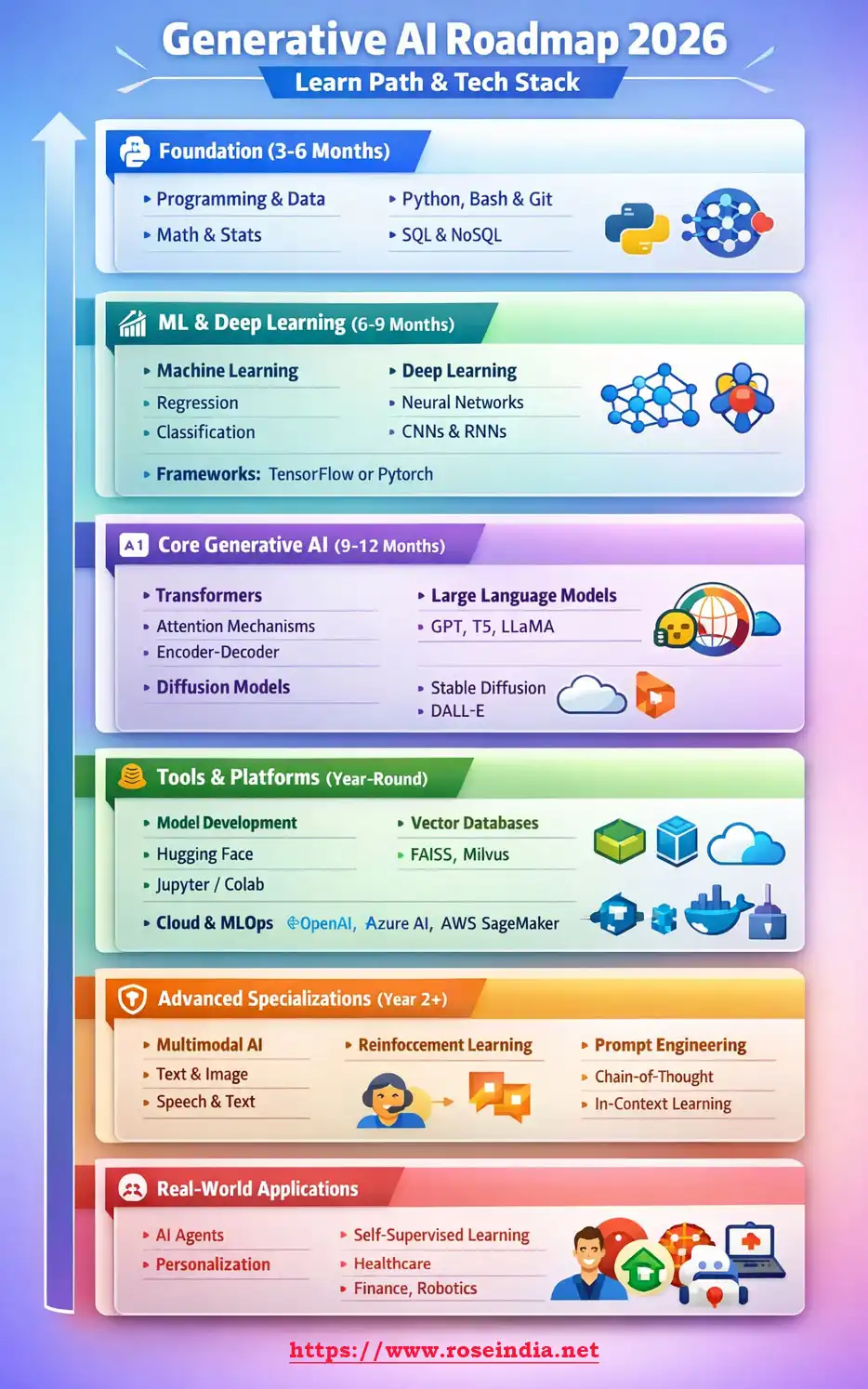
This article is a complete beginner-to-advanced guide designed to help you become an AI Engineer in 2026, even if you are starting with zero AI knowledge. It is written as a long-form optimized resource covering everything in the AI and it is suitable for learners, professionals, and educators. So, let's get started.
Table of Contents
- What Is an AI Engineer?
- Why AI Engineering Is a Top Career in 2026
- Skills Required to Become an AI Engineer
- Step 1: Programming Foundations
- Step 2: Mathematics for AI
- Step 3: Data Engineering Fundamentals
- Step 4: Machine Learning
- Step 5: Deep Learning
- Step 6: Generative AI & LLMs
- Step 7: MLOps & Model Deployment
- Step 8: Cloud Computing & GPUs
- Step 9: Responsible AI, Ethics & Security
- Step 10: Building Real-World AI Projects
- Step 11: AI System Design
- Step 12: Career Roadmap, Jobs & Salaries
- Learning Timeline (Beginner to Job-Ready)
- Common Mistakes Beginners Make
- Final Advice & Next Steps
1. What Is an AI Engineer?
An AI Engineer is a software professional who builds intelligent systems using machine learning, deep learning, and generative AI techniques. Unlike traditional software engineers who write rule-based logic, AI Engineers create systems that learn from data and adapt over time. The role of AI Engineers is bigger as it requires through understanding of data, data cleansing, data generation, manipulation of data and use of AI technologies to get insight of data.
What Makes AI Engineering Different?
- Traditional Software: Logic written by humans
- AI Systems: Logic learned from data
An AI Engineer bridges the gap between data science, machine learning research, and software engineering.
Key Responsibilities of an AI Engineer
- Designing ML and GenAI pipelines - It requires technological in-depth knowledge of many technologies and requires time to gain skills in these technologies.
- Training, fine-tuning, and evaluating models - You have to learn various model fine-tuning techniques and work on projects to gain skills.
- Integrating AI into applications and APIs - Understanding various Python libraries are important as it requires multiple integration for a complete pipeline to run.
- Deploying models to cloud platforms - Deployment of LLMs and business applications on cloud is important skills.
- Monitoring performance and model drift - You should be able configure and use various performance monitoring tools.
- Ensuring scalability, security, and compliance - You should be able to use various tools and ensure system performance and security.
2. Why AI Engineering Is a Top Career in 2026
AI is no longer optional—it is a competitive necessity. So, now it is a must to learn AI skills to keep competitive in the market and explore new opportunities. Due to the features provided by AI, companies are using AI based applications for their businesses.
Industry Adoption
- Enterprises use AI for automation and decision-making - Industries are now using AI in their application
- Startups build AI-first products - Startups companies are now building AI-first products and there is huge demand for engineers having the right AI skills.
- Governments adopt AI for public services - Governments around the world is now adopting AI for their services and there is huge demand of skilled professionals
- Developers use AI copilots daily - It is advised developers to start using AI copilots on daily bases.
Career Benefits
- High salaries - AI engineers having right skills are getting higher salaries
- Global demand - There is a global demand of highly skilled AI professionals
- Remote opportunities - Some companies are providing remote work to the skilled professionals.
- Long-term career stability - Learning AI skills will provide you long-term career stability
AI Engineers are among the highest-paid tech professionals because they combine engineering depth with AI expertise. AI Engineers should have engineering skills along with the AI skills.
Read more at What is AI?
3. Skills Required to Become an AI Engineer
AI Engineering is a multidisciplinary role. You must master multiple layers of the tech stack. Now we will explore the skills you should gain to become a highly successful AI Engineer.
Core Skill Areas
- Programming & Software Engineering
- Mathematics & Statistics
- Data Engineering
- Machine Learning
- Deep Learning
- Generative AI & LLMs
- MLOps & Deployment
- Cloud Computing
- AI Ethics & Governance
Now we are going to cover all of them in detail.
4. Step 1: Programming Foundations (The Backbone)
Best Programming Language for AI in 2026: Python
Python remains the dominant language for AI engineering due to its readability, ecosystem, and industry adoption. Python is easy to learn and it's much easier to develop various types of code in Python. So, there is adoption in the industry and programmers prefer to use Python language for development.
Python Concepts You Must Learn
Here are the Python concepts you must learn and master.
- Variables and data types
- Conditional statements
- Loops
- Functions and modules
- Object-Oriented Programming (OOP)
- File handling
- Exception handling
- Virtual environments
Essential Python Libraries
These libraries are used in AI ML projects for manipulation and visualization of data and you must learn and master these.
- NumPy – This library is used for numerical computing
- Pandas – Pandas is one of the famous library for data manipulation
- Matplotlib & Seaborn – These are the data visualization in AI/ML projects and analytics
- Requests – Famous Python library for API integration
All these libraries are essential libraries in Python being used in the industry for various data handling activities. Learn and master these libraries for a better career in 2026.
Why Software Engineering Skills Matter
Many beginners fail because they focus only on models. In real companies, AI Engineers write production-grade code, not notebooks. So, you should learn programming well and make yourself capable of writing production-grade code.
5. Step 2: Mathematics for AI (Conceptual, Not Academic)
You do not need advanced math—but you must understand how models work internally.
Linear Algebra
- Vectors and matrices
- Dot products
- Matrix multiplication
- Eigenvalues (intuition)
Probability & Statistics
- Mean, median, variance
- Standard deviation
- Probability distributions
- Bayes theorem
- Sampling techniques
Calculus (Foundations)
- Derivatives
- Gradients
- Gradient descent intuition
Mathematics helps you debug, optimize, and trust your models. You should have an in-depth understanding of all these mathematical concepts. You should be able to represent all these in the forms of computer programs and models.
6. Step 3: Data Engineering Fundamentals
AI systems fail without quality data.
Data Skills Required
- Data collection - Learn about the various data collection methodologies
- Data cleaning - Understanding the process of data cleansing is very important and you should be able to use Python libraries for such tasks.
- Handling missing values - Data given to you is always not good and should be able to handle missing values or bad data in your program.
- Feature engineering - This is one of the most used topics and you should master it as well.
- Exploratory Data Analysis (EDA) - You should be able to develop a program to analyze data on adhoc basis. You should be able to understand data using charts/graphs and various statistical techniques.
Tools & Technologies
- SQL (mandatory) - Data is often available in relational databases and you should be able to work with SQL to get and query data.
- CSV, JSON, Parquet formats - You should understand and use various data file formats such as csv, json, parquet etc..
- Data pipelines - You should learn and gain experience in building data pipelines.
- Basic ETL concepts - Basic ETL concepts are important and you should learn it well.
AI Engineers must understand where data comes from and how it flows. They should be able to make data engineering, AI/ML and GenAI pipelines for enterprises.
7. Step 4: Machine Learning (Core Skills)
Machine Learning allows systems to learn patterns from data.
Types of Machine Learning
- Supervised learning
- Unsupervised learning
- Semi-supervised learning
- Reinforcement learning (introductory)
Algorithms You Must Learn
- Linear Regression
- Logistic Regression
- Decision Trees
- Random Forest
- Gradient Boosting (XGBoost, LightGBM)
- K-Means clustering
Evaluation Metrics
- Accuracy
- Precision & Recall
- F1 Score
- ROC-AUC
Tools
- scikit-learn
8. Step 5: Deep Learning (Modern AI Systems)
Deep Learning enables computers to understand images, text, audio, and video.
Core Concepts
- Neural networks
- Activation functions
- Loss functions
- Backpropagation
Architectures
- Feedforward networks
- Convolutional Neural Networks (CNNs)
- Recurrent Neural Networks (RNNs)
- Transformers
Frameworks
- PyTorch (industry standard)
- TensorFlow
9. Step 6: Generative AI & LLMs (Critical in 2026)
Generative AI has transformed AI engineering.
Key Concepts
- Tokens and embeddings
- Attention mechanism
- Prompt engineering
- Fine-tuning
- Retrieval-Augmented Generation (RAG)
Tools & Frameworks
- OpenAI / Azure OpenAI
- Open-source LLMs
- LangChain
- LlamaIndex
- Vector databases (FAISS, Pinecone, Weaviate)
Applications
- AI chatbots
- Enterprise knowledge assistants
- AI agents
- Code generation tools
10. Step 7: MLOps & Model Deployment
Training a model is only 30% of the job. You should learn the skills to deploy the model on the production environment.
MLOps Skills
- Experiment tracking
- Model versioning
- CI/CD pipelines
- Model monitoring
- Data and model drift detection
Tools
- Docker
- FastAPI / Flask
- MLflow
- Kubernetes (basic)
11. Step 8: Cloud Computing & GPU Acceleration
AI workloads are cloud-native.
Platforms
- AWS
- Azure
- Google Cloud
Core Concepts
- Cloud storage
- Managed ML services
- GPUs vs CPUs
- Cost optimization
12. Step 9: Responsible AI, Ethics & Security
AI Engineers must build trustworthy systems.
Key Topics
- Bias and fairness
- Explainable AI (XAI)
- Data privacy and PII handling
- Model security
- AI governance and compliance
13. Step 10: Real-World AI Projects
Projects prove your skills.
Beginner Projects
- Spam classifier
- Sales prediction model
- Image classifier
Advanced Projects
- GenAI chatbot with RAG
- Recommendation engine
- Autonomous AI agent
14. Step 11: AI System Design
AI Engineers design systems—not just models.
Topics
- Data pipelines
- Batch vs real-time inference
- Model serving architectures
- Scalability and fault tolerance
15. Step 12: Career Roadmap, Jobs & Salaries
Common Job Titles
- AI Engineer
- Machine Learning Engineer
- GenAI Engineer
- Applied AI Engineer
Interview Focus Areas
- Python & ML coding
- Model evaluation
- System design
- Real-world case studies
16. Learning Timeline (12–18 Months)
- Months 1–3: Python, Math, SQL
- Months 4–6: Machine Learning
- Months 7–9: Deep Learning
- Months 10–12: GenAI & Projects
- Months 13–18: MLOps & Cloud
17. Common Mistakes Beginners Make
- Ignoring math completely
- Only watching tutorials
- Not building projects
- Avoiding deployment
- Chasing hype instead of fundamentals
18. Final Advice for Aspiring AI Engineers
- Focus on fundamentals
- Build real-world systems
- Learn continuously
- Understand business use cases
AI Engineering in 2026 is challenging—but it is one of the most rewarding tech careers available. After learning and mastering all these skills you will be able to get hired for the most rewarding job role. We will be providing you YouTube video courses, online classes and workshops to help you learn AI Engineering in 2026.
Related Tutorials