What is Python? A Complete Beginner-Friendly Guide
In this tutorial we are learning about Python and understand this powerful yet easy to learn programming language. Python is not a new language, it is a very old programming language whose development started in 1991 and now Python is one of the top programming languages for application development. Python is the top programming language and your decision to learn Python is right. In this post you will learn what Python is and how it is useful in programming. Let’s get started.
Check video: What is Python? A Complete Beginner-Friendly Guide
Python is one of the most popular and powerful programming languages for enterprise and AI/ML application development in the world today. This programming is used by beginners from writing their first line of code to large enterprises building AI-driven systems. Python is used everywhere in programming right from beginning by a learner to enterprises running their business.. In this post you will learn, what exactly is Python, and why has it become so widely adopted?
In this blog post, we’ll explore what Python is, its history, key features, use cases, and why you should learn Python today.
What is Python?
Python is a high-level, easy to learn, easy syntax, interpreted, general-purpose programming language which is now the top programming language. Python is well known for its simplicity, readability, and versatility. It was designed for simplicity and to help developers write clear code for small and large-scale projects. Its syntax is easy and written in simple English.
Python focuses on readable syntax, which means you can express concepts in fewer lines of code compared to many other programming languages.
Example:
print("Hello, World!")
Python comes with simple syntax which makes it an excellent choice for beginners while still powerful, feature rich for advanced applications.
History of Python
Now we will understand the history of the Python programming language. Python was created by Guido van Rossum and first released in 1991. Guido wanted to design a language that:
- Was easy to read and write
- Reduced complex syntax
- Improved developer productivity
Python’s name is inspired by the British comedy show “Monty Python’s Flying Circus”, not the snake. So, the name of Python does not come from Snake but is from the name of a comedy show.
Since then, we have seen many updates and upgrades in this programming language. Python has evolved through multiple versions, with Python 3 being the current standard used worldwide.
Key Features of Python
Here are the key features of Python Programming Langaugae:
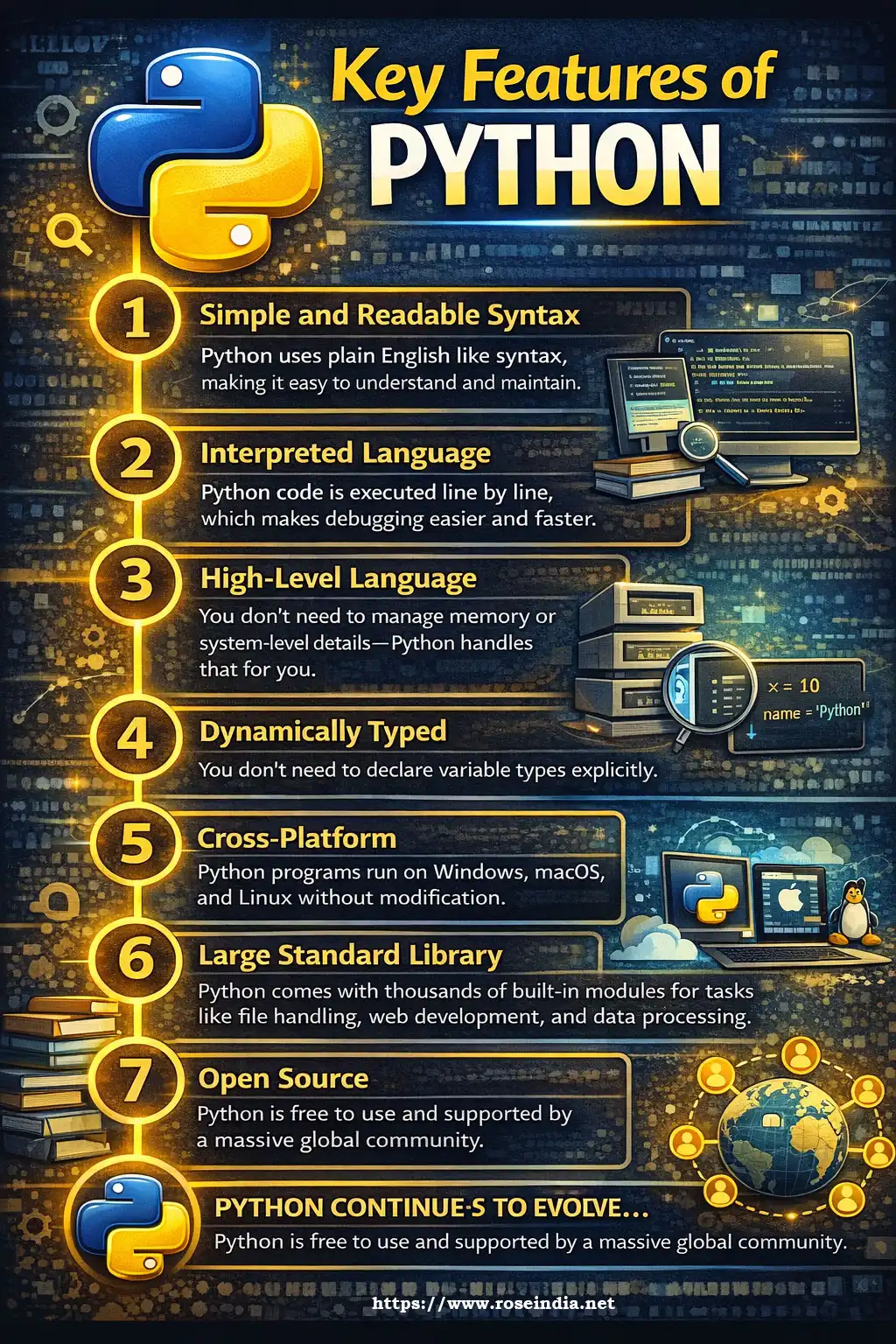
- Simple and Readable Syntax
Python uses plain English-like syntax, making it easy to understand and maintain. The simple English-like syntax makes it easy to learn and understandable programming language. You can start learning Python very fast and in few days you will be able to make applications in Python
- Interpreted Language
Python code is executed line by line, which makes debugging easier and faster. You write code line by line on the Python console and each line is executed one by one, which makes debugging easy for the programmer.
- High-Level Language
You don’t need to manage memory or system-level details—Python handles that for you. Python handles automatic memory management and other system-level-details which enables programmers to concentrate on the programming logic rather than memory management.
- Dynamically Typed
You don’t need to declare variable types explicitly.
x = 10
name = "Python"
It's much easier to program in case of dynamically typed programming language.
- Cross-Platform
Python programs run on Windows, macOS, and Linux without modification. You write a program once on the platform of your choice and after that deploy on any available Platform. This makes easy programming and deployment.
- Large Standard Library
Python comes with thousands of built-in modules for tasks like file handling, web development, and data processing. A large number of Python libraries are available which can be installed in the Python environment and used for application programming.
- Open Source
Python is free to use and supported by a massive global community. A large number of open-source Python packages are also available which makes it one of the best programming languages for various application development tasks.
What Can You Do with Python?
Python is a general-purpose language, meaning it can be used in almost every technology domain.
- Web Development
Python is widely used to build web applications using frameworks like:
- Django - For web application development
- Flask - For creating rest api and simple web applications
- FastAPI - This is also used for API development
On the Internet there are many popular websites like Instagram, Spotify, and Dropbox that use Python.
- Data Science & Analytics
Python provides machine learning and data science libraries used by Data Scientists around the world. Python dominates the data world due to libraries such as:
- NumPy - Numerical computation libraries
- Pandas - Working with the large data sets
- Matplotlib - Data visualization library.
- Seaborn - This is another data visualization library.
It’s used for data analysis, visualization, and statistical modeling.
- Artificial Intelligence & Machine Learning
There are many libraries available in Python for development of machine learning models. Python is the backbone of AI and ML with libraries like:
- TensorFlow
- PyTorch
- Scikit-learn
- Keras
From chatbots to recommendation systems, Python powers modern AI.
0- Automation & Scripting
Python is also good for developing general purpose scripts used for automatic repetitive tasks. Python is excellent for automating repetitive tasks like:
- File handling
- Web scraping
- Email automation
- Report generation
Example:
import os
os.rename("old.txt", "new.txt")
- Game Development
Python also provides libraries for the development of games. Python supports game development using libraries such as:
1- Pygame
- Panda3D
- DevOps & Cloud
In today’s world DevOps plays a major role in the infrastructure management and code deployment tasks. Python is heavily used in:
- AWS, Azure, and GCP automation
- Infrastructure scripting
- CI/CD pipelines
- Desktop & GUI Applications
Python is not limited to the backend tasks, it comes with the libraries for developing GUI for Desktop applications. Using frameworks like:
- Tkinter
- PyQt
- Kivy
You can build desktop applications with Python.
2Why is Python So Popular?
Python consistently ranks among the top programming languages globally. Here’s why:
- Easy to learn for beginners
- High demand in the job market
- Massive community support
- Used by top companies like Google, Netflix, Amazon, and Microsoft
- Perfect balance between simplicity and power
Who Should Learn Python?
3Python is ideal for:
- Beginners starting programming
- Students learning computer science
- Data Analysts & Data Scientists
- AI/ML Engineers
- Backend Developers
- Automation & DevOps Engineers
No matter your background, Python fits almost every career path in tech.
Python vs Other Programming Languages
4| Feature | Python | Java | C++ |
| Syntax | Simple | Verbose | Complex |
| Learning Curve | Easy | Medium | Hard |
| Speed | Moderate | Fast | Very Fast |
| Use Cases | AI, Web, Data | Enterprise Apps | System Programming |
Python may not be the fastest language, but it is one of the most productive.
Is Python Easy to Learn?
Yes! Python is often recommended as the first programming language because:
5- Minimal syntax rules - Easy to code
- English-like keywords - Easy to learn and understand
- Immediate results - Line by line execution which shows results immediately
- Huge learning resources - There are many tutorials on the Internet to learn Python programming language.
Many learners write useful programs within their first week of learning Python.
Future of Python
Python’s future looks extremely strong due to:
6- Growth in AI & Machine Learning
- Data-driven decision-making
- Automation in enterprises
- Cloud-native applications
Python is expected to remain a top language for many years, so Python is a good programming language to start learning now. If you are planning career or career growth in 2026 and beyond you should learn Python programming language.
Conclusion
Python is a powerful, flexible, and beginner-friendly programming language that has transformed how software is built today. Whether you want to develop web applications, analyze data, build AI systems, or automate tasks, Python is the perfect choice.
7If you’re thinking about learning programming, Python is one of the best places to start.
Related Tutorials: