Java Development Roadmap: Java Full Stack Developer Roadmap 2026: The Complete Guide
As an aspiring Java learner, if you want to shape your career as a Java full-stack developer to avail the top-notch career opportunities, this detailed guide will take you through all the necessary steps. We have updated this roadmap with the latest tools and considered Java 25, the latest LTS release, as the baseline. Following every LTS release, we are going to update this guide. Let’s start with the roadmap.
What does a Java Full-Stack Developer Do?
By a full-stack developer, we refer to someone who can build both the frontend and backend of an application. Now, a Java full-stack developer does the same thing, with the only distinction of using Java for the backend. He builds the backend in Java, mostly using the Spring Boot framework, implements the business logic, handles data persistence, and integrates APIs. He also builds the frontend that can just be an application built with a JavaScript or TypeScript framework like React, Angular, or Vue, or much less frequently, a Java-native client-facing UI layer built straight on top of the Spring Boot-based backend.
What Makes Them Different from MEAN/MERN/MEVN Full-Stack Developers?
While in applications built by MERN or MEAN full-stack developers, JavaScript is used across both frontend and backend, Java full-stack developers use both Java and JavaScript languages and tools. They rely on REST or sometimes GraphQL APIs to connect these two language ecosystems. Naturally, the pure Java full-stack developer roadmap is quite different from the learning path for JavaScript full-stack development.
Java Full-Stack Developer Roadmap at a Glance
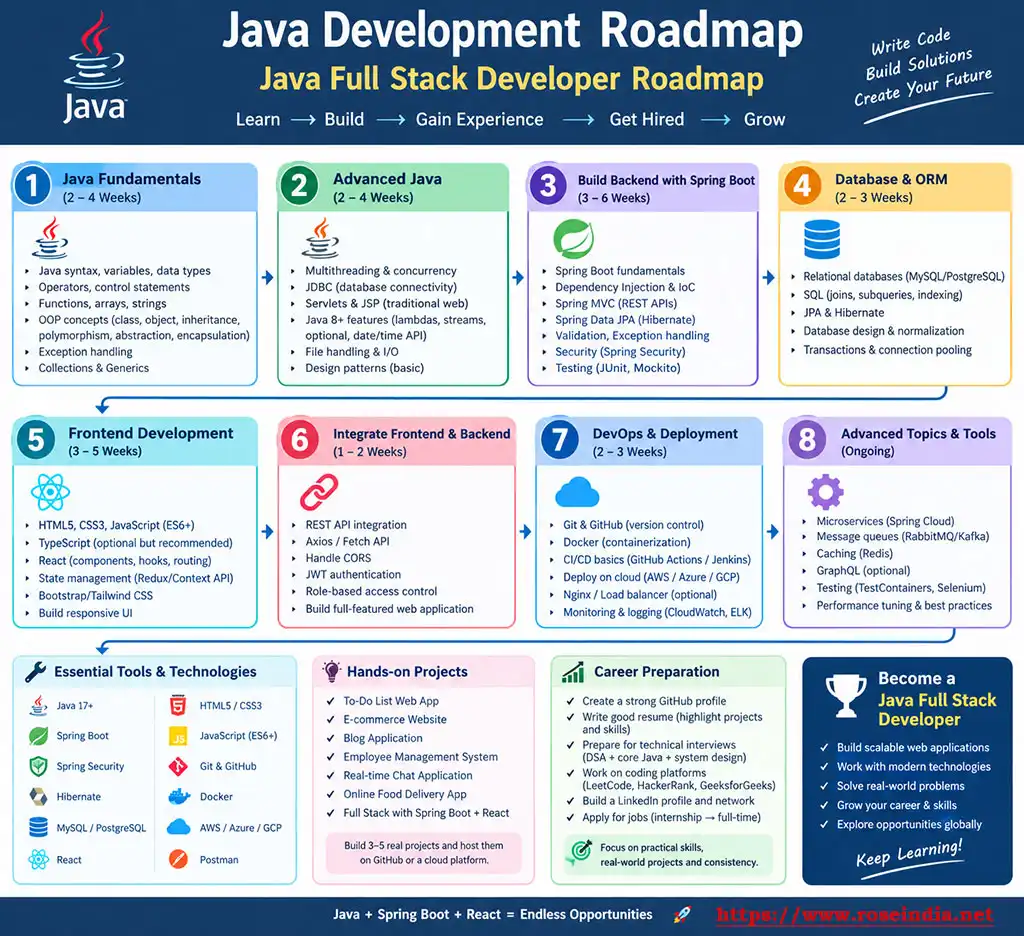
| Phase | Focus | Typical Duration |
| 1 | Core Java foundation | 4 to 6 weeks |
| 2 | Web development fundamentals including HTML, CSS, JavaScript, or TypeScript | 2 to 3 weeks |
| 3 | Frontend development frameworks like React, Angular, or VueJS | 4 to 6 weeks |
| 4 | Java backend development using the Spring Boot framework | 6 to 8 weeks |
| 5 | Learning both SQL and NoSQL databases | 2 to 3 weeks |
| 6 | API development, API integration, and documentation | 2 weeks |
| 7 | Understanding Git, Docker, CI/CD protocol, and cloud ecosystem | 3 to 4 weeks |
| 8 | System design fundamentals, building portfolio projects and interview preparation | 4 to 6 weeks |
So, for someone with little or no programming knowledge, the entire Java full-stack developer roadmap is likely to take around 7 to 9 months of learning and hands-on practice. If you have programming knowledge, the first two phases of the roadmap can be shortened significantly.
Phase 1: Core Java Foundation
All other things to be discussed in the following roadmap can only come when you have a solid understanding of the core Java fundamentals. In the foundational step, you cover the topics in the following order:
- Variables and data types
- Control flow
- Methods
- Arrays
- Object-oriented programming concepts like classes, inheritance, interfaces, polymorphism, and encapsulation
- Exception handling and the Collections Frameworks like ArrayList, HashMap, and HashSet
When you have grasped these foundational concepts, you can move on to lambda expressions and the Streams API. Learning lambda expressions and the Streams API is important because they work inside a big portion of the code in Spring Boot.
In this respect, it is important to know that Java 25, the latest LTS release, has made it easier for beginners to write their first Java program. Java 25 introduced compact source file syntax. Thanks to this, beginners can do away with the traditional path of using public class and String[] args boilerplate. Using the newer syntax. Though for a new learner, the traditional path is equally worth knowing.
Before moving on to the next phase, check the following to test your foundational knowledge:
- Can you write the class hierarchy with inheritance and interfaces from scratch?
- Without checking syntax, can you correctly use the generics and exception handling?
- By using Streams, can you filter, map, and collect a list of objects?
If you are still not confident enough doing any of the above correctly, you should give more time to this phase instead of moving on.
Phase 2: Web Fundamentals including HTML, CSS, and JavaScript or TypeScript
This phase is about learning the fundamentals of web development. In this phase, you will learn semantic HTML, CSS layout, specifically Flexbox and Grid, and basic JavaScript through ES6+. You will learn JavaScript arrow functions, destructuring, promises, async/await, and modules. Since the Angular framework uses TypeScript, in 2026 many consider learning it should not be optional anymore. Learning TypeScript also helps developers navigate React or Vue codebases by using strict typing. By learning both TypeScript and JavaScript side by side, you can be fully equipped for every frontend framework and codebase and avoid relearning in the future.
Phase 3: Learning a Frontend Framework
Most guides here either suggest one framework ahead of others or just explain all three without going deeper into the contexts. We would like to sit somewhere in between these two extremes.
React
React, undoubtedly as a frontend skill, enjoys the largest share of the job market reach among the three frameworks. It is also the most widely adopted framework for frontend development. If you want to learn a frontend framework that offers you exposure to the wider job market, React is the safest bet.
Angular
Angular, on the other hand, has the largest share in enterprise environments. It is particularly the go-to frontend framework at enterprises with existing backend development teams versed in Java or .NET ecosystems. The backend-focused developers always prefer Angular because of its structured and opinionated architecture, inbuilt dependency injection, and strong typing through TypeScript. As a Java developer, if you aim to be a part of large enterprise teams, Angular can be your ideal choice.
Vue
VueJS framework, on the other hand, sits somewhere between React and Angular. It has a lower learning curve and far less strictness for architecture and code typing than Angular, while it comes with more inbuilt structure compared to that of React. Vue is also increasingly popular as an enterprise adoption choice.
Java-native UI frameworks
If you do not want to use two separate codebases for frontend and backend development and want to use the same pool of tools from the Java ecosystem, you can opt for Java-native UI frameworks like Vaadin. Actually, these frameworks are powerful enough to help you build fully-equipped web interfaces entirely using Java on top of Spring Boot. However, Java-native UI frameworks are not ideal for every project. Whenever a project needs specialized frontend development or API-first architecture, any of the three JavaScript frameworks comes as the reasonable choice.
Phase 4: Backend Specialization with Spring Boot Ecosystem
Java is primarily a backend language, and Spring Boot is the irreplaceable Java framework used for backend development. So, this phase is the most critical, and a significant portion of your Java full-stack roadmap is covered here. Learn in the following order:
- Spring Boot fundamentals: Here you learn all the modern features of Spring Boot such as REST controllers, dependency injection, application configuration, and the auto-configuration model.
- Spring Data JPA and Hibernate: Here you learn how the vast majority of databases interact in a Spring Boot application and the key concepts like object-relational mapping, repository interfaces, and query methods that make the database interaction possible.
- Spring Security: You learn authentication and authorization techniques and concepts, including JWT-based stateless auth, the widely used protocol for securing REST APIs used by a decoupled frontend.
- Validation and error handling: You learn making requests for validation annotations and handling exceptions in a centralized manner.
- Testing: You learn JUnit 5 for unit tests, Mockito for mocking dependencies, and Testcontainers for integration tests.
- Build tooling: Among the many build tools, Maven is the most widely used in enterprise Java environments, though you should also learn Gradle, known for providing a much faster build system. You can learn Maven first, then Gradle.
- Update on virtual threads: Java 25 has introduced virtual threads to help Spring Boot cater to the demands of high-concurrency workloads. It allows writing simple, blocking-style code for handling concurrent requests at scale. So, in 2026, you should learn to leverage virtual threads for projects where addressing concurrency is likely to be a key demand.
Phase 5: SQL and NoSQL Databases
Though MySQL is still the most used relational database, PostgreSQL is preferred widely across enterprise environments. Start learning MySQL first and grasp concepts like schema design, joins, and indexing basics. Learn SQL deeply to write good queries and reason queries directly and effectively, not relying on an ORM. As for the NoSQL database, learn MongoDB, which is an effective choice for projects involving a more flexible, document-based schema.
Phase 6: APIs, Integration, and Documentation
Now that you have a solid grasp of frontend frameworks and Spring Boot fundamentals for backend development, you need to learn about APIs that connect the frontend and backend. You learn in this phase REST API design principles such as resource naming, correct use of HTTP status codes, and pagination, dealing with the CORS protocol for connecting a frontend and backend hosted separately, and API documentation using OpenAPI or Swagger. As a test project, you must be able to establish a complete, well-performing connection between a frontend and a Spring Boot backend in a real project.
Phase 7: Git, Docker, CI/CD, and Cloud Fundamentals
Since DevOps as an approach is inseparable from most enterprise production environments, as a Java full-stack developer, it is very much expected of you to have at least working knowledge of DevOps. Already through the projects in earlier phases, you must have had an understanding of Git and GitHub workflows, and you can further sharpen your understanding of them in this phase. You need to learn Docker, which is used to containerize a Spring Boot application. Docker is also crucial to run the application alongside a database within a setup involving multiple local containers. You need to learn to create a basic CI/CD pipeline, for which you should learn GitHub Actions as a commonly used starting point. Lastly, you need to be versed in cloud deployment techniques. For an honest assessment, take any of the leading cloud platforms like AWS, Azure, or GCP, and deploy a containerized application to any of these platforms.
Phase 8: System Design Fundamentals and Interview Prep
A Java full-stack developer roadmap does not end with the successful development and deployment of a project. After the elementary development phases, you need some crucial training on solution design fundamentals. This is crucial because nowadays even entry-level job interviews probe your understanding of system design approaches and concepts. In this phase, learn about monolithic and microservice architectures and their trade-offs, the fundamental caching concepts, and how REST APIs are accommodated in larger systems where message queues are used. A good understanding of all the above, at least at a broader conceptual level, is sufficient for this stage.
Portfolio Projects to Showcase Your Full-Stack Development Skill
We don’t want to repeat the same vague advice by uttering cliches like "build some projects". On the contrary, we would like to propose three projects that cover almost everything that you have learned in this full-stack developer roadmap. Here we go:
- A simple task management solution: For this project, the stack will be React or Angular frontend, Spring Boot REST API, JWT authentication, and PostgreSQL. Through this project, you can prove your foundational knowledge of how the frontend-to-backend-to-database pipeline works from start to finish.
- A basic and small e-commerce platform: Here you need to build the core features like a product catalog, cart, order flow, separate role-based access controls for admin and customer, and a sandbox for payment integration like the test mode provided by Stripe for free. This project will help assess your ability to handle complex data relationships and varied authorization logics typical of e-commerce stores.
- A containerized, deployed capstone: This third project is all about testing your deployment skills. Take any of the above two projects, add automated test suites like JUnit or Testcontainers, a CI/CD pipeline for automatic Docker image generation and running these tests, and deploy the final output to any of the leading cloud platforms like AWS, Azure, or GCP through a live URL. The successful completion of this deployment ultimately guarantees that you have learned all the fundamental skills to launch your career as a Java full-stack developer.
Final Thoughts
The above enumeration goes well beyond an 8-phase curriculum and list of skills. At every step, we have explained the tools in light of the questions developers face in real-world projects. We have also covered some not-so-common diversions like Java-native UI frameworks and added a phase covering system design and interview preparation. Last but not least, this roadmap also provides three all-around projects for a complete assessment of your skills.
Related Tutorials