
Understanding Generative Models: VAEs and GANs (High-Level)
In this section we have to understand the important generative models, the generative models are AI models which generate the output such as text, image, video, audio etc. These models generate the same type of data as the training datasets. For example if we train a model on the image dataset, it will produce images resembling the training images.
Generative models are complex and advanced models in the field of AI/ML that generates new content, these models are the most exciting areas as of now in the machine learning and artificial intelligence field. In this section we will understand VAEs and GANs. The classical machine learning models are used for prediction or classification while these new generative models generate or create new data. New data created by generative models resembles the training data set and used for creating realistic images, music, text etc in various industries.
In this section we are learning following concepts:
- Concepts:
- Variational Autoencoders (VAEs): What they do (learn a latent space, generate similar data).
- Generative Adversarial Networks (GANs): The generator-discriminator game, how they learn to generate realistic data.
- Key differences and use cases for VAEs vs. GANs.
The Variational Autoencoders (VAEs) and Generative Adversarial Networks (GANs) are widely used and most famous generative models. Here we are going to explore the core concepts, their working and key differences. We will also see the use cases of two types of generative AI models.
1. Variational Autoencoders (VAEs)
What are VAEs?
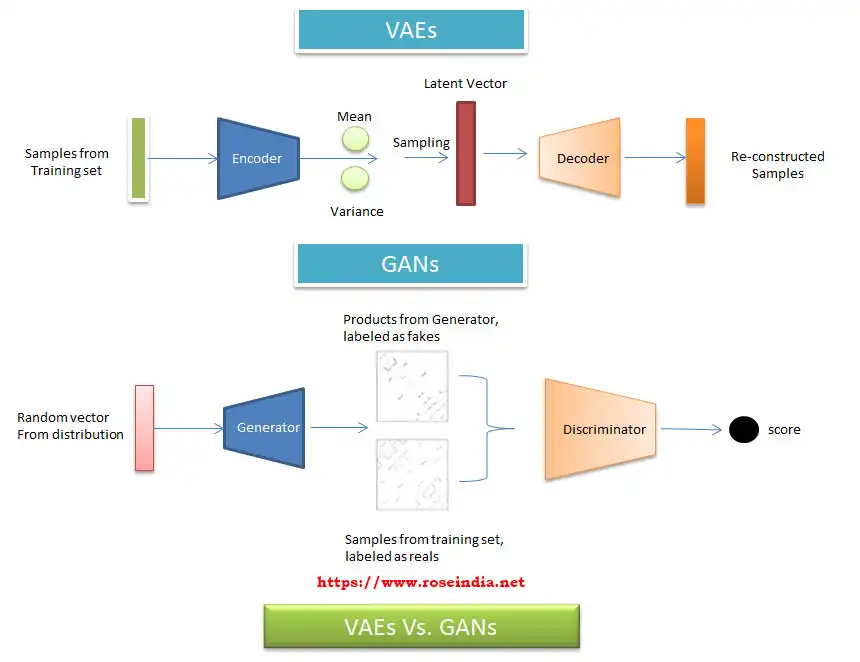
The VAEs or Variational Autoencoders of generative mode which is a type of probabilistic generative model. They learn from input data such as images, text, audio, video by compressing the data in the meaningful representation in a latent space. Encoders take the input data and compresses it in a latent space. During the generation process it samples the data from latent space and uses the decoders to generate realistic data.
In simpler terms:
- They compress input data (encoding) in a latent space..
- They reconstruct the data from this compressed form decoding process. Sample from the latent space is used by the decoder to generate data.
- By learning nearby points in the latent space, they can generate new, similar data.
How VAEs Work (High Level)
Now we will see the working of VAE generative models.
A Variational Autoencoder (VAE) has two main parts:
- Encoder → The encoder component is responsible for compressing the data into a latent representation.
- Decoder → The decoder reconstructs data back from that representation, which resembles data on to which model is trained.
The VAEs models are different from a simple autoencoder, a VAE introduces probability and randomness into the latent space. This makes the generation of data much more realistic.
How these works:
- Encoder: The encoder's responsibility is to take an input (say, an image of a handwritten digit) and compress it into a latent vector. Encoder design is complex and instead of producing a single point, it outputs a distribution (mean and variance).
- Latent Space Sampling: This is a process of drawing a point (vector) from this distribution and this sample is passed to the decoder for construction of generation of new data. In simple terms we sample a latent vector and this way mode doesn’t memorize but instead generalizes the data.
- Decoder: Decoding is the process of generation of data or output. The decoder takes the sampled latent vector and then reconstruct the output
The training objective balances:
- Reconstruction Loss - It determines how close the output is to the input.
- Regularization Loss - The regularization loss is forcing the latent space to follow a standard distribution, usually Gaussian.
Why VAEs Are Useful
Let’s see the feature and importance of this model:
- They provide smooth latent spaces: If we make small changes in the latent vector then there will be gradual and meaningful changes in the generated data.
- This model is very useful in tasks like data interpolation (blending two images smoothly) or anomaly detection.
2. Generative Adversarial Networks (GANs)
What are GANs?
A generative adversarial network or GAN is a machine learning model which is capable of generating realistic data from existing training dataset. It falls under an unsupervised learning framework using deep learning techniques which uses two neural networks working in opposition. One neural network generates data while the second neural network evaluates whether the generated data is real or generated.
GANs was introduced by Ian Goodfellow in his 2014 paper Generative Adversarial Nets, which was offering the groundbreaking solution to the challenges faced in training neural network based generative AI models. His solution paved the way to develop models that create high-quality and realistic data.
GAN Approach
GANs set up a game between two neural networks:
- A Generator: This is one neural network that tries to create fake but realistic-looking data.
- A Discriminator: This is a second neural network that tries to distinguish between real data and fake data generated by the Generator.
This way, the generator improves until it can produce data indistinguishable from the real thing. Such models are used widely in the industry for various tasks.
How GANs Work (High Level)
- Generator Input: The input starts with a random noise vector.
- Generator Output: It produces the fake data (e.g., an image).
- Discriminator: Evaluates both real and fake data, outputting probabilities of “real” or “fake.”
- Training Loop:
- The discriminator gets better at spotting fakes.
- The generator gets better at fooling the discriminator.
During the training process, the generator learns to produce data so realistic that even humans may struggle to tell it apart from real samples. Once training is completed the model is saved for interference.
Why GANs Are Useful
- GANs are very powerful models and are capable of producing sharp, realistic images.
- They power applications like deepfakes, super-resolution, and image-to-image translation.
3. Key Differences: VAEs vs. GANs
Here are the table of key differences between VAEs and GANs.
| Aspect | VAEs | GANs |
| Core Idea | Learn a latent space and reconstruct input data | Generator-discriminator adversarial game |
| Output Quality | Often blurry outputs (due to averaging effect of reconstruction) | High-quality, sharp, realistic outputs |
| Latent Space | Well-structured, smooth, interpretable | Less interpretable latent space |
| Training Stability | More stable, easier to train | Tricky to train (mode collapse, instability) |
| Use Cases | Representation learning, anomaly detection, interpolation | Image synthesis, deepfakes, artistic content generation |
4. Use Cases for VAEs vs. GANs
Lets see the top use cases of VAEs and GANs models.
VAEs
- Anomaly Detection: Detects unusual data by measuring reconstruction error.
- Data Compression: Effective for encoding large datasets into compact representations.
- Latent Space Exploration: Ideal when we need a meaningful representation of data for downstream tasks.
- Drug Discovery & Molecular Design: The VAEs models are widely used in bioinformatics to generate molecules with desired properties.
GANs
- Image Generation: Creating realistic faces, objects, and scenes (e.g., StyleGAN).
- Image-to-Image Translation: Converting sketches to photos, day to night images, etc.
- Super-Resolution: Enhancing the quality of low-resolution images.
- Creative Applications: Generating art, music, and design prototypes.
5. Summary
In this section we have learned about VAEs and GANs models. We understood these models at a very high level. You can always explore AVEs and GANs by reading the research papers and books.
VAEs focus on learning a smooth, structured latent space and reconstructing data. They are great for understanding and exploring data.
While GANs focus on creating highly realistic data by pitting two networks against each other. They are great for producing visually stunning results.
Choosing between VAEs and GANs depends on the goal:
- If you need interpretability and structured latent space, use VAEs.
- If you need realistic-looking outputs, use GANs.
These two models are the backbone of modern AI creativity, and understanding VAEs and GANs is the first step to exploring the fascinating world of synthetic data generation. In the next section we will learn more AI/ML topics.
Related Tutorials: