
Core Concepts of Neural Networks and Deep Learning
Today we are going to teach you the core concept of neural networks which have become the backbone of modern artificial intelligence enhancements. The Neural networks are powering modern voice assistants, self-driving cars, various assistants in the mobile and other devices. These modes are the heart of today’s AI revolution and it's getting complex day-by-day.
In this post we will explain to you the core concepts of neural networks, we will first explain what neural networks are, what are activation functions and then go into more advanced topics such as backpropagation. Finally we will provide you the high-level cover of different types of neural networks.
As you already know Deep Learning is a highly sought after technology in IT work these days. There is a huge demand for such professionals in the market. If you are planning to make your career in Deep Learning you should learn Deep Learning separately.
Neural network Concepts:
- What are neural networks? (Inputs, outputs, layers, weights, biases).
- Basic activation functions (ReLU, Sigmoid).
- Briefly understand backpropagation (don't need to deep dive into math yet).
- Introduction to different types of neural networks (e.g., Feedforward, CNNs, RNNs - very high level for context).
1. What Are Neural Networks?
Now we will first learn about neural networks and understand what neural networks are? The core of neural networks are computational models which are created by understanding the working of the human brain, where a large number of neurons are interconnected to learn the things and produce the output. In the human brain, a large number of neurons are interconnected to learn things and produce intelligence for the person. The neurons in the human brain receive, process and transmit the signals. The artificial neural network uses the same concept and it also receives the signal (data), processes it and finally produces the output. The output in the artificial neural network is known as predictions. So, we just provided you with the working details of Neural Networks. Let's explore Neural networks in more detail.
1.1 Structure of a Neural Network
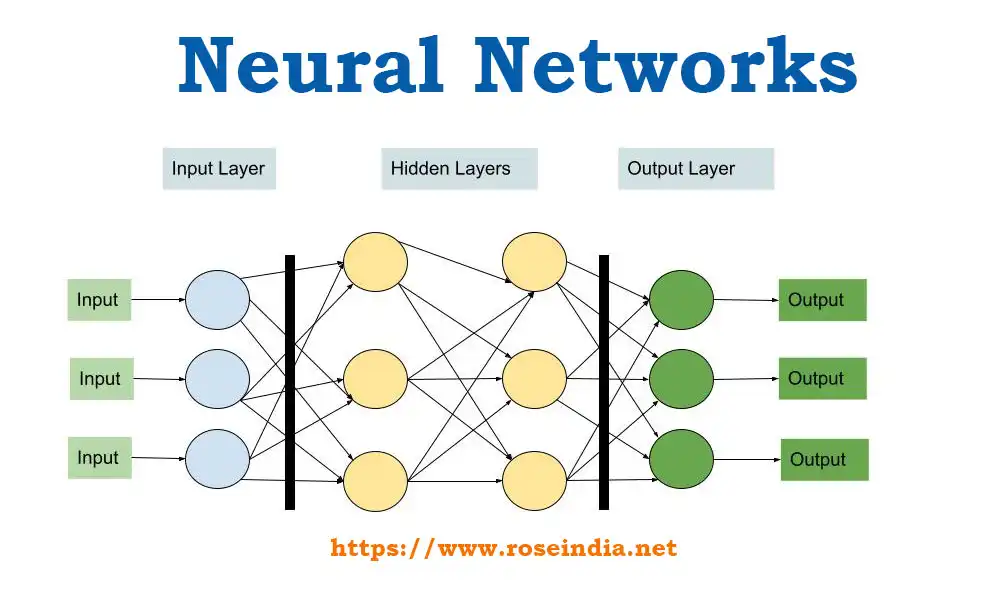
Lets discuss the structure of an artificial neural network. A typical neural network is made up of:
- Inputs
- The input represents the raw data fed into the network.
- Example: In case of image recognition task, teach the pixel's intensity value passed to the model as the input. The input is received by the Input layers. The model uses this data for making predictions.
- The input represents the raw data fed into the network.
- Layers
Neural networks are made of of layers and these are the organizations of the layers:
- Input Layer – The Input Layer is responsible for accepting the initial data.
- Hidden Layers – There can be multiple hidden layers in a model and these hidden layers perform most of the computations using weights and biases.
- Output Layer – The Output Layer produces the final prediction or classification. The final prediction is the output of the model which can be further used in other programs. For example, the output of the stock trading model can be used to decide whether to sell or purchase particular shares.
- Weights
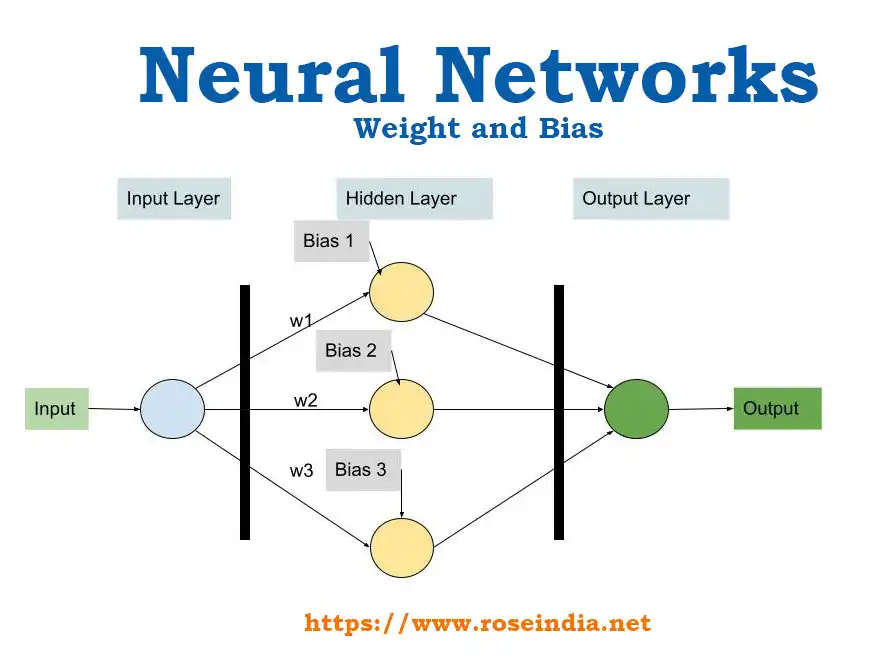
- Each connection between neurons has a weight—a numeric value that determines the importance of the input. When two neurons are connected, the value from the first neuron is used by another neuron in the neural network.
- During the Model training phase, these weights are adjusted to minimize error.
- Each connection between neurons has a weight—a numeric value that determines the importance of the input. When two neurons are connected, the value from the first neuron is used by another neuron in the neural network.
- Biases
A bias is an extra parameter added to a neuron (node) which actually shifts the activation function left or right.
- A bias allows the model to shift the activation function, enabling better flexibility and fit.
- This is an extra input that is always set to 1 and multiplied by a trainable parameter.
- A bias allows the model to shift the activation function, enabling better flexibility and fit.
- Outputs
- The final results or the prediction produced by the network after processing inputs through layers. The model takes inputs, applying weights and biases, passes through all the layers and finally generates the output.
- Example: In case of image classification the probability scores for different classes is known as output.
Flow of Data (Forward Pass)
Here is the summary of working of neural networks. When input data passes through the network:
- Each neuron computes a weighted sum of its inputs.
- A bias is added.
- The result is passed through an activation function to introduce non-linearity.
- This output becomes the input for the next layer.
2. Basic Activation Functions
Activation functions in the neural network are very important as it determines if a neuron should “fire” or not. The activation function helps the neural network to learn complex patterns. Without an activation function a neural network will behave like a simple linear regression model and it won’t be able to solve complex tasks.
Mathematically activation function of a node in an artificial neural network is a function that calculates the output of a node by using the individual inputs and their weights.
Here we will discuss ReLU and Sigmoid activation functions.
2.1 ReLU (Rectified Linear Unit)
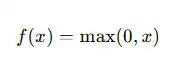
- Formula:
- How it works:
If the input is positive, it outputs the same value; if negative, it outputs zero.
- Advantages:
- It reduces the risk of vanishing gradients and this activation function is computationally efficient.
- It reduces the risk of vanishing gradients and this activation function is computationally efficient.
- Common usage: Its common usage is with hidden layers in deep networks.
2.2 Sigmoid
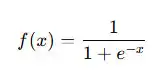
- Formula:
- How it works:
Squashes values into a range between 0 and 1.
- Advantages:
Useful for probability-based outputs.
- Limitations:
- It can cause vanishing gradients and is less common in deep hidden layers but still used in binary classification outputs.
- It can cause vanishing gradients and is less common in deep hidden layers but still used in binary classification outputs.
Other basic activation functions are:
- Sigmoid (Logistic)
- Tanh (Hyperbolic Tangent)
- Leaky ReLU
- Parametric ReLU (PReLU)
- ELU (Exponential Linear Unit)
- Softplus
3. Understanding Backpropagation (At a High Level)
Now we will learn the important concept in neural networks which is known as backpropagation. During the model training phase weights and biases are adjusted so that neural network predictions get closer to the desired outputs. Here backpropagation comes into play.
- Step 1: Forward Pass
In this step the input data moves through the network to produce predictions.
- Step 2: Calculate Error
In this step predictions are compared with the true value using a loss function (e.g., Mean Squared Error, Cross-Entropy Loss).
- Step 3: Backward Pass
In this step the error is propagated backward through the network.
- Step 4: Weight Updates
In this step neural network updates the weight using gradient descent, the algorithm calculates how much each weight contributed to the error and adjusts them accordingly.
You can think of backpropagation as a self teaching process where the neural network self-corrects in each step. This way model predictions become better and better after each step.
4. Introduction to Different Types of Neural Networks
The basic building blocks of neural networks are similar and different architectures are designed for different problems. Here are the list of most common types of Neural Networks:
4.1 Feedforward Neural Networks (FNNs)
This is the simplest type of neural network, in which information flows in one direction—from input to output—without cycles. This model is good for basic classification and regression tasks.
4.2 Convolutional Neural Networks (CNNs)
CNNs are specialized neural networks for image and spatial data. It is used to detect features like edges, textures, and shapes. The applications of CNNs are image classification, object detection, and medical imaging.
4.3 Recurrent Neural Networks (RNNs)
This neural network is designed for sequential data such as text, speech, and time-series and it contains loops that allow information to persist across time steps. In this neural network variants like LSTM and GRU address the vanishing gradient problem.
Conclusion
In this section we have understood the core concepts of neural networks—from inputs, outputs, and layers to activation functions and backpropagation, which provided us a strong foundation for diving deeper into deep learning. The neural networks like feedforward, CNNs, and RNNs are just the starting point, there is a lot to learn in neural networks. In the future tutorials we will learn about the more advanced architectures like Transformers and Generative Adversarial Networks (GANs).
Related Tutorials: