How to Master Java in 2026: A Complete Beginner-to-Expert Roadmap
Java has been very popular since its public release in 1995. Still Java tops as a programming language which survived multiple technology waves. Java has been popular for Internet, Backend Servers, Desktop and utility application development. Java is still popular for these applications development and now also provides tools for cloud application development. In this post we are going to understand why and how one should master Java in 2026. We are presenting a complete roadmap for the beginners.
Java has survived multiple technology waves—desktop applications, web apps, mobile, cloud computing, big data, and now artificial intelligence. In 2026, Java is not just surviving—it is thriving and now providing tools for cloud based application development. Many enterprises developed cloud applications in Java that are running on the cloud servers 24x7 and powering the business.
Check Tutorial: Master Java In A Week
This guide is for students, working professionals and anyone planning to learn Java in 2026. If you’re wondering how to master Java in 2026, whether you’re a student, working professional, backend developer, or architect, this guide provides a complete, future-proof roadmap. You’ll learn what to study, in what order, which tools matter, and how to become industry-ready in a Java-dominated job market. We will also provide the links to the tutorials for learning and mastering Java.
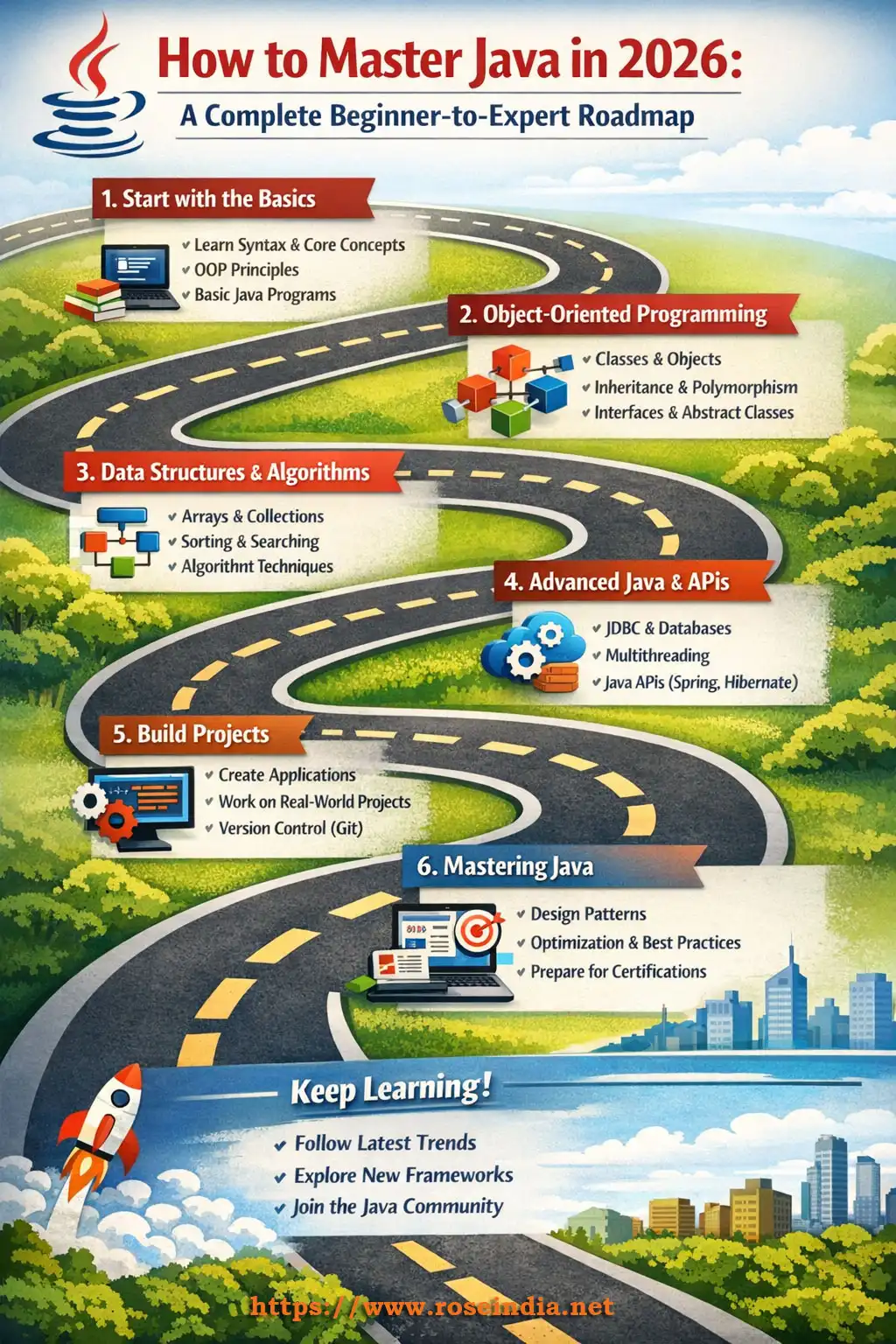
1. Start with the Basics
- Learn Syntax & Core Concepts
- OOP Principles
- Basic Java Programs
2. Object-Oriented Programming
- Classes & Objects
- Inheritance & Polymorphism
- Interfaces & Abstract Classes
3. Data Structures & Algorithms
- Arrays & Collections
- Sorting & Searching
4. Advanced Java and APIs
- JDBC & Databases
- Multithreading
- Java APIs (Spring, Hibernate, Spring Boot)
5. Build Projects
- Create Applications
- Work on Real-World Projects
- Version Control (Git)
6. Mastering Java
- Design Patterns
- Optimization & Best Practices
- Prepare for Certifications
Why Learning Java in 2026 Is a Smart Career Move
Despite the rise of Python, JavaScript, and Go, Java continues to dominate enterprise software development and is considered a smart career move in the Java programming field.
Why Java Is Still Relevant in 2026
- Java is very popular and used by 90% of Fortune 500 companies
- Java is backbone of banking, fintech, telecom, healthcare, and e-commerce
- There is strong presence of Java in cloud-native and microservices architectures
- Java comes with massive ecosystem of libraries, frameworks, and tools, which makes it possible for several types of application development
- Java is in continuous development and innovation with Java LTS releases (17, 21, 25+). Free version of Java as OpenJDK is also available for free deployment of applications.
- High-paying roles with long-term stability. There are several high paying jobs in the market for Java developers.
Java’s “write once, run anywhere” philosophy has evolved into “write once, scale everywhere.” You can now run your Java program on the distributed high-end clusters to meet today’s data processing requirements. Java is the best technology for developing distributed data processing and serving applications.
Understanding the Modern Java Ecosystem (2026 Perspective)
Before diving into learning Java, it’s important to understand what Java means today.
Java Is No Longer Just a Language
In 2026, Java is:
- A platform
- A runtime ecosystem
- A cloud-native backend powerhouse
- A foundation for data engineering, AI pipelines, and distributed systems
Modern Java development includes:
- Spring Boot & Spring Cloud
- REST & event-driven architectures
- Docker & Kubernetes
- Cloud platforms (AWS, Azure, GCP)
- Observability, security, and scalability
Step 1: Build a Strong Core Java Foundation
Mastering Java begins with solid fundamentals. Skipping this step leads to confusion later, especially with frameworks like Spring. So, you must learn Java step-by-step and master each and every concept. Our guide provides you with all the tutorials you should learn to master Java.
Java Basics You Must Learn Thoroughly
Java Architecture
- JVM (Java Virtual Machine)
- JRE vs JDK
- How Java code is compiled and executed
- Bytecode and platform independence
Core Language Concepts
- Variables and data types - Learn about variables and data types
- Operators
- Control flow statements (if, switch, loops,
do while loop)
- Methods and parameter passing - Learn it at Java - Class, Object and Methods in Java
- Arrays and Strings - Check tutorials Introduction to Java Arrays and Java String Examples
Object-Oriented Programming (OOP)
- Classes and objects - Check tutorial: Class, Object and Methods in Java
- Encapsulation
- Inheritance
- Polymorphism
- Abstraction
- Interfaces vs abstract classes
This tutorial “Core Java tutorial”, “Java OOP concepts”, and “Java basics for beginners” will help programmers in learning Java from scratch and master this programming language.
Step 2: Master Modern Java Features (Java 8 to Java 21+)
Many developers still write Java like it’s 2014. In 2026, that’s a career blocker.
Essential Modern Java Features
Functional Programming in Java
- Lambda expressions
- Functional interfaces
- Method references
Streams API
- Filtering, mapping, reducing
- Parallel streams
- Real-world data processing use cases
Optional Class
- Avoiding NullPointerExceptions
- Cleaner, safer code
New Language Enhancements
- Records
- Sealed classes
- Pattern matching
- Switch expression enhancements
Project Loom (Virtual Threads)
- Lightweight concurrency
- High-throughput applications
- Scalable backend systems
Modern Java is cleaner, faster, and more expressive than ever.
Step 3: Data Structures and Algorithms Using Java
To truly master Java, you must understand how data is stored, accessed, and optimized.
Why DSA Still Matters in 2026
- Interview evaluations
- Performance optimization
- Writing scalable systems
- Debugging production issues
Key Topics to Cover
- Time and space complexity (Big O)
- Arrays and linked lists
- Stack and queue implementations
- HashMap, HashSet, TreeMap
- Sorting algorithms
- Searching techniques
- Recursion and basic dynamic programming
Java Collections Framework (Deep Dive)
- List vs Set vs Map
- Internal working of HashMap
- Concurrent collections
- Immutability and performance tradeoffs
Step 4: Backend Development with Spring Boot
In 2026, Java developer = Spring Boot developer.
Why Spring Boot Is Mandatory
- Rapid development
- Production-ready defaults
- Massive enterprise adoption
- Cloud-native support
What You Must Learn in Spring Boot
Core Spring Concepts
- Dependency Injection
- Inversion of Control
- Bean lifecycle
REST API Development
- Controllers
- Request/response mapping
- Validation
- Exception handling
Data Access
- Spring Data JPA
- Hibernate ORM
- Pagination and sorting
- Native queries
API Documentation
- OpenAPI / Swagger
- API versioning
Most enterprise Java applications today are Spring Boot microservices.
Step 5: Databases, SQL, and Data Handling
Java applications live and breathe data.
SQL Skills Every Java Developer Needs
- SELECT, JOIN, GROUP BY
- Indexing and query optimization
- Transactions and isolation levels
- Stored procedures (basics)
ORM and Persistence
- JPA vs Hibernate
- Lazy vs eager loading
- N+1 query problem
- Caching strategies
NoSQL and In-Memory Databases
- MongoDB for document storage
- Redis for caching
- Use cases and tradeoffs
Understanding data deeply makes you production-ready, not just interview-ready.
Step 6: Microservices Architecture with Java
Monolithic applications are fading. Microservices dominate 2026. Companies are developing microservices due to its features and benefits. You should learn and master microservices also in 2026 and beyond.
Core Microservices Concepts
- Service decomposition
- Stateless services
- REST vs messaging
- Synchronous vs asynchronous communication
Spring Cloud Essentials
- Service discovery
- Config server
- API gateway
- Circuit breakers
- Distributed tracing
Messaging and Event-Driven Systems
- Apache Kafka
- RabbitMQ
- Event sourcing basics
Microservices knowledge separates junior developers from senior engineers.
Step 7: Cloud-Native Java Development
Java has fully embraced the cloud.
Must-Learn Cloud Skills
- Dockerizing Java applications
- Kubernetes fundamentals
- Configuring autoscaling
- Cloud-native logging and monitoring
Cloud Platforms
- AWS (EC2, RDS, ECS, EKS)
- Azure (App Service, AKS)
- GCP basics
Cloud-ready Java developers are highly sought after in 2026.
Step 8: Build Real-World Java Projects
Projects convert knowledge into expertise.
0Recommended Java Project Ideas
- Banking transaction system
- E-commerce REST API
- Authentication and authorization service
- Log ingestion pipeline
- Payment gateway simulation
- Microservices-based order management system
Best Practices
- Clean code
- Layered architecture
- Meaningful Git commit history
- Proper documentation
A strong GitHub profile often matters more than certifications.
Step 9: Testing, Security, and Performance Optimization
Professional Java developers write safe, fast, and testable code.
Testing Skills
- JUnit 5
- Mockito
- Integration testing
- Testcontainers
Security Concepts
- JWT authentication
- OAuth2
- Role-based access control
- Secure API design
- Preventing SQL injection and XSS
Performance Tuning
- JVM memory management
- Garbage collectors
- Profiling tools
- Load testing
Step 10: Advanced Java and System Design
To master Java, you must think like an architect.
1Advanced Java Topics
- Design patterns
- SOLID principles
- Clean architecture
- Reactive programming
- GraalVM and native images
- Event-driven architecture
Java-Based System Design
- Designing scalable APIs
- High-availability systems
- Caching strategies
- Rate limiting
- Fault tolerance
This stage prepares you for Senior Developer, Tech Lead, or Architect roles.
Step 11: Java + AI, Data Engineering, and GenAI
Java is increasingly used alongside AI systems.
Emerging Java Use Cases
- AI-powered backend services
- Data pipelines with Spark
- Integrating LLM APIs
- GenAI orchestration layers
- RAG-based enterprise systems
Java’s reliability makes it ideal for AI production workloads.
2How Long Does It Take to Master Java?
| Level | Time Estimate |
| Beginner | 2–3 months |
| Intermediate | 4–6 months |
| Advanced | 8–12 months |
| Architect | Continuous learning |
Consistency matters more than speed.
Common Mistakes to Avoid While Learning Java
- Skipping core Java fundamentals
- Ignoring SQL and databases
- Learning frameworks without understanding basics
- Avoiding testing and performance topics
- Not building projects
- Stopping at tutorial-level knowledge
Final Thoughts: Java Mastery Is a Long-Term Asset
Mastering Java in 2026 is not about chasing trends—it’s about building deep, transferable engineering skills.
Java offers:
3- Long-term career stability
- Enterprise-grade opportunities
- Strong salaries
- Global demand
If you follow this roadmap step by step, Java can take you from beginner to highly paid professional, and eventually into technical leadership or architecture roles.
Related Tutorials:
- Java Tutorials
- Core Java
- Java SE 6
- Java SE 7
- Advanced Java
- J2ME
- JSP
- Servlets
- JDBC
- EJB
- Web Services
- JSTL
Mastering Java:
4