AI Application Development Services for Businesses
We are premium organization providing AI Application Development Services for Businesses.
AI Application Development Services for Businesses: A Complete Guide to Building Custom AI Solutions
Businesses across industry domains, irrespective of size and market capitalization, now use artificial intelligence. While most use AI just as a time-saving tool in their day-to-day tasks, only a few use AI in a way that positively impacts their revenue. A McKinsey survey in 2026 reports that among the vast majority of organizations that use AI in their everyday business processes, only 37% have experienced any tangible impact of AI on their earnings.
The gap between AI adoption and actual impact continues to be a key concern for businesses that are investing in AI-driven workflows. AI application development services can play a major role in bridging this gap. How they can build high-value AI solutions, what these solutions cost, and how to implement AI successfully, we will discuss in this blog.
What AI Application Development Services Do
An AI application development service develops AI-enabled software solutions or designs AI-powered workflows, helps with AI integration with existing systems, and handles AI-driven software maintenance. An AI solution provider handles the entire product lifecycle, from strategy, prioritizing use cases, data preparation, model selection, custom model training, core solution build, legacy system integration, QA and testing in an actual environment, deployment, and monitoring.
An AI solution provider helps the business use AI in a meaningful and business-specific manner. Rather than using market-available AI models with a subscription, businesses through a custom AI solution can help a business automate processes based on their workflows, generate insights from business’s own data, deliver brand-specific context-aware customer support, and deliver security and compliance measures based on industry regulations and organization’s own benchmarks.
Key Reasons Businesses Are Investing in Custom AI Solutions
While most businesses are still stuck with off-the-shelf AI solutions, their limitations are widely known. On the other hand, an increasing number of businesses are investing in custom AI solutions that can cater to their specific intelligent automation needs.
Here are the key reasons businesses are investing in custom AI solutions.
- Off-the-shelf AI tools don't match a company's actual workflows and processes. In contrast, a custom AI solution is designed to meet those processes and workflow needs.
- A company's own pool of proprietary business data allows it to create RAG-based AI solutions to work as a custom knowledge engine, ensuring optimum accuracy, precision, and authenticity, rather than answering with generic knowledge an AI model is trained with.
- Lastly, building and maintaining custom AI solutions has become cheaper with model routing, mature frameworks, and AI-assisted coding.
But the risks should also be measured equally. According to a popular MIT study, no considerable revenue impact has been experienced from around 95% of enterprise generative AI pilots. If the above-mentioned advantages of custom AI solutions are true, where’s the problem then? Well, the real problem lies in the skill gap. Creating a pilot AI solution that works well with standard parameters is just an initial step. The real challenge lies further downstream, in deploying the solution in the actual production environment. This is where forward-deployed engineers who handle the entire product cycle from strategy to deployment can play a mission-critical role.
Different Facets of Custom AI Solutions
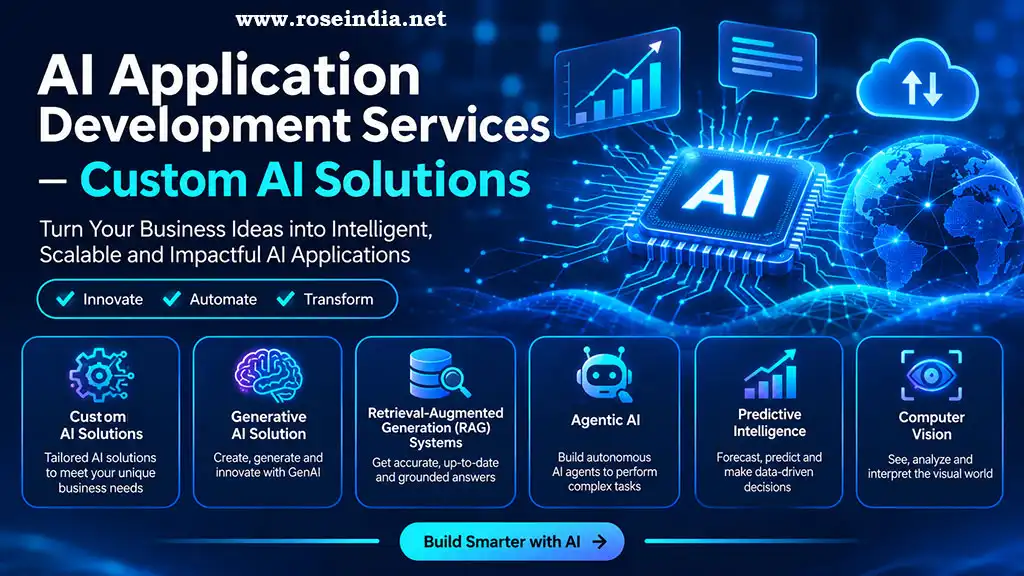
Custom AI solutions fall into several different categories. Some of the most popular custom AI solution types include the following.
- Generative AI solution: LLM-powered content creation, knowledge assistants, and conversational AI interfaces fall in this category.
- Retrieval-augmented generation (RAG) systems: Internal knowledge assistants and customer-facing knowledge bots that answer questions from an organization’s own databases with precise source citations fall under this category.
- Agentic AI: AI systems with deep context awareness and reasoning abilities that autonomously complete tasks in a multi-step workflow with zero or minimal human oversight come under the category of agentic AI.
- Predictive intelligence: AI-powered demand forecasting, fraud detection, churn prediction, and personalized recommendation engines that make predictions, suggestions, and recommendations based on historical data fall in this category.
- Document ingestion & parsing: AI tools that ingest documents, extract specific data fields, classify data, make summaries, create reports, and route requests fall under this category.
- Computer vision: Computer-aided quality inspection, inventory numbering, and safety monitoring based on image data come in this category.
Custom Development, SaaS Solutions, or Hybrid: What Should An Organization Choose?
Should you build a custom AI solution from scratch, or should you opt for a ready-to-integrate SaaS AI product? Or should you opt for a hybrid of these two opposite choices? This is what an organization needs to decide at an early stage of AI adoption.
Let’s briefly look at the pros and cons of each.
- SaaS AI Solution: To start with a limited AI automation scope, a SaaS solution can be a good choice. It helps you automate customer support or provides your business development team with a generative AI tool with generic answering and content creation abilities. But it never caters to your need for a solution tuned to your specific business workflow.
- Custom AI App Development: Building your own custom AI solution makes sense when you need a solution to adjust to the existing workflow. Custom AI solutions are also preferred to ensure organizational data integrity. When customizing off-the-shelf tools involves big investments, building the solution from scratch is a better option.
- A Hybrid Between SaaS & Custom Development: Most enterprises prefer a hybrid approach between custom development and SaaS platforms. A business can subscribe to the foundation model and underlying infrastructure, and build its custom workflow and orchestration layer on top. While the core model is a third-party SaaS solution, customization is done around business-specific data pipelines, retrieval logic, compliance and regulations, business logic, and task-based agents.
According to industry statistics and estimates, the hybrid approach dominates the enterprise AI adoption scene in 2026. An experienced AI integration service partner can make all the difference between a successful hybrid AI adoption and a cost-intensive custom development.
The AI Application Development Process
AI app development services with strong credentials and robust domain exposure always follow a phased development process. Here we describe the most widely followed development stages.
- Use-case selection: AI solutions need to be planned around specific use cases. Instead of targeting multiple use case scenarios at once, you need to prioritize use cases that can deliver a measurable outcome faster.
- Data audit: Preparing the data to train a model is the elementary step. It begins with assessing the existing data types, data locations, quality, and ownership status.
- Prototyping: When prototyping a solution, make sure you use real data rather than samples. You need to build the most basic version that can be effective for the core use case with a positive test result for the riskiest edge case.
- QA testing: The QA process for the solution should be defined first by mentioning edge cases, test sets, accuracy thresholds, and additional checks for unreliable output.
- App development: Now the model needs to be wrapped in an actual application. Follow the best development practices, security protocols, and access control measures.
- Security and compliance check: This is the step to check compliance and regulatory requirements and address them. Common requirements include data safety, access control, safeguards from prompt injections, and domain-specific rules such as GDPR, HIPAA, etc.
- Deployment: For many AI solutions, the real challenge often shows up during deployment in the actual production environment. Some of the key things that need continuous monitoring during and after deployment include model accuracy, latency, cost per request, user feedback, and data drift over time.
- Iteration and handover: In the final stage before handing over the solution, some iterative adjustments based on usage data can be required. Lastly, to make the most of the new AI solution, the organization needs to train the responsible employees and key stakeholders.
Why AI Projects Fail, and How to Avoid It?
Looking at AI adoption across industry domains, we can observe a clear pattern demarcating the success and failure of enterprise AI solutions. Most of the failed AI app projects share the below-mentioned signs or tendencies.
- No quantified business goal: An AI adoption project without a clearly quantifiable objective.
- Poor data preparation: When the data foundation remains weak, model output suffers. Inconsistent, siloed, or a lack of data labelling results in generic output.
- Shipping PoC-quality as products: A prototype that has not been tested and iterated in a real production environment can break down when facing actual traffic and in edge cases with unplanned constraints.
- Poor quality check: Not planning a QA process with relevant edge cases and scalable use scenarios can result in poor performance when facing adversarial conditions and increased traffic.
- Not training staff enough: Not training the responsible employees and stakeholders who need to use the new AI solution on a day-to-day basis can make the solution useless.
Ending Notes
Building a custom AI solution can impact business revenue when it solves a particular business problem. To build a successful AI application, make sure you have a clean, well-organized database, a rigorous QA process, and a post-deployment continuous monitoring mechanism in place. Most important of all, always start with the most obvious use case that can deliver quick and measurable results. Finally, choose an AI application development partner with proven experience in your domain.
We request you to call us at +91 9313063554 or email us at [email protected] for you software development needs.