Services | Updates | Contact
Home | Ajax | BioInformatics | Dojo | EAI | EJB | Hibernate | J2ME | Java | Java Glossary | Java Servlets | JavaScript | Jboss | JDBC | JDO | Jmeter | JSF | JSP | JUnit | Maven | MySQL | Spring Framework | SQL | Struts | Technology | WAP | Web Services | XML
GridLayout
To add Components to a GridLayout
 
JEE 5 API
The list presented here will list the APIs available on the Java EE 5 platform.
 
More Tutorials...


    Loan Information     Struts     Open Source

Programming Tutorials: Ajax | Articles | JSP | Bioinformatics | Database | Free Books | Hibernate | J2EE | J2ME | Java | JavaScript | JDBC | JMS | Linux | MS Technology | PHP | RMI | Web-Services | Servlets | Struts | UML


Dojo

 
Comments


Dojo StackContainer


In this section, you will learn about the StackContainer with example.

Try Online: Stack Container

StackContainer : This is a container that has more children, but displays only one child at a time (look the pages in a book one by one). This container is a good for wizards, slide shows, and long listing or text blocking.


Here is the code of Program:

<html>
<head>
<title>Stack Container Demo</title>
    <style type="text/css">
      @import "../resources/dojo.css";
      @import "../dijit/themes/tundra/tundra.css";
      
  </style>
    <script type="text/javascript" src="dojo.xd.js"
    djConfig="parseOnLoad: true"></script>
    <script type="text/javascript">
        dojo.require("dojo.parser");
        dojo.require("dijit.layout.ContentPane");
        dojo.require("dijit.layout.StackContainer");
        dojo.require("dijit.form.Button");
     </script>
</head>
<body class="tundra">
        <button id="previous" 
onClick=
"dijit.byId('mainTabContainer').back()"><<-Previous</button>
        <button id="next" onClick="dijit.byId('mainTabContainer').forward()">
   Next->></button>
        <div id="mainTabContainer" dojoType="dijit.layout.StackContainer"
             style="width: 90%; border:1px solid #9b9b9b; height: 10em;
                         margin: 0.5em 0 0.5em 0; padding: 0.5em;">
        <p id="Page1" dojoType="dijit.layout.ContentPane" label="Intro">
                Page First  
    </p>
       
        <p id="Page2" dojoType="dijit.layout.ContentPane">
                Page Second.
    </p>
        <p id="Page3" dojoType="dijit.layout.ContentPane" >
                Page Third.
    </p>
   </div>
</body>
</html>

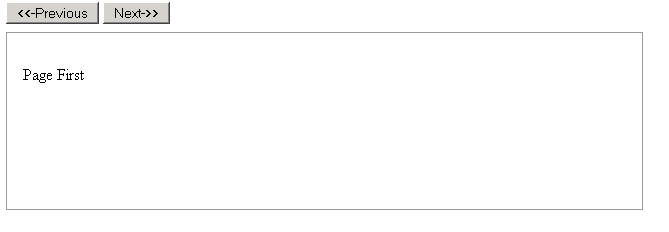
Output of the Program:

Whenever you click the "Previous" command button the you get the previous pages and click the "Next" command button then you get next pages of the stack container.


Facing Programming Problem?
Add This Tutorial To:
  Del.icio.us   Digg   Google   Spurl   Blink   Furl   Simpy   Y! MyWeb 

Current Comments

0 comments so far (post your own) View All Comments Latest 10 Comments:

Leave your comment:

Name:

Email:

URL:

Title:

Comments:


Enter Code:


Note: Emails will not be visible or used in any way, and are not required. Please keep comments relevant. Any content deemed inappropriate or offensive may be edited and/or deleted.

No HTML code is allowed. Line breaks will be converted automatically. URLs will be auto-linked. Please use BBCode to format your text.

  EAI Articles
  Java Certification
Tell A Friend
Your Friend Name
Search Tutorials


Browse all Java Tutorials
Java JSP Struts Servlets Hibernate XML
Ajax JDBC EJB MySQL JavaScript JSF
Maven2 Tutorial JEE5 Tutorial Java Threading Tutorial Photoshop Tutorials Linux Technology
Technology Revolutions Eclipse Spring Tutorial Bioinformatics Tutorials Tools SQL
 

Home | JSP | EJB | JDBC | Java Servlets | WAP  | Free JSP Hosting  | Search Engine | News Archive | Jboss 3.0 tutorial | Free Linux CD's | Forum | Blogs

About Us | Advertising On RoseIndia.net  | Site Map

India News

Send your comments, Suggestions or Queries regarding this site at roseindia_net@yahoo.com.

Copyright © 2007. All rights reserved.